
Interstate 405 (California): route, history and role in Greater Los Angeles
Interstate 405 (I-405) is a major north–south freeway across western Los Angeles and northern Orange County, linking I-5 at both ends, serving LAX and the ports, and known for heavy congestion.
Overview
Interstate 405 (I-405) is an auxiliary Interstate Highway that runs through the western portion of the Los Angeles metropolitan area in Orange County and Los Angeles County, in the state of California. It is a spur of Interstate 5, beginning near San Fernando and reconnecting to I-5 near Irvine. The route provides a continuous north–south corridor along the region's western communities and is often described as one of the busiest highways in the United States because it carries large commuter, commercial, and airport traffic.
Image gallery
9 Images


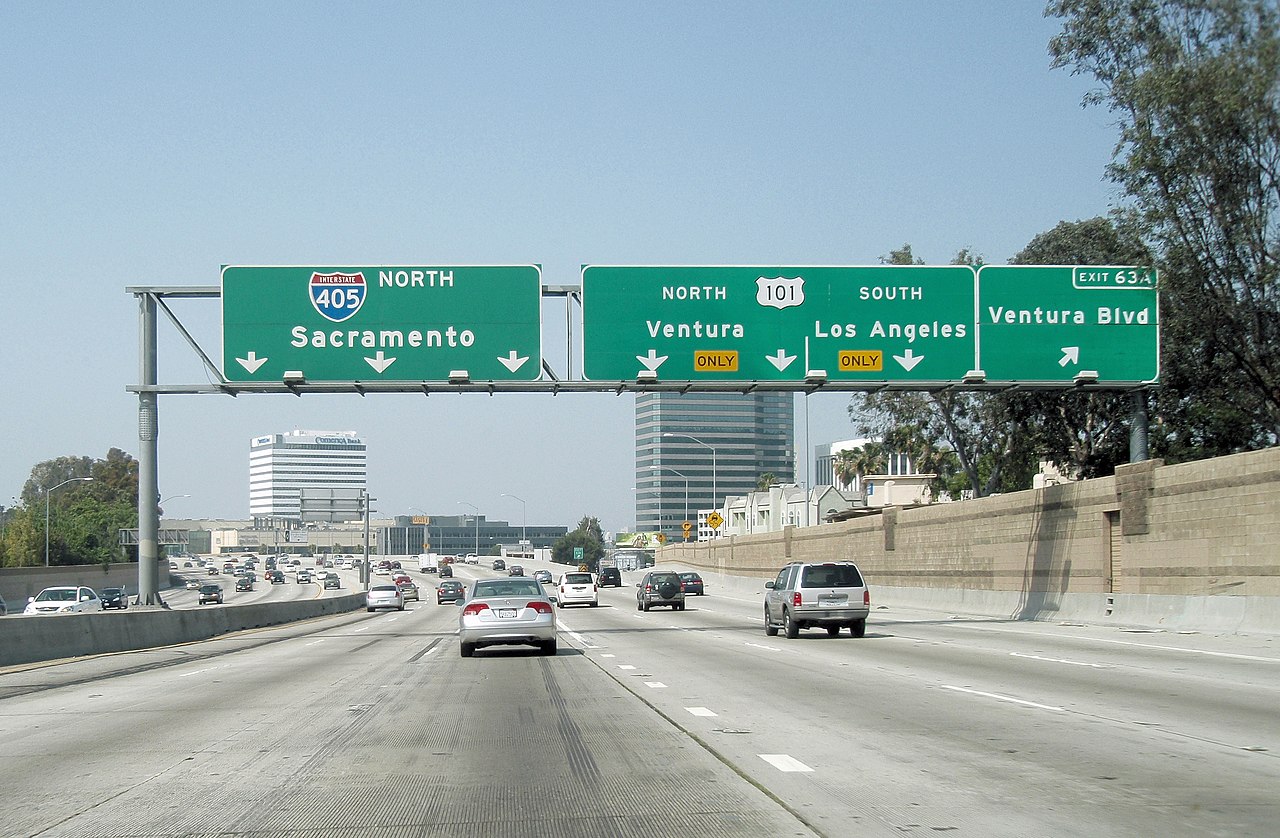


Route and characteristics
I-405 traverses the west side of Los Angeles, serving residential, commercial, and industrial zones. It links major activity centers such as Los Angeles International Airport, the ports that serve the region, and the urban centers of Long Beach and nearby cities. The freeway includes multiple general purpose lanes, high-occupancy vehicle (HOV) lanes, and sections with express or managed lanes designed to improve throughput during peak periods.
Major features
- Connects to I-5 at both northern and southern ends, acting as a coastal bypass of central I-5 traffic (Interstate 5).
- Provides direct freeway access to Los Angeles International Airport and to seaport complexes serving Long Beach and Los Angeles.
- Contains HOV/express lanes and has been the subject of repeated widening and modernization projects to address congestion.
History and development
The freeway was built in stages during the postwar period as Southern California expanded. Over decades it has been upgraded to accommodate growing traffic, with major reconstruction projects near key bottlenecks such as the Sepulveda Pass and airport corridors. Investment has focused on lane additions, interchange rebuilds, and dedicated carpool or tolled express lanes to manage demand.
Importance, usage and issues
I-405 is vital to daily commuting patterns on the west side of the region and to the movement of cargo to and from the ports. Its heavy usage makes it a frequent site of severe congestion and delay, which in turn has driven policy debates about transit alternatives, freight routing, and demand-management measures. Planned and completed projects aim to improve safety and reliability but congestion remains a defining feature.
Notable distinctions
Besides carrying substantial commuter flows, I-405 is often referenced in discussions of urban freeway impacts, regional mobility, and infrastructure trade-offs. It serves a diverse mix of trips—from local errands to international freight and airport access—making it a central element of Southern California's transportation network.
For regional planning, traffic analysis, or travel information, see official sources and transportation agencies linked from regional portals (Orange County, Los Angeles County, California, and federal/state highway references such as I-5).
Questions and answers
Q: What is Interstate 405?
A: Interstate 405 (I-405) is an Interstate Highway in the Orange and Los Angeles counties of California. It is a spur route of the Interstate 5.
Q: Where does I-405 begin and end?
A: I-405 begins at the I-5 near San Fernando, and ends back at the I-5 near Irvine.
Q: Why is it so busy?
A: It is the busiest highway in the United States mainly because it is the only highway in the west side of Los Angeles that goes from north to south.
Q: What important places does it pass by?
A: It passes by Los Angeles International Airport and the ports of Los Angeles and Long Beach.
Q: How long is I-405?
A: The length of I-405 varies depending on which section you are referring to, but overall it runs for approximately 110 miles from San Fernando to Irvine.
Q: Are there any other highways that run through Los Angeles' west side?
A: No, I-405 is currently the only highway running through this area from north to south.
Q: Does I-405 have multiple lanes?
A Yes, most sections of I-405 have multiple lanes allowing for more traffic flow.
Author
AlegsaOnline.com Interstate 405 (California): route, history and role in Greater Los Angeles Leandro Alegsa
URL: https://en.alegsaonline.com/art/140057
Sources
- dot.ca.gov : "State Truck Route List"
- timeforkids.com : timeforkids.com
- corsair.smc.edu : Santa Monica College Corsair News Article
- fhwa.dot.gov : "Most Travelled Urban Highways Average Annual Daily Traffic"
- dot.ca.gov : "California Log of Bridges on State Highways: District 7"
- traffic-counts.dot.ca.gov : All Traffic Volumes on CSHS
- dot.ca.gov : "I-405 Northbound"
- dot.ca.gov : "I-405 Southbound"
- losangeles.cbslocal.com : "405 Freeway NB Montana Avenue Offramp Dies At 57"