
Hello, Dolly! (1969 film)
1969 screen adaptation of the Broadway musical Hello, Dolly! directed by Gene Kelly, starring Barbra Streisand and Walter Matthau, known for its lavish production numbers and Jerry Herman songs.
Overview
Hello, Dolly! is a 1969 American musical romantic comedy film adapted from the hit Broadway show of the same name. The screen version translates the stage book—itself based on Thornton Wilder's play The Matchmaker—into a large-scale cinematic spectacle guided by director and choreographer Gene Kelly.
Image gallery
5 Images
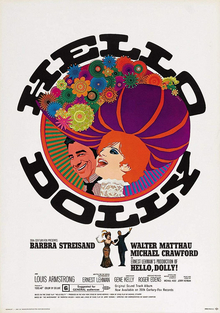


Cast and principal contributors
The film stars Barbra Streisand as the matchmaker Dolly Levi and Walter Matthau as the businessman Horace Vandergelder. Supporting performers include a mix of stage and screen actors who recreate and reinterpret the musical's ensemble numbers. The score and songs were written by Jerry Herman, whose stage songs supply the film's melodic backbone.
Music and notable recordings
Several signature songs from the stage score appear in the film, including the title tune. The song "Hello, Dolly!" became widely known before the movie through a popular 1964 recording by Louis Armstrong, and that recording helped maintain public interest in the property prior to the film's release. The soundtrack emphasizes brassy, Broadway-style arrangements adapted for cinema.
Production and style
Produced by a major Hollywood studio, the film is notable for its lavish sets, grand choreography and elaborate costume work. Gene Kelly staged large ensemble sequences and used cinematic techniques to expand songs beyond the constraints of the theater. While aiming to capture the scale and color of Broadway, the movie also reimagines some scenes to suit on-screen pacing and visual composition.
Reception and legacy
Upon release, Hello, Dolly! received mixed critical reactions: many reviewers praised its production values and performances while others questioned the film's length and adaptation choices. It attracted award attention for its technical and musical achievements and has remained a reference point in discussions about stage-to-screen musicals. For background on the original stage show, see the Broadway production here.
Notable facts
- The film is part of the lineage of 1960s Hollywood musicals that sought to translate Broadway spectacle to cinema.
- Louis Armstrong's 1964 recording of the title song helped popularize the material before the movie’s release; for more about that recording see Louis Armstrong.
- Modern viewers often compare the film to the original stage performances and later revivals when assessing casting, choreography and scenic choices.
For additional production details and archival materials, consult filmographies and musical theatre references or visit studio and theatre archives linked resources.
Questions and answers
Q: What is Hello, Dolly!?
A: Hello, Dolly! is a 1969 American musical and romantic comedy movie.
Q: What is the movie based on?
A: The movie is based on the Broadway production of the same name.
Q: Who recorded the title tune of Hello, Dolly!?
A: Louis Armstrong recorded the title tune of the same name.
Q: Did the title tune of Hello, Dolly! become popular?
A: Yes, the tune hit #1 in May 1964.
Q: What is the genre of Hello, Dolly!?
A: The genre of Hello, Dolly! is musical and romantic comedy.
Q: When was Hello, Dolly! released?
A: Hello, Dolly! was released in 1969.
Q: Who starred in Hello, Dolly!?
A: The movie starred Barbra Streisand, Walter Matthau, and Michael Crawford.
Author
AlegsaOnline.com Hello, Dolly! (1969 film) Leandro Alegsa
URL: https://en.alegsaonline.com/art/139604