
H. J. Muller
Overview of geneticist H. J. Muller (1890–1967): his work on X‑ray induced mutations, career in genetics, public advocacy on radiation hazards, political stance, and scientific legacy.
Hermann Joseph Muller (1890–1967), usually cited as H. J. Muller, was an American geneticist whose experiments and public advocacy shaped 20th‑century thinking about mutation, radiation, and the social responsibilities of scientists. He is best known for demonstrating that ionizing radiation can induce mutations in genes, a finding that earned him the 1946 Nobel Prize in Physiology or Medicine and that had broad implications for genetics, medicine, and public policy.
Image gallery
4 Images
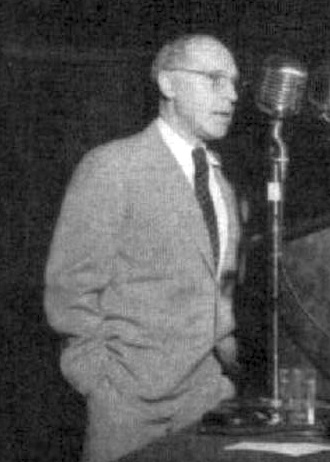


Scientific contributions
Muller worked extensively with the fruit fly Drosophila, a model organism that made it possible to observe heredity and mutation directly. Through controlled experiments he showed that X‑rays and related forms of ionizing radiation increase the rate of heritable changes. This experimental evidence established a clear link between physical agents and genetic mutation, providing a basis for later research on radiation biology, mutagenesis, and cancer causation. His laboratory methods and conceptual framing helped turn experimental genetics into a quantitative science.
Career and movements
Trained in the tradition of early 20th‑century Drosophila genetics, Muller held academic posts in the United States and abroad. Over his career he organized and led genetics laboratories at several universities, spent years working in Europe and the Soviet Union during the interwar period, and later returned to the United States where he continued both laboratory research and public outreach. Political developments—most notably the suppression of classical genetics in the Soviet Union under Lysenkoism—affected his appointments and prompted moves that shaped the international diffusion of genetics research.
Public engagement and politics
Muller was an outspoken figure on matters beyond the laboratory. He warned about the long‑term hazards of radioactive fallout from nuclear weapons testing and spoke frequently about the ethical responsibilities of scientists in modern societies. Earlier in his life he participated in debates over eugenics and social reform — positions that he revised and debated throughout his career — and he described himself with political labels that reflected his commitment to social change. His public advocacy combined technical authority with moral urgency, especially on issues where genetics intersected with public health and policy.
Legacy and distinctions
The Nobel Prize citation recognized Muller for showing that mutations can be induced by X‑rays; the result accelerated research on mutagens and guided regulations about radiation exposure. His work remains central to understanding how environmental agents alter DNA and to the development of safety standards in medicine, industry, and nuclear policy. He is also remembered as a polemicist and teacher who influenced generations of geneticists and shaped debates about the social implications of genetic knowledge.
Selected links and further reading
- Biographical overview
- Genetics background
- Nobel Prize citation
- Radiation and mutation studies
- Public warnings on fallout
- Early life and origins
- Training and mentorship
- Drosophila research context
- Model organism resources
- Academic appointments
- University affiliations
- Time in Europe
- Work in the Soviet Union
- Period in Edinburgh
- Role advising wartime projects
- Professorships and teaching
- X‑rays and mutagenesis
- Nuclear era implications
- Eugenics and scientific debates
- Political views and activism
- Personal beliefs and influences
Questions and answers
Q: Who was Hermann Joseph Muller?
A: Hermann Joseph Muller, also known as H. J. Muller, was an American geneticist, educator, and Nobel Prize winner.
Q: What is he best known for?
A: He is best known for his work on the physiological and genetic effects of radiation, as well as his outspoken political beliefs.
Q: Where did he get his PhD?
A: He got his PhD at CalTech in Morgan's Drosophila fly lab.
Q: How did he become Professor of Zoology at Indiana University?
A: After spending time in Berlin, Leningrad (St Petersburg), and Moscow; then moving to Edinburgh with 250 strains of Drosophila; and finally returning to the United States in 1940 where he became an advisor to the Manhattan Project, he became Professor of Zoology at Indiana University.
Q: What did Muller win a Nobel Prize for?
A: He won a Nobel Prize in Physiology or Medicine in 1946 "for the discovery that mutations can be induced by X-rays".
Q: What were some of Muller's political beliefs?
A: Muller was a wholehearted enthusiast for eugenics, socialism, atheism and other relatively unpopular ideas.
Q: What was Mueller's real contribution to genetics?
A: His real contribution to genetics was discovering that mutations can be induced by X-rays.
Author
AlegsaOnline.com H. J. Muller Leandro Alegsa
URL: https://en.alegsaonline.com/art/139289