
Breccia: composition, formation, types, and uses
Breccia is a coarse rock made of angular fragments cemented into a matrix. This article explains its composition, origins (sedimentary, tectonic, volcanic, impact), practical uses and how it differs from similar rocks.
Overview
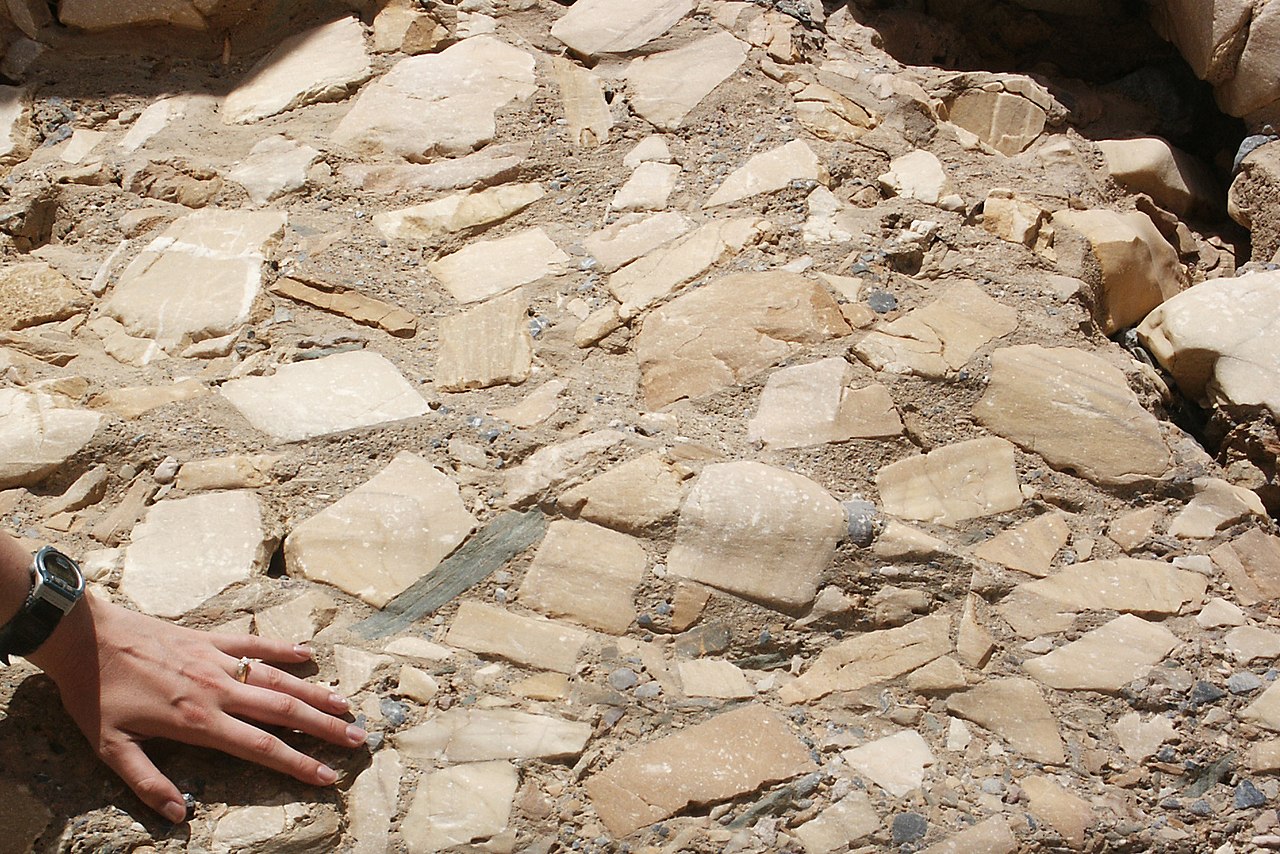
Breccia is a clastic rock composed of broken, angular fragments of minerals or other rocks (clasts) that are set in a finer-grained matrix. The fragments are typically noticeably angular, which distinguishes breccia from similar coarse sedimentary rocks. The term comes from an Italian word meaning 'broken rock' and is used broadly in geology to describe rocks whose visible pieces have not been rounded by long transport.
Image gallery
10 Images




Composition and characteristics
Fragments in breccia can range from pebble to boulder size and may be made of a single rock type (monomict) or many different types (polymict). The matrix that binds the clasts can be a finer mineral sediment, crystalline cement, or a recrystallized groundmass. The clast support and matrix proportions give rise to textures described as clast-supported or matrix-supported. For a general discussion of rock classification see rock and the way fragments are cemented together in clastic materials like clastic rocks.
Formation and common types
- Sedimentary breccia: formed close to the source by short transport, often at the base of cliffs or from rockfalls.
- Tectonic or fault breccia: produced by crushing and grinding during fault movement.
- Volcanic and hydrothermal breccias: created by explosive volcanic activity or by mineral-rich fluids breaking host rock.
- Impact breccia: produced when meteorite impacts shatter target rock.
When comparing coarse clastic rocks, the key difference is rounding: breccias contain angular clasts, while conglomerates contain well-rounded clasts.
Uses and geological importance
Breccias have practical and scientific value. Durable breccias are used as decorative building stone and aggregate; some hydrothermal breccias host economically important mineral deposits because circulating fluids concentrate metals in the broken zones. Geologically, breccia textures record processes such as collapse, faulting, explosive volcanism, and impact events, making them valuable indicators of past environments.
Notable distinctions and observations
Descriptions of breccia often note clast composition, size distribution, angularity, and the nature of the matrix or cement. Terms like monomict or polymict, and clast- versus matrix-supported, help geologists classify breccias and infer their origins. Because the fragments are not rounded, breccias usually signal rapid breakage and deposition near the source or in situ fragmentation rather than long transport.
For introductory summaries and classification schemes consult general geology resources and specialized literature on sedimentology and structural geology for detailed diagnostic criteria.
Questions and answers
Q: What is breccia?
A: Breccia is a type of rock formed of broken fragments of minerals or rock cemented together by a fine-grained matrix.
Q: What is the matrix in breccia made of?
A: The matrix in breccia may be similar to or different from the composition of the fragments.
Q: What are rocks formed by sticking together pieces of previous rocks called?
A: Rocks formed by sticking together pieces of previous rocks are called clastic rocks.
Q: What are the two types of clastic rock?
A: The two types of clastic rock are conglomerates and breccias.
Q: What divides these two categories?
A: The amount of rounding divides these two categories.
Q: Are the particles in conglomerates well-rounded or angular?
A: The particles in conglomerates are well rounded.
Q: Are the particles in breccias well-rounded or angular?
A: The particles in breccias are angular.
Related articles
Author
AlegsaOnline.com Breccia: composition, formation, types, and uses Leandro Alegsa
URL: https://en.alegsaonline.com/art/13862
Sources
- meteorlab.com : "Glossary of Meteoritical Terms"