
Fourier series: representing periodic functions with sines and cosines
A clear overview of Fourier series: definition, structure, historical development, convergence issues, common examples, and applications such as signal processing and heat theory.
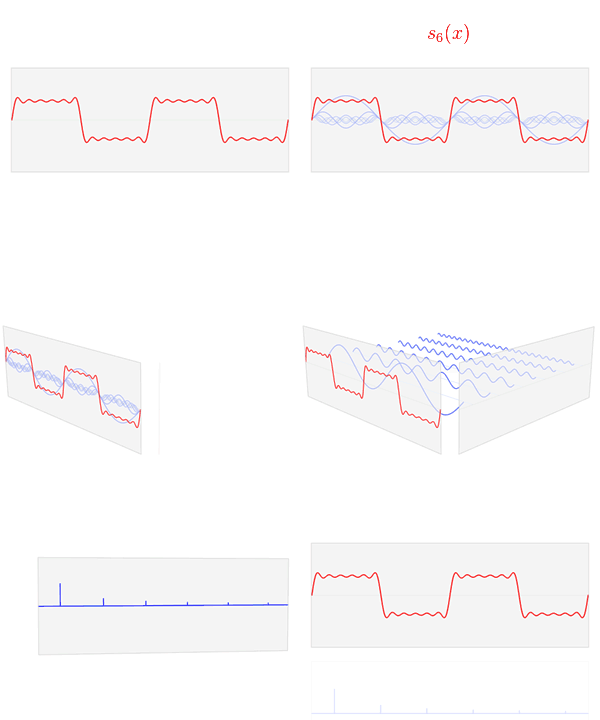
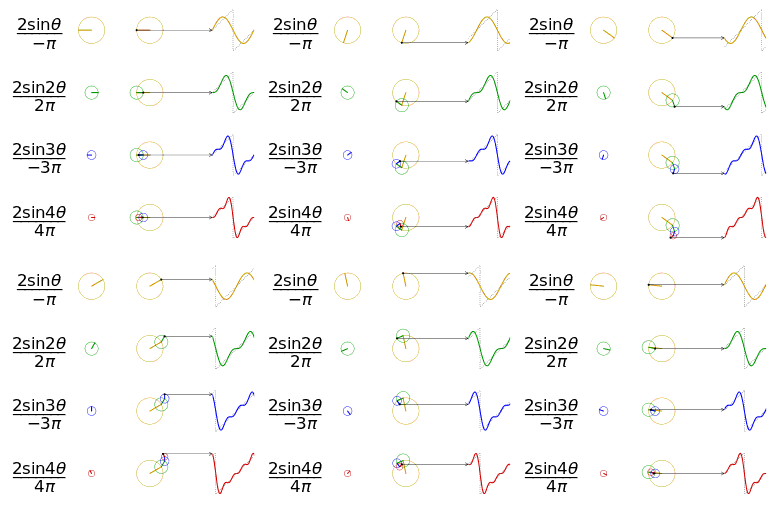
A Fourier series expresses a periodic function as an infinite sum of simple oscillating functions — sines and cosines or, equivalently, complex exponentials. The idea is that many complicated periodic waveforms can be rebuilt from a weighted combination of harmonics (integer multiples of a base frequency). A standard real form is written informally as f(x) = a0 + Σ_{n=1}^∞ (a_n cos(nx) + b_n sin(nx)), where the coefficients a_n and b_n encode how much of each harmonic is present. Coefficients are determined by exploiting orthogonality of sines and cosines over one period.
Image gallery
8 Images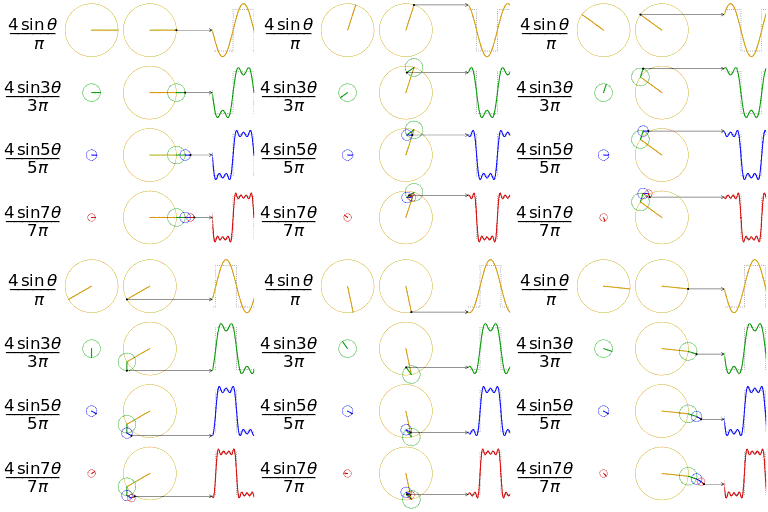





Key characteristics
Fourier series are defined for functions that are periodic on some interval (often taken as length 2π). Important features include:
- Basis of harmonics: The set of functions {1, cos(nx), sin(nx)} (or e^{inx} in the complex form) forms an orthogonal basis for many function spaces on a finite interval, allowing expansions of sufficiently regular functions.
- Coefficient calculation: Coefficients are obtained by integrating the product of the target function with the corresponding basis function over one period; this projects the function onto each harmonic.
- Convergence behavior: Depending on smoothness and discontinuities, the series may converge uniformly, pointwise, or in an average (mean-square) sense. The Gibbs phenomenon — overshoot near jump discontinuities — is a notable and unavoidable feature for discontinuous functions.
- Parseval/Plancherel relations: Energy or L2-norm of a function is related to the sum of squares of its Fourier coefficients, linking time-domain and frequency-domain descriptions.
Historical development
The use of trigonometric series predates their formal theory: mathematicians such as Euler, Bernoulli and Lagrange used sinusoids to model vibrations and other phenomena. The systematic claim that arbitrary (suitably regular) functions could be expanded in trigonometric series is most often attributed to Joseph Fourier in his 1822 work on heat. Fourier's proposals stimulated debate because they challenged prevailing ideas about what functions were admissible for series expansion; over subsequent decades mathematicians clarified conditions for convergence (Dirichlet and others) and extended the foundations into what is now Fourier analysis.
Uses and examples
Fourier series are a foundational tool across mathematics, physics and engineering. Practical and theoretical applications include:
- Analysis of vibrating strings and heat conduction in solids — the original motivating problems for the theory.
- Digital signal processing: decomposition of signals into frequency components is central to filtering, compression, and spectral analysis.
- Solving partial differential equations with periodic boundary conditions by separating variables and expanding initial or boundary data in a Fourier series.
- Modeling periodic phenomena in acoustics, optics and electrical engineering.
Extensions and related concepts
The Fourier series is closely related to the Fourier transform, which generalizes the same idea to nonperiodic functions or signals defined on the whole real line by replacing sums of discrete harmonics with integrals over continuous frequencies. The general subject that studies such decompositions is Fourier analysis, which connects harmonic expansions to functional analysis, distribution theory, and signal theory. Formal manipulations and proofs often rely on properties of the interval or domain chosen; for a periodic interval one integrates across that interval to obtain coefficients and test convergence.
Practical notes and caveats
When applying Fourier series in practice, bear in mind several important points: coefficients are computed by projection integrals that assume integrability of the function; pointwise convergence can fail at discontinuities where the series approaches the average of left and right limits; and truncating to a finite number of terms gives an approximation whose error decreases with the number of harmonics, often with oscillatory artifacts near sharp transitions. Historically and practically, the method of expanding with sine waves to approximate or reconstruct another function remains one of the most widely used techniques in applied mathematics and engineering. For accessible introductions and computational examples see resources linked below.
Further reading and computational tools are available for those who want to explore specific applications or proofs in greater depth: introductory texts on Fourier series, numerical recipes for computing coefficients, and advanced treatments in functional analysis and distribution theory. For online materials and references, consult the basic overviews and specialized notes indicated by these entry points: Fourier, Fourier transform, and broader Fourier analysis.
Questions and answers
Q: Who was Joseph Fourier?
A: Joseph Fourier was a French mathematician who proposed that sine waves can be used to approximate another function.
Q: What is a Fourier series?
A: A Fourier series is a series that uses sine waves to approximate another function.
Q: What is the Fourier transform?
A: The Fourier transform is a generalization of the theory that uses sine waves to approximate another function.
Q: What is Fourier analysis?
A: Fourier analysis is a mathematical analysis of the functions that use sine waves to approximate another function.
Q: Who used sinusoids to approximate and model other functions in the 18th century?
A: Mathematicians such as Euler, Lagrange and Bernoulli used sinusoids to approximate and model other functions in the 18th century.
Q: What did Fourier propose in his work on heat in 1822?
A: In his work on heat in 1822, Fourier proposed that such approximations using sine waves exist for any continuous function in a given interval.
Q: What is the use of Fourier series in digital signal processing?
A: Fourier series are used a lot in digital signal processing to approximate and analyze signals.
Author
AlegsaOnline.com Fourier series: representing periodic functions with sines and cosines Leandro Alegsa
URL: https://en.alegsaonline.com/art/138512