
Balto‑Finnic languages
Branch of the Uralic language family spoken around the Baltic Sea, including Finnish and Estonian; characterized by agglutination, rich case systems, and several smaller, often endangered varieties.
Overview
The Balto‑Finnic (or Finnic) languages form a closely related subgroup of the larger Uralic family. They are concentrated in Northeastern Europe around the Baltic Sea. The best known members are Finnish and Estonian, whose standard forms serve as national languages. In addition to these two, the branch includes several regional and minority languages spoken in parts of Finland, Estonia and northwestern Russia.
Image gallery
4 Images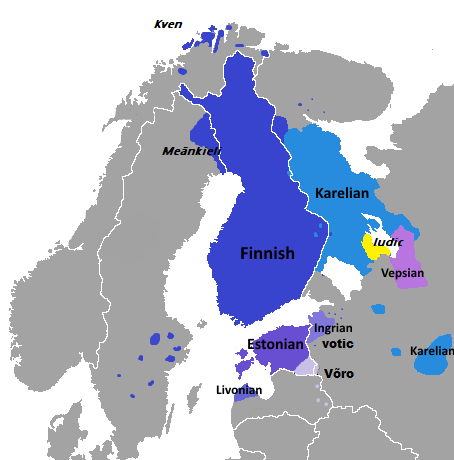


Linguistic characteristics
Balto‑Finnic languages share a number of typological traits that distinguish them from neighbouring Indo‑European tongues. Typical features include:
- Agglutinative morphology: Grammatical relations are expressed by adding suffixes and endings rather than separate function words.
- Rich case systems: Nouns and pronouns decline in many cases to mark role and relation instead of relying on prepositions.
- Vowel harmony and phonological alternations: Many varieties show vowel harmony and alternations such as consonant gradation that affect word forms.
- No grammatical gender: There is generally no gender distinction in pronouns or noun classes.
Members and status
The subgroup contains several languages and dialect clusters. In addition to the widely spoken standards, there are smaller languages such as Karelian, Veps, Votic, Ingrian and historically Livonian; some of these are vulnerable or endangered. Standard Finnish and Estonian have extensive literary traditions and official status, while smaller varieties are often maintained by regional communities and activists.
History and development
Balto‑Finnic languages derive from ancestral Uralic speech and have been shaped by long contact with Baltic, Germanic and Slavic neighbors. These contacts influenced vocabulary, phonology and loanword patterns but did not erase the distinctive agglutinative grammar. The development of written standards in the 19th and 20th centuries strengthened national literatures and modern education in Finland and Estonia.
Uses, importance and distinctions
Besides everyday communication, Balto‑Finnic languages are central to cultural identity, education and media in their respective countries. Linguists study them for insights into Uralic reconstruction, contact linguistics and typology. Key contrasts include the mutual intelligibility between some dialects and the clear separation between the Finnic branch and other Uralic branches such as Sami or Hungarian. For further general context on the family and region see resources on the Uralic family and regional overviews of Northeastern Europe.
Representative standard languages: Finnish — national language of Finland; Estonian — national language of Estonia. Other regional varieties occur in northwestern Russia and coastal areas around the Baltic Sea.
Questions and answers
Q: What are the Balto-Finnic languages?
A: The Balto-Finnic languages are a group of languages that belong to the Uralic language family.
Q: Where are the Balto-Finnic languages spoken?
A: The Balto-Finnic languages are spoken in Northeastern Europe around the Baltic Sea, mainly in Finland, Estonia, and Northwestern Russia.
Q: What are the two main languages in the Balto-Finnic branch?
A: The two main languages in the Balto-Finnic branch are Estonian and Finnish.
Q: What other countries speak Balto-Finnic languages?
A: Other countries that speak Balto-Finnic languages include Russia, Sweden, Norway, and Latvia.
Q: How many languages are in the Balto-Finnic group?
A: There are several languages in the Balto-Finnic group, but Estonian and Finnish are the two main ones.
Q: Are Balto-Finnic languages related to any other language families?
A: Yes, they are related to the Uralic language family.
Q: Are the Balto-Finnic languages in danger of becoming extinct?
A: No, the Balto-Finnic languages are not currently in danger of becoming extinct, and efforts are being made to preserve and promote their use.
Author
AlegsaOnline.com Balto‑Finnic languages Leandro Alegsa
URL: https://en.alegsaonline.com/art/138374