
Bread and Salt: Slavic Welcome Ceremony and Symbolic Food
Bread and salt is a traditional Slavic greeting in which a loaf of bread and a dish of salt are offered on an embroidered towel to honor guests; it symbolizes hospitality, prosperity, and respect.
Overview
Bread and salt is a longstanding form of welcome used across many Slavic cultures. As both a ritual and a culinary symbol, it involves presenting a loaf of bread together with salt to guests as a gesture of hospitality and honor. The custom survives in ceremonial contexts, public receptions and family events, and also appears as a symbolic package in specialized settings such as spaceflight.
Image gallery
10 Images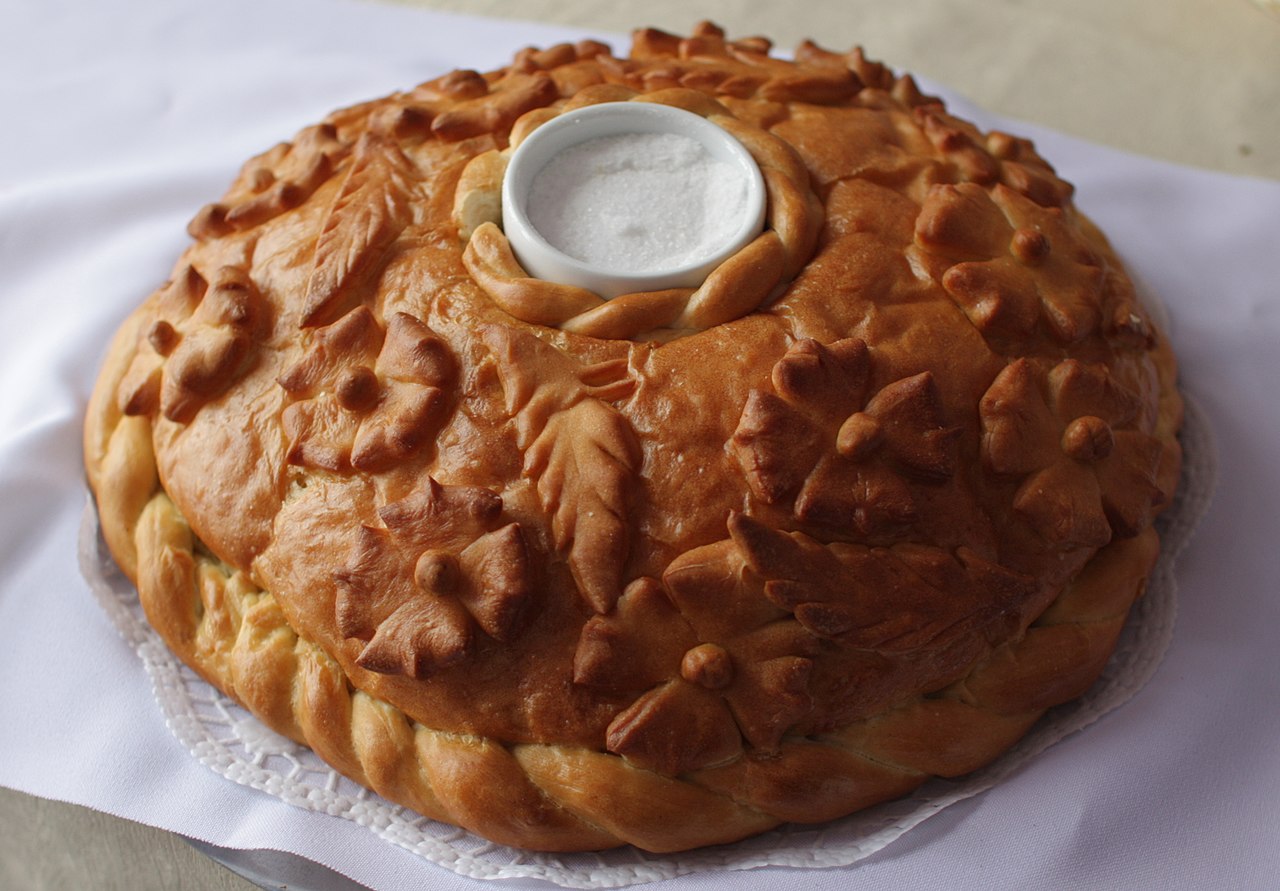





Key elements and symbolism
The presentation normally comprises a round or decorated loaf and a small container of salt placed on or beside it. A cloth with traditional embroidery, often called a rushnik, commonly supports the loaf. The bread itself represents sustenance and life; salt stands for preservation, durability and value. In some versions the salt is set in a shallow depression on top of the loaf or in a salt cellar. The practice functions as a public statement that guests are welcomed, safe and honored.
Contexts and variations
The ritual appears in many situations and with local variations. Typical occasions include:
- State and diplomatic receptions, when visiting dignitaries are greeted with an official presentation.
- Weddings and family ceremonies, where newlyweds may be offered bread and salt as a blessing for prosperity and unity.
- Public festivals or the opening of important events, often featuring a specially decorated loaf.
- Historical arrivals, such as the welcoming of travelers or emigrants at stations or ports.
Different regions may use distinct types of bread (for example, elaborately braided or stamped loaves) and costume elements when presenting the gift. For formal occasions in modern Russia, the loaf and salt are sometimes presented by young women wearing traditional costumes.
History and modern practice
The ritual has deep roots in rural communal life, where sharing bread and salt expressed mutual obligation and respect. Over time it became codified for public ceremonies and diplomatic protocol. On official visits the custom emphasizes hospitality and cultural identity; in private it conveys personal goodwill. It is also adapted to special contexts: compact or sealed bread-and-salt packets have been used where the full ceremony cannot be staged, for example in constrained environments such as long-distance travel or space missions.
Notable facts and distinctions
Although most widely associated with Slavic nations, the idea of offering bread and salt as a sign of welcome resonates with hospitality practices in other cultures. The phrase "bread and salt" is often invoked metaphorically to describe a bond of trust or the acceptance of a guest. For further general background see a short entry on the custom as a welcome greeting and its role as a type of food in ceremonial use. For more cultural detail consult regional sources or collections that illustrate specific embroidered towels, loaf types and presentation styles, for example guides to ritual textiles and ceremonial baking traditions here.
Questions and answers
Q: What is bread and salt?
A: Bread and salt is a Slavic welcome greeting ceremony and a type of food.
Q: Who is given bread and salt?
A: Important, respected, or admired guests are given bread and salt.
Q: How is bread and salt presented to guests?
A: A loaf of bread is placed on a rushnik (embroidered towel), and a salt holder or salt cellar is placed on top of the bread loaf or secured in a hole on the top of the loaf.
Q: What happens in modern Russia on official occasions with bread and salt?
A: On official occasions in modern Russia, young women dressed in national costumes present the "bread and salt."
Q: What happens during spaceflight with bread and salt?
A: During spaceflight, small packages of bread and salt are used to observe this tradition.
Q: Why is bread and salt given to guests?
A: Bread and salt is given to guests as a sign of welcome and respect.
Q: What is rushnik?
A: Rushnik is an embroidered towel on which the bread is placed during the bread and salt ceremony.
Related articles
Author
AlegsaOnline.com Bread and Salt: Slavic Welcome Ceremony and Symbolic Food Leandro Alegsa
URL: https://en.alegsaonline.com/art/13821
Sources
- news.google.com : news.google.com/newspapers?nid=894&dat=19950317&id=gyYOAAAAIBAJ&sjid=mn0DAAAAIBAJ&pg=6611…
- suzymchale.com : suzymchale.com