
Eight O'Clock Walk
1954 British courtroom drama directed by Lance Comfort, starring Richard Attenborough; examines miscarriage of justice, eyewitness evidence and the social debate over capital punishment.
Overview
Eight O'Clock Walk is a 1954 British drama film directed by Lance Comfort and distributed by British Lion Films. Presented as a courtroom and social drama, the picture focuses on the consequences of a criminal investigation and trial that hinge on circumstantial and eyewitness evidence. The film stars Richard Attenborough and a supporting ensemble including Cathy O'Donnell, Derek Farr and Ian Hunter.
Image gallery
1 Image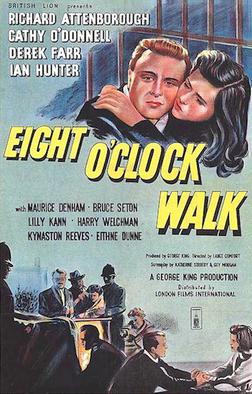
Plot and themes
The story follows the arrest and prosecution of an ordinary man accused of causing the death of a child. Rather than offering a genre thriller, the film pays close attention to police procedures, the presentation of testimony in court and the way public opinion can influence a legal case. Central themes include the fallibility of eyewitness identification, the pressures of a sensational case on suspects and families, and broader questions about the fairness of capital punishment and the criminal justice system in mid-20th-century Britain.
Production and cast
Lance Comfort, a director active in British cinema in the 1940s and 1950s, guided the film with a restrained, realistic approach common to social dramas of the era. The cast features:
- Richard Attenborough — lead performance
- Cathy O'Donnell — principal supporting role
- Derek Farr, Ian Hunter, Noel Dyson, Maurice Denham, Ian Fleming, Harry Welchman, Eithne Dunne — ensemble
Reception and legacy
At the time of release the film was noted for tackling sensitive legal and moral topics rather than relying on sensational plot twists. Critics and audiences who valued social realism responded to its measured treatment of a miscarriage-of-justice storyline. Over time the picture has been cited as part of a strand of British cinema that used domestic drama to question institutions and public attitudes in the post‑war period.
Notable aspects
The film is often remembered for its emphasis on character and procedure over melodrama, and for bringing attention to how ordinary errors or assumptions can have grave consequences in a criminal case. It also reflects contemporary debates about capital punishment and the need for careful legal safeguards. While not a large‑scale commercial spectacle, its topical focus and performances have helped it retain interest among viewers exploring British courtroom and social films of the 1950s.
Author
AlegsaOnline.com Eight O'Clock Walk Leandro Alegsa
URL: https://en.alegsaonline.com/art/137914