
D. B. Cooper — The Unsolved 1971 Hijacking and Its Legacy
D. B. Cooper is the alias of the unidentified man who hijacked a Boeing 727 in 1971, extorted $200,000, parachuted into the night and vanished. The case remains unsolved and influenced aviation security and public fascination.
The name D. B. Cooper refers to the alias used by an unidentified hijacker who, on November 24, 1971, forced his way into the national imagination by taking control of Northwest Orient Airlines Flight 305, demanding ransom and parachutes, and then parachuting from the rear stairway of a Boeing 727 into stormy night. The episode is commonly called the Cooper case, and the Federal Bureau of Investigation labeled its inquiry "NORJAK" (for "Northwest Hijacking"). From the moment the aircraft landed in Seattle and the man disappeared into darkness, the story combined a daring criminal act, scant physical evidence, competing theories, and enduring public fascination. Despite decades of investigation, no conclusive identification of Cooper has been accepted by investigators, and the FBI announced in 2016 that it had closed its active investigative file. The episode had immediate practical consequences for airline procedures and long-term cultural effects, inspiring books, documentaries, songs, and an annual community event.
Image gallery
10 Images




The context: hijacking in the early 1970s
The Cooper case occurred during a period when aircraft hijackings were a relatively frequent problem worldwide and in the United States. At that time, routine airport screening was far less strict than in later decades, and passengers could often board domestic flights without the kinds of searches and metal detectors that became common after a string of high-profile incidents. The hijacker's ability to carry a briefcase onto a short-haul flight was therefore not unusual for the era. The ease of access to aircraft and the number of unrelated hijackings of the period led airlines and regulators to reexamine procedures. Over time, rules and equipment changes reduced the vulnerability exploited in the Cooper incident, and the case itself helped spur targeted technical modifications to certain aircraft types used in the United States.
The hijacking: demands, exchange and departure
On the late-November afternoon of the crime, a man who identified himself under a name that became legendary presented a note to flight attendants and claimed to have a bomb in his briefcase. He demanded $200,000 in small bills and four parachutes. After the plane landed at Seattle-Tacoma International Airport, airline and law-enforcement personnel arranged for the ransom and parachutes to be delivered. The hijacker released the paid ransom in exchange for releasing the passengers and some crew. Once airborne again, the 727 was flown at a low speed and low altitude with the rear airstair extended. The man then left the aircraft by the rear stairway and vanished into the darkness over the Pacific Northwest. The aircraft involved was a Boeing 727, a tri-jet equipped with a rear airstair that could be lowered in flight — a feature that would later be associated with the crime in popular accounts and technical solutions.
Immediate physical evidence and later finds
Physical traces directly tying the money or the individual to a final resting place have been limited. Investigators documented several items and discoveries that became central to the public story and to the official inquiry. Among the best-known physical leads are:
- Currency recovered: In 1980, a portion of the ransom — $5,880 in deteriorated twenty-dollar bills — was discovered in a bundled state on a bank of the Columbia River. The bills were identified by serial-number ranges as part of the ransom, suggesting at least some of the money left the aircraft and later washed ashore. The small recovered sum contrasted with the $200,000 taken and raised questions about whether other bills had dispersed, been buried, carried out to sea, or collected by persons unknown.
- Aircraft placard: Several years after the event, a metal placard that contained instructions for lowering the 727 rear stairs was found within a coastal area consistent with drift models of material released or lost near the plane’s reported flight path. This placard is commonly referenced as a tangible link to the aircraft and the tactical circumstances of the escape (placard).
- Parachute evidence: The hijacker was supplied with multiple parachutes. Later investigation showed that he selected the older-looking main canopy rather than a newer sport-jumping parachute, and that he tied the ransom satchel to himself with a cord from the functional parachute. Years after the event a worn parachute was discovered within the presumptive drop area and examined; forensic assessment determined that the discovered canopy was made of silk and dated to an earlier era and therefore did not match the nylon chute issued on the plane (parachute, nylon, silk).
- Tie and partial DNA: Flight crew members later observed that the hijacker left a necktie on the aircraft. In 2007 the FBI reported that scientists were able to extract a partial DNA profile from material on that tie, and the bureau posted updated sketches and documents online to solicit new tips in the then-revived public appeal (partial DNA, tie).
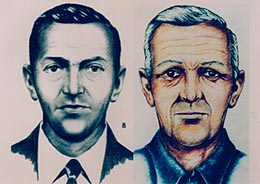
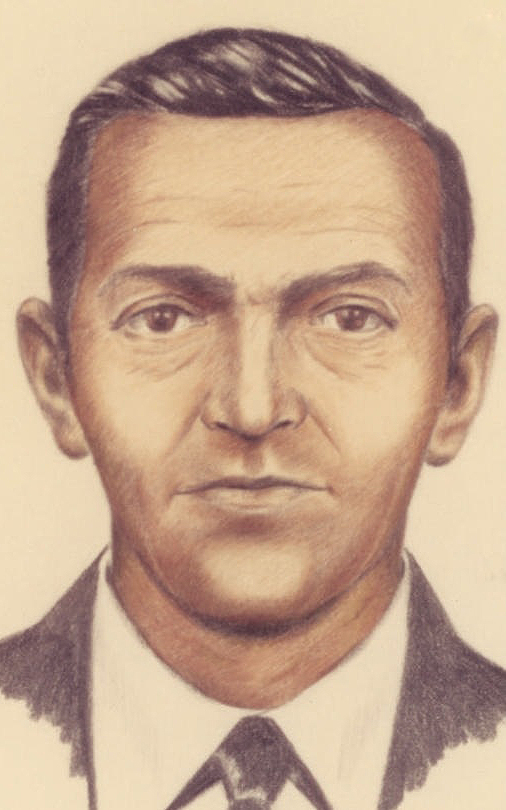
- Witness descriptions: Crew members who interacted with the hijacker provided detailed descriptions used to construct composite sketches. Two flight attendants who spent significant time with him gave closely matching accounts of his size, age range and appearance. Those sketches remained a cornerstone of reconstruction efforts and public identification drives.
What is reliably known about the hijacker’s actions and equipment
Accounts consolidated from crew interviews, aircraft records and subsequent FBI summaries allow confident statements about several specifics: he demanded and received $200,000 in small bills and four parachutes, he released passengers after obtaining the money, he tied the money to himself with cord from the functional parachute, and he exited the aircraft via the rear stairway of the 727 while it flew at low speed. Observers also noted small personal details recorded by attendants: cigarette brand preference, drink choice, the placement of a tie clip, and conversational remarks that suggested some familiarity with local geography. Although these details are sometimes treated as clues, none led directly to a definitive identification or to proof of survival.
Assessments of parachute skill and survivability
Much of the debate about the likely fate of the hijacker centers on whether he had the necessary parachuting skill, equipment, and local knowledge to survive. Investigators and independent analysts generally emphasize several factors that make a successful night jump unlikely: the jump occurred at night, in rainy November conditions, with strong winds and significant wind chill at altitude; the jumper wore ordinary clothing rather than specialist protective gear; he selected an older main parachute rather than the newer sport canopy available; and the reserve parachute he selected for the set was later determined to be a training or "dummy" pack with the reserve sewn shut. The combination of these elements led many investigators to conclude that a successful landing and subsequent survival would have been improbable without prior experience and careful planning or external ground support.
Investigative theories about background and motive
From the start law-enforcement investigators considered if the man had military experience, an aviation-related occupation, or was an opportunistic criminal acting from financial desperation. One persistent hypothesis involved the alias itself. The name Cooper invited a link to a European comic-strip hero named Dan Cooper, a fictional aviator and test pilot popular in French-language publications. The FBI suggested the hijacker may have been familiar with that series, which reinforced ideas that he might have traveled abroad or had international exposure. Other theory threads included the possibility of prior parachute familiarity from military service or from civilian aviation work, such as an aircraft cargo loader who might have received rudimentary parachute training during an era when some air personnel were equipped with emergency chutes. Still, none of these occupational or biographical leads produced conclusive identification, and investigators repeatedly emphasized that the most plausible motive for a violent, risky extortion is urgent financial need rather than publicity or romance of the act (comic origin, paratrooper / training, extortion motive).
Legal, forensic and administrative developments
To avoid the hijacker escaping prosecution by the passage of time, federal authorities took steps to preserve the case. In 1976 a Portland grand jury returned charges tied to the alias; the unusual posture reflected the difficulty of prosecuting a person who remained unidentified. Over the ensuing decades federal investigators periodically reexamined physical evidence as analytical technologies evolved. In 2007 the FBI publicly released never-before-published composites and fact sheets and announced a partial DNA profile derived from the tie. Later searches tested newly found materials within the presumptive drop area; in 2008 a parachute discovered near Amboy, Washington was examined and ultimately excluded as belonging to the hijacker when its material and construction were found to predate the chute set used in the aircraft (Portland grand jury, DNA announcement, parachute search, official notices).
Public interest, amateur investigation and media portrayals
The absence of a definitive resolution has encouraged sustained public attention and private investigation. Amateur sleuths, authors, private investigators, and retired officials have proposed suspects and assembled circumstantial cases. Documentaries, magazine features, podcasts and television specials have periodically renewed mainstream interest; a 2009 National Geographic special, for example, examined scenarios about why much of the ransom and the hijacker were never recovered and reviewed explanations ranging from accidental death in the river to burial at sea after recovery by a commercial ship. The publicity and competing theories simultaneously keep the story alive and complicate efforts to find verifiable, prosecutable evidence.
Technical and procedural changes linked to the case
Though security measures change slowly and often in response to multiple pressures, the Cooper incident contributed to an ongoing reassessment of airline vulnerabilities. Airlines and manufacturers adopted both procedural and technical remedies to reduce the chance of a recurrence of an in-flight rear-stair escape. Among these steps were operational restrictions on in-flight airstair use and retrofitted mechanical features intended to prevent the rear stair from being lowered in flight without crew authorization. Those changes reflect a broader move away from permissive boarding procedures and toward greater screening and security oversight at airports and on aircraft.
Why the case remains unsolved
Several converging factors limit the possibility of an undisputed, documented conclusion. Evidence was limited from the outset and has degraded or been lost over time; some physical materials were misplaced in storage or were no longer available for modern analysis when new techniques matured. The environmental conditions of a night jump into forested, riverine and coastal terrain in late November made it likely that any body, if present, could go unrecovered; currency and small artifacts could be scattered by water and tides. Memory of witnesses and bystanders has faded and some records are incomplete. The FBI long favored the conclusion that survival was unlikely, driven by technical analysis of the jump conditions and the parachute selections, but the lack of a recovered body or a clear, fully traceable chain of ransom bills leaves room for alternative accounts and continued speculation.
Community memory and commemorations
The Cooper case is more than a file in an archive: it has entered local and national popular culture. Since 1999 the community of Ariel, Washington, near the river areas associated with the case, has organized an annual D. B. Cooper celebration on the anniversary of the jump. The event draws history enthusiasts, amateur investigators, journalists and curious members of the public. The story also circulates in cultural forms—songs, poems, novels and dramatic retellings—that reinforce the figure of the unknown hijacker as an ambiguous symbol combining criminality, cunning and mystery.
Current status and opportunities for new information
Officially, the active federal investigative effort was wound down and archives remain the primary resource for researchers. From time to time the FBI has issued public appeals for information and released archival material to encourage tip generation. Advances in forensic science and renewed interest can prompt reexamination of evidence when documentary continuity and sample integrity allow it. Because small but tangible links — most notably the Columbia River currency find and the airplane placard — connect some physical materials to the case, there is occasional potential for new leads if surviving artifacts are reanalyzed or if credible new evidence emerges.
What is generally agreed and what remains debated
Certain basic facts about the event are uncontested: a man using an assumed name boarded a flight without search, claimed to have a bomb, demanded and received $200,000 and a set of parachutes, released the passengers after the exchange, and exited the aircraft from the rear stairway of a Boeing 727 over the Pacific Northwest. Beyond those central elements, important questions remain: whether he survived the jump, whether he had accomplices or prearranged ground support, and what ultimately happened to the bulk of the ransom. Investigators point to the unlikelihood of survival given the jump conditions and equipment choices, while others emphasize that decisive proof either of survival or of death is lacking in the public record.
Selected references and research directions
Researchers interested in primary documentation typically consult the official case name, public releases and archived exhibits that the investigating agency and other repositories have made available at various times. Elements often mentioned in secondary accounts include the aircraft's aft-stair capability and placard (placard), the Columbia River currency discovery by a child (Columbia River find), later forensic announcements about the tie and DNA (DNA notice, tie), and investigatory statements regarding parachute selection and functionality (parachute, nylon, silk). The legal and administrative record includes the Portland grand jury action intended to preserve the possibility of prosecution (grand jury) and commentary about statutes of limitation that shaped prosecutorial choices (statute of limitations).
Conclusion
Long after the flight, D. B. Cooper remains a compelling unresolved episode in American criminal and aviation history. The combination of a daring airborne theft, the use of a distinctive aircraft feature, limited but intriguing physical evidence, and a vanished perpetrator creates an enduring puzzle. The case influenced changes in procedures and aircraft equipment and endures as a subject of public interest and forensic curiosity. Whether future developments in science, archival discovery, or an eyewitness recollection will close the story remains unknown; for now the Cooper case remains a carefully documented mystery that continues to attract investigation and debate.
Core documented elements in this entry can be traced to official summaries, investigative releases and widely reported findings: the man used an alias and committed the well-known hijacking on November 24, 1971, demanding and receiving a ransom and parachutes before exiting a 727 over the Pacific Northwest. Investigators have debated whether he was a trained paratrooper or an aviation employee with rudimentary jump experience; public materials note possible connections to the European "Dan Cooper" comics (comic link), and officials have discussed motives consistent with criminal behavior motivated by urgent need (extortion motive). Forensic and archival touches referenced above include the DNA work on a tie, searches for a parachute subsequently determined not to match the issued chutes, and legal steps such as the Portland grand jury and statute considerations (grand jury, statutes).
Readers seeking additional detail should consult public repositories of official releases and documented exhibits, recognizing that some materials have been reexamined over time and that interpretive disagreements persist. The Cooper case remains a notable intersection of criminal daring, technical aviation detail and the limits of forensic proof; it continues to be discussed, reappraised and commemorated in local traditions and broader cultural works.
See also: official timelines and notices from the 2000s reexaminations and the 2007–2008 investigative actions (April 2008 notice, 2008 materials), commentary on the environmental hazards of a night jump in November (wind chill and conditions), and retrospective discussion about parachute selection, reserve functionality and why investigators concluded a skilled jumper would probably not have chosen the configuration observed during the case (parachute training, canopy material, dating evidence).
Related indexed references: ransom detail — alias note — Columbia River find — aircraft placard — comic name — criminal motive — parachute training — environmental hazard — forensic DNA — tie artifact — parachute discovery — official notice — 2008 investigation — nylon vs silk — parachute dating — hijacking verb — event date — aircraft type — region — legal limits — Portland proceedings
Questions and answers
Q: Who is D.B. Cooper?
A: D.B. Cooper is an alias used by a man who hijacked an airplane in November 24, 1971 and received the ransom payment of $200,000 before jumping from the plane over the Pacific Northwest.
Q: What type of plane was hijacked?
A: The plane that was hijacked was a Boeing 727.
Q: How did D.B Cooper receive his ransom money?
A: D.B Cooper received his ransom money in "neogoatble American Currency".
Q: What physical description has been given for D.B Cooper?
A: The physical description given for D.B Cooper is around 5 feet 10 inches tall, 180 pounds, mid-40s, with close-set piercing brown eyes and swarthy skin; he may have been left handed; he smoked Raleigh Cigerettes and drank Bourbon and soda.
Q: What clues have arisen about the case?
A: A few important clues have arisen about the case including a placard which had instructions on how to lower the rear stairs of a 727 being found just a few flying minutes north of Cooper's projected drop zone as well as $5,880 in decaying $20 bills being found on the banks of the Columbia River in February 1980 by 8 year old Brian Ingram .
Q: Is there any speculation regarding where Dan Cooper may have come from?
A: There is speculation that Dan Cooper may have been Canadian due to him not only demanding a ransom in "neogoatble American Currency" but also possibly using the Dan Cooper comic name which was never translated into English nor imported to the U.S.. It is speculated that he encountered them during a tour of duty in Europe while serving in Air Force or another military branch .
Q: What theories are there regarding what happened after his jump? A: Several people have tried to explain what happened after his jump and some explanations contradict each other because no one expected him to jump and little is known of what happened afterwards leading people to still be interested in this unsolved mystery .
Author
AlegsaOnline.com D. B. Cooper — The Unsolved 1971 Hijacking and Its Legacy Leandro Alegsa
URL: https://en.alegsaonline.com/art/137164