
Cohabitation: living together without marriage
Cohabitation is two people in an intimate relationship sharing a household without formal marriage. It covers arrangements, social change, legal effects, reasons for living together, and distinctions from marriage.
Cohabitation describes an arrangement in which two people in an intimate relationship live together and share a domestic life without being formally married. The term most often refers to partners who are romantically or sexually involved, and it applies to both opposite‑sex and same‑sex relationships. Cohabitation can be short‑term or long‑term and ranges from trial unions intended as a step toward marriage to permanent partnerships that replace marriage for the people involved.
Image gallery
3 Images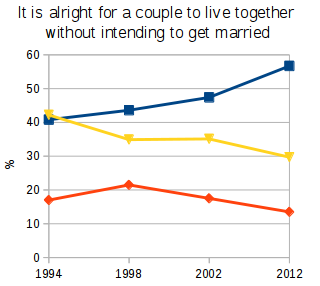


Key characteristics
Cohabiting households commonly include shared living space, combined or separate finances, mutual domestic responsibilities and sometimes joint parenting. Unlike marriage, cohabitation usually lacks a single, consistent legal framework; recognition and consequences depend on national and local law. Typical features include:
- Shared residence and daily life.
- Informal or formal agreements about rent, bills and possessions.
- Varying degrees of social and family recognition.
- Possible joint parenting of children born within or outside the relationship.
History and social change
Patterns of cohabitation expanded notably during the 20th century as social attitudes toward premarital sex, gender roles and family structures shifted. Economic factors such as housing costs, women’s increased labor force participation and the later average age of first marriage also contributed. In many societies cohabitation moved from stigma to a widely accepted option, though persistence of religious and cultural differences means acceptance varies.
Legal and economic implications
The legal status of cohabitants differs around the world. Some jurisdictions grant limited rights similar to marriage after a period of living together (often called common‑law marriage or domestic partnership), while others treat cohabitants as unrelated tenants with few protections. Important legal and financial considerations include:
- Property ownership and division on separation.
- Parental rights and child custody arrangements.
- Inheritance, health care decision authority and social benefits.
- Availability of formal contracts (cohabitation agreements) to clarify obligations.
Reasons, uses and social roles
People cohabit for diverse reasons: to test compatibility before committing to marriage; to combine resources and reduce living costs; as a preferred long‑term alternative to marriage; or because of personal or religious objections to marriage. Cohabitation also affects family formation patterns: in some places a substantial share of births occur to cohabiting parents rather than married ones.
Distinctions and notable facts
Cohabitation differs from marriage chiefly in legal form and often in social recognition. Other related concepts include living‑apart‑together (partners in a relationship who keep separate households) and registered partnerships with formal legal status. When considering cohabitation, people often weigh emotional commitment, financial arrangements and potential legal risks, and many choose to document their intentions through written agreements to reduce later disputes.
Questions and answers
Q: What is cohabitation?
A: Cohabitation is an arrangement where individuals who are romantically or sexually attracted to each other live together without being married.
Q: Does cohabitation only apply to opposite-sex relationships?
A: No, cohabitation can also be used to describe same-sex relationships.
Q: Is cohabitation a common practice in many countries?
A: Yes, cohabitation has become common in many countries.
Q: Are children often born outside of marriage in countries where cohabitation is common?
A: Yes, in countries where cohabitation is common, a percentage of children are born outside of marriage.
Q: Can cohabitation be considered an alternative to marriage?
A: Yes, cohabitation can be considered an alternative to marriage for many people.
Q: Are there any legal rights awarded to individuals in a cohabitation relationship?
A: It depends on the country and the laws in place. In some countries, cohabitating partners have certain legal rights, while in others, they do not.
Q: Can cohabitation be seen as a stepping stone towards marriage?
A: Yes, for some couples, cohabitation may be seen as a way of testing the waters before deciding whether to get married or not.
Author
AlegsaOnline.com Cohabitation: living together without marriage Leandro Alegsa
URL: https://en.alegsaonline.com/art/136780