
Brahmanas: Vedic ritual commentaries
Prose Vedic texts explaining the performance, symbolism, and meanings of rituals. Attached to the Vedas, the Brahmanas are key priestly manuals and sources for early Indian religion and thought.
The Brahmanas are a group of prose texts from the Vedic literary tradition that explain, elaborate and prescribe the rituals found in the Vedic hymns. They form part of the larger corpus associated with each Veda and are principally concerned with the correct performance of sacrifices, the roles of priests, and the symbolic meanings behind liturgical acts. Scholars treat them as a bridge between the earlier Samhitas of hymns and the later philosophical Upanishads. For a general overview see Brahmana literature.
Image gallery
8 Images


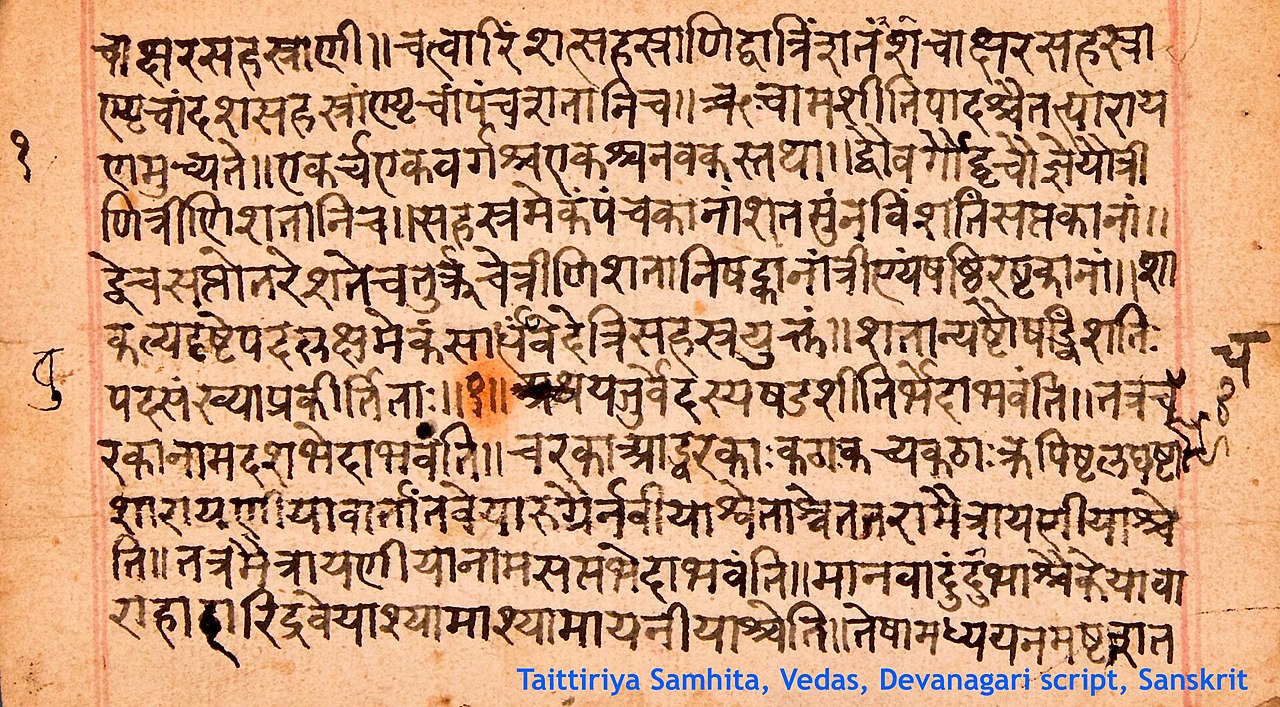


Characteristics and contents
Brahmana texts are primarily procedural and exegetical. They give step-by-step instructions for complex sacrificial rites, assign duties to different priests, and explain why particular gestures, utterances and offerings are made. Interwoven with technical directions are etiological myths and interpretive passages that explore the ritual's symbolic or cosmological significance. The language is prose rather than the metrical verse of the Samhitas, and the tone is often didactic and prescriptive. Many passages also preserve early mythological narratives and explanations of ritual origins. For their relationship to the Vedas see Vedic texts.
Major examples and manuscript history
- The Aitareya Brahmana (associated with the Rigveda) and the Shatapatha Brahmana (linked to the Yajurveda) are among the better known surviving works.
- Other named Brahmanas include the Taittiriya and the Gopatha; many local or school-specific Brahmana compositions have been lost over time.
- Each Vedic shakha (school) traditionally preserved its own Brahmana, so the corpus was once larger than the surviving record.
Surviving Brahmanas vary in length and completeness. Manuscript transmission was uneven, and modern editions rely on scattered palm-leaf and paper manuscripts collected in different regions. For introductions and editions consult standard references in Vedic studies or institutional catalogs such as library resources.
History and chronological context
Composed in the late Vedic period—broadly the first half of the first millennium BCE—the Brahmanas reflect a stage when ritual practice and priestly procedures were being formalized. They developed after the Samhitas of hymns and are roughly contemporary with or slightly earlier than the Aranyakas and the earliest Upanishadic reflections. Their composition marks a stage when ritual exegesis became central to elite religious life.
Uses, significance and distinctions
Functionally the Brahmanas served as practical handbooks for priests and as interpretive guides that made ritual meaningful. They are important historical sources for the study of ancient religion, social roles, and early Indian cosmology. Compared with the Aranyakas (forest texts) and Upanishads (philosophical treatises), Brahmanas remain focused on liturgy and symbol rather than metaphysical speculation. For further comparative material see textual relationships and specialized studies at research collections.
Questions and answers
Q: What are the Brahmanas?
A: The Brahmanas are a collection of Indian books that provide more information on the Vedas, the four holiest books of the Hindu religion.
Q: What do the Brahmanas provide instructions on?
A: The Brahmanas provide instructions on the proper performance of rituals and explain the original symbolic meanings.
Q: Which Vedic shakha has its own Brahmana?
A: Each Vedic shakha (school) has its own Brahmana.
Q: How many Brahmana texts existed in ancient India?
A: Many Brahmana texts existed in ancient India.
Q: Have all Brahmana texts survived?
A: No, most of the Brahmana texts have been lost.
Q: What is the significance of the Vedas in Hindu religion?
A: The Vedas are considered the four holiest books of the Hindu religion.
Q: What is the importance of the Brahmanas?
A: The Brahmanas provide deeper insights into the Vedas and help in understanding the proper performance of rituals.
Related articles
Author
AlegsaOnline.com Brahmanas: Vedic ritual commentaries Leandro Alegsa
URL: https://en.alegsaonline.com/art/13640
Sources
- britannica.com : "Brahmana"