
Cassegrain telescope: design, variants, and applications
A compact reflecting telescope using a primary and a secondary mirror to fold the light path. Describes optical layout, true Cassegrain figures, common variants, history, advantages, and uses.
Overview
The Cassegrain telescope is a reflecting telescope design that folds the optical path using two mirrors so the final focus appears behind the primary mirror. It is a member of the broader family of reflector telescopes. The folded layout yields a relatively short tube for a long effective focal length, which makes Cassegrain-style instruments convenient for both portable amateur setups and large professional instruments.
Image gallery
2 Images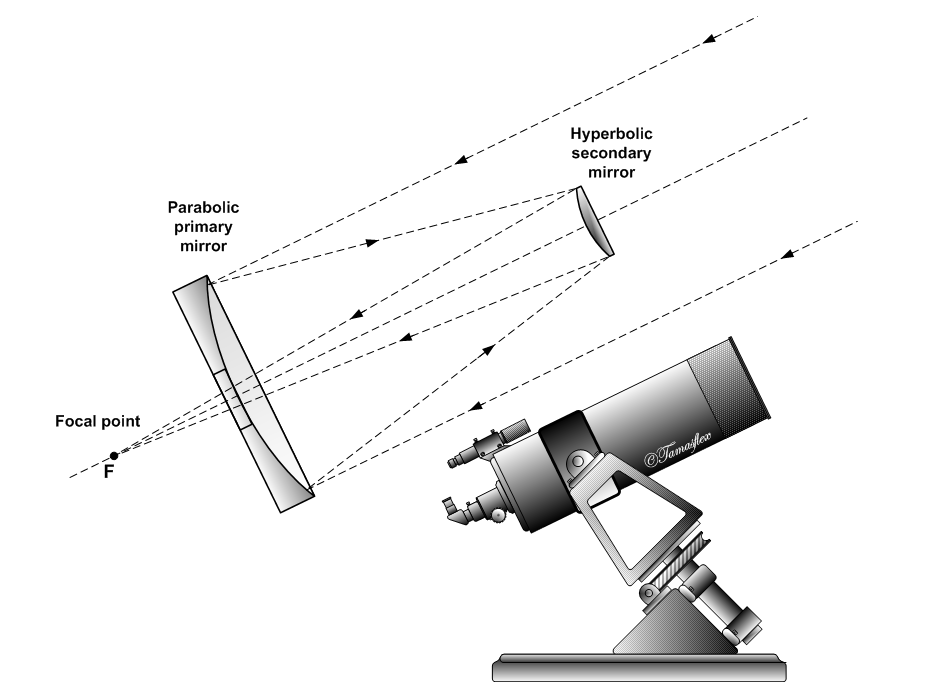

Optical characteristics
In the classic or "true" Cassegrain, the large primary mirror is a concave paraboloid and the smaller secondary mirror is a convex hyperboloid. Light collected by the primary is reflected toward the secondary, which redirects it back through a hole in the center of the primary to the focal plane. The convex secondary increases the effective focal length without requiring a long physical tube, producing high magnification in a compact form.
Why specific mirror shapes matter
The particular shapes—parabola for the primary and hyperbola for the secondary—are chosen to correct spherical and coma aberrations for on-axis light so that a sharp image is formed at the rear focus. Fabricating these conic sections to high precision is challenging, so some commercial designs use spherical mirrors for ease of manufacture and then add a corrective lens or plate to restore image quality. Catadioptric versions combine lenses and mirrors to reduce aberrations while keeping construction simpler.
Common variants
- Ritchey–Chrétien: Both mirrors are hyperbolic; very popular in professional observatories because it reduces coma across a wide field.
- Dall–Kirkham: Elliptical primary and spherical secondary; easier to make but shows off-axis aberrations that limit wide-field performance.
- Schmidt–Cassegrain: Uses a spherical primary plus a Schmidt corrector plate at the entrance pupil; compact and widely used by amateurs.
- Maksutov–Cassegrain: Employs a meniscus corrector lens with spherical mirrors; offers good correction and rugged design.
History and development
The design is named after Laurent Cassegrain, a 17th-century French priest who described the basic two-mirror scheme. Over subsequent centuries instrument makers refined the mirror profiles and adapted the layout for different goals—ease of manufacture, wide-field imaging, or extreme resolution. Modern observatories often use modified Cassegrain forms, such as the Ritchey–Chrétien, for large research telescopes because of their favorable imaging across wide detector areas.
Uses, advantages, and trade-offs
Cassegrain variants are used in visual observing, astrophotography, research telescopes, and many commercial designs. Advantages include compactness, a long effective focal length in a short tube, a conveniently placed rear focus for instruments, and mechanical stability. Trade-offs include a central obstruction (the secondary) that reduces contrast and can produce diffraction effects, and sensitivity to precise mirror figure and alignment (collimation).
Practical considerations and terminology
Beginners who buy Cassegrain-style telescopes should be aware of terms such as focal ratio, back focal distance, and central obstruction, and may encounter marketing names that indicate a particular hybrid design. A discussion of the geometric shapes used in optics can be found via basic references to parabola and hyperbola. Professional instrument teams choose among variants by balancing manufacturing cost, field correction, and the intended scientific program.
Questions and answers
Q: What is a Cassegrain telescope?
A: A Cassegrain telescope is a type of reflector telescope that makes use of two curved mirrors to produce an image.
Q: How does a Cassegrain telescope work?
A: The primary mirror of the Cassegrain telescope gathers and focuses light while the smaller secondary mirror reflects the light through the back of the mirror. The secondary mirror is also curved to lengthen the light path.
Q: What is a "true Cassegrain"?
A: A "true Cassegrain" is a Cassegrain telescope that uses a primary mirror with a parabola-shaped curve and a secondary mirror with a hyperbola-shaped curve.
Q: What is the advantage of using a "true Cassegrain"?
A: A "true Cassegrain" produces clear and high-quality images, perfect for serious astronomy work.
Q: Why do some Cassegrain telescopes use sphere-shaped curves?
A: Sphere-shaped curves are easier to make.
Q: What is a catadioptric telescope?
A: A catadioptric telescope is a type of telescope that makes use of both lens and mirror to produce an image.
Q: How does a catadioptric telescope fix the blurry image issue in Cassegrain telescopes?
A: A catadioptric telescope fixes the blurry image issue in Cassegrain telescopes by using a special lens in front of the telescope.
Author
AlegsaOnline.com Cassegrain telescope: design, variants, and applications Leandro Alegsa
URL: https://en.alegsaonline.com/art/136217