
Box Car Racer
Short-lived American alternative/post-hardcore side project formed by Tom DeLonge and Travis Barker; released one studio album in 2002 and influenced the later sound of Blink-182.
Overview
Box Car Racer was a short-lived rock project formed in 2001 in San Diego, California. Conceived as a creative outlet outside of the members' main bands, it is best known as a side project led by Tom DeLonge and featuring drummer Travis Barker. Musically it drew from alternative rock and post-hardcore sensibilities while retaining traces of the pop-punk background of its principals.
Image gallery
2 Images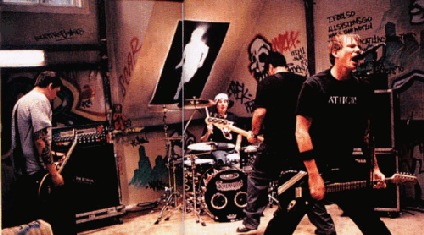

Musical style and themes
Box Car Racer adopted a darker, more atmospheric approach than the members' pop-punk work. Songs emphasize mood, guitar textures and restrained vocal delivery, exploring themes such as alienation, mortality and personal conflict. Reviewers and listeners compared the band's sound to post-hardcore and emo-influenced acts, highlighting a deliberate move away from radio-friendly hooks toward more angular, introspective arrangements.
History and activities
The group formed in 2001 and recorded an eponymous album released in 2002 on MCA Records. The recording line-up centered on DeLonge (vocals, guitar) and Barker (drums); David Kennedy, known from other rock projects, contributed on guitar, and touring bass duties were handled by Anthony Celestino. The band toured briefly and promoted several singles from the album before becoming inactive by 2003.
Band members
- Tom DeLonge — founding member, vocals and guitar (Tom DeLonge).
- Travis Barker — drums and percussion (Travis Barker).
- David Kennedy — lead guitar and songwriting contributions (associated with other projects).
- Anthony Celestino — touring bassist for live dates.
Impact and legacy
Although active for only a short time and releasing a single studio album, Box Car Racer is often cited for its influence on the musical direction of the members' primary band, Blink-182, whose subsequent recordings adopted some of the darker textures and experimental arrangements. The project also demonstrated how established artists can use side projects to explore different genres within a broader American rock tradition.
Notable facts
Box Car Racer is remembered as a deliberate departure from mainstream pop-punk, bringing alternative and post-hardcore elements into the spotlight during its brief run. Fans and critics continue to discuss the album for its moodier production and candid lyrical content, and the project remains a notable footnote in early-2000s rock.


History
The project began in 2002 when a tour by blink-182 had to be cancelled due to DeLonge's back problems. DeLonge and drummer Travis Barker originally formed the band out of boredom. The idea began during sessions while recording the album Take Off Your Pants and Jacket, with DeLonge playing acoustic guitar. The newly formed band was to be called The Kill, the first album Et Tu, Brute. They eventually decided on Box Car Racer, the name of a band Barker had played in shortly after graduating from high school.
In December 2001, the band began recording their first and only album, Box Car Racer. Jerry Finn was hired as producer. Tom DeLonge deliberately wrote more serious and thoughtful themes for the album, which were also influenced by depression due to his ongoing back problems. On Box Car Racer, DeLonge played bass as well as rhythm guitar, and Anthony Celestino was hired for concerts. The band's first live performance (with Celestino) was on April 1, 2002.
Box Car Racer was finally released on 21 May 2002, reaching twelfth place on the US charts. The album was certified gold by the CRIA, with the single I Feel So reaching 120th on the Billboard 200, eighth on the Modern Rock and 41st on the UK charts. The second single, There Is, failed to chart in the Billboard 200, but did chart at number 32 in the Modern Rock chart.
Box Car Racer is a concept album about a boy who sees a bleak future in which a greedy government destroys the Earth. With a group of misfits, he flees the disaster and falls in love with one of the fugitives along the way. Various alternative and punk artists make guest appearances. Tim Armstrong and Jordan Pundik of Rancid and New Found Glory, for example, can be heard on "Cat Like Thief." The bassist of blink-182, Mark Hoppus, also participated on the album. One of the ways the album differs from blink-182's releases is the more introspective and darker music and the more serious lyrics that lack blink-182's typical humor. It is believed that Box Car Racer influenced blink-182s fifth album, titled with the band's name, as it also has a rather darker and more serious atmosphere than previous albums.
Box Car Racer has been well received by critics, receiving positive reviews from Sputnikmusic, Slant Magazine, IGN, PopMatters, AbsolutePunk, and Allmusic, among others. In a review of I Feel So, Sarah Dempster of the New Musical Express called the song "better than anything by blink-182".
In October 2002, the band embarked on their first tour, for which The Used were hired as the opening act. Although Box Car Racer had written a new song during the tour, the last concert took place on December 17, 2002. Tom DeLonge stated that he could well imagine being back on stage with Box Car Racer one day, but now wanted to focus on blink-182 and their fifth album. With this the band was considered to be disbanded.
DeLonge formed the alternative rock band Angels & Airwaves in 2005, which he considered a follow-up project to Box Car Racer. The last songs written by Box Car Racer were used for the band's first studio album, We Don't Need to Whisper.
Discography
Albums
- 2002: Box Car Racer
Singles
- 2002: I Feel So
- 2003: There Is
Related articles
Author
AlegsaOnline.com Box Car Racer Leandro Alegsa
URL: https://en.alegsaonline.com/art/13479