
Bowler (Cricket)
A bowler in cricket is the player who delivers the ball to the batter. This article describes roles, delivery types, legal constraints, tactics, training and historical development.
Overview
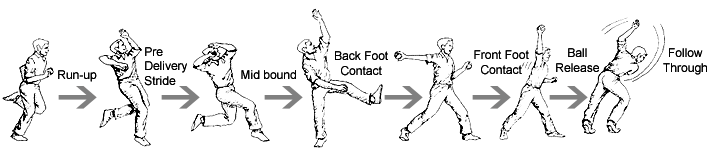
A bowler is the player in the sport of cricket who delivers the ball from one end of the pitch toward the striker (batter) with the twin aims of taking wickets and limiting the number of runs scored. Unlike a baseball pitcher, a legal bowling action in cricket requires the arm to remain effectively straight at the elbow from the point when it passes above shoulder height. An action in which the elbow straightens noticeably is commonly called a throw and is illegal; such concerns are assessed by umpires and, where available, by video and biomechanical review.
Image gallery
8 Images




Types and techniques
Bowling styles are generally grouped by pace and method of imparting movement. Pace bowlers rely on speed, bounce and seam or swing movement through the air; their deliveries include bouncers, yorkers and slower balls used as variations. Medium-paced bowlers emphasise control, seam position and subtle changes of pace. Spin bowlers bowl at lower speeds and use finger or wrist action to make the ball deviate on pitching: common categories are off-spin and leg-spin for right-arm bowlers, plus equivalent left-arm orthodox and wrist-spinning variants. Specialist variations—such as cutters, off-cutters, the doosra, the carrom ball and arm-ball—are developed to confuse the batter and gain advantage.
- Fast and pace bowling: generate speed, bounce and lateral movement; often used to exploit early pitch conditions.
- Swing and seam: controlled seam position and atmospheric conditions can produce movement in the air.
- Spin bowling: rely on rotation and variations in flight to deceive batters; wrist spinners often produce greater turn.
- All-rounders: players who combine effective bowling with strong batting provide balance to a side.
Legal delivery and umpiring
The Laws of Cricket prescribe how a ball must be delivered. The front foot must land within the bowler's crease or the delivery is a no-ball; wides are called when a delivery is judged to be out of the batter's reasonable reach. A bowling action that extends the elbow beyond permitted limits during delivery is scrutinised as an illegal throw. When illegal deliveries occur, they typically result in an extra run to the batting side and require the ball to be re-bowled. Modern match officiating increasingly uses slow-motion replay and biomechanical assessment to determine whether an action is within the rules. For discussion of illegal arm use see throwing.
Role within a team and tactical use
Teams select a mix of bowlers to suit the surface, weather and format. Opening or new-ball bowlers are tasked with exploiting early seam and swing, middle-overs bowlers focus on control and building pressure, and death-overs specialists aim to restrict scoring in the final stages. Captains and bowlers work together on field placements and plans to target a batter's weaknesses. Strategies differ by format: in multi-day games bowlers seek long spells and consistent pressure; in limited-overs matches they use precise lines, variations and changes of pace to curb aggressive batting.
Training, fitness and injury prevention
Bowlers follow technical coaching that emphasises rhythm, alignment and a repeatable action to maintain performance and reduce injury risk. Fast bowlers in particular are subject to heavy physical loads; strength, conditioning and workload management are routine parts of preparation. Common problems can include stress on the back, shoulders and knees; modern support teams use conditioning plans, physiotherapy and monitored training loads to mitigate these risks. Video analysis and biomechanics help refine technique and ensure compliance with legal delivery standards.
Pitch and environmental influences
Pitch surface, weather and the condition of the ball all affect bowling. Dry or abrasive pitches tend to assist spin by providing greater turn, while green or fresh surfaces can offer seam and bounce for pace bowlers. Humid or overcast conditions may favour swing. Captains often choose their bowlers and set fields based on these variables to maximise effectiveness.
History and distinctions
Bowling evolved from the game's early underarm deliveries to round-arm and eventually overarm actions in the 19th century, a series of changes that expanded technique and speed. Distinctions among bowlers include the arm used (right- or left-arm), primary skill (pace or spin) and specialised roles such as swing specialist, wrist spinner or death-overs pace bowler. Advances in coaching, equipment and analysis have continued to refine how bowlers prepare and adapt.
Key terms and statistics
Common statistical measures for bowlers include wickets taken, bowling average (runs conceded per wicket), economy rate (runs conceded per over) and strike rate (deliveries per wicket). Match contexts influence which metric is most valued: economy rate is crucial in limited-overs formats, while average and strike rate are widely used to judge wicket-taking effectiveness over time. Bowling remains a central, highly skilled element of cricket, combining physical ability, technique and tactical understanding to influence match outcomes.
Further reading
For a general introduction to the sport see cricket resources, and for a comparison with similar throwing and pitching actions see material on baseball pitching and on the rules and controversies around throwing.
Questions and answers
Q: What is a bowler?
A: A bowler is a person who delivers a ball to the batsman in the game of cricket with a straight arm.
Q: What is the difference between a bowler and a pitcher in baseball?
A: The difference between a bowler and a pitcher in baseball is that a bowler delivers the ball with a straight arm, while a pitcher delivers with a bent arm.
Q: What is a throw in cricket?
A: A throw in cricket is when the ball is bowled with the elbow bent, which is illegal.
Q: What happens if a bowler bowls while not in the right part of the nonstriker's ground?
A: If a bowler bowls while not in the right part of the nonstriker's ground or bowls the ball out of the reach of the striking batter, it is illegal and gives the batting team 1 point.
Q: Does illegal bowling count towards the limit on the number of deliveries in the game?
A: No, illegal bowling doesn't count towards the limit on the number of deliveries in the game.
Q: What is an all-rounder?
A: An all-rounder is a bowler who can also bat well.
Q: Does a cricket team usually have a mix of different types of bowlers?
A: Yes, a cricket team usually has a mix of different types of bowlers.
Related articles
Author
AlegsaOnline.com Bowler (Cricket) Leandro Alegsa
URL: https://en.alegsaonline.com/art/13465