
Agnès Sorel (1421–1450)
Agnès Sorel was a prominent 15th-century French noblewoman best known as the celebrated mistress of King Charles VII; she influenced court fashion, patronage, and appears in notable contemporary art.
Overview
Agnès Sorel (1421 – 9 February 1450) was a highly visible figure at the court of King Charles VII of France. Widely remembered for her beauty and for the influence she exercised as the king's preferred companion, she was the mother of three daughters by Charles and acquired a reputation that made her one of the best-known royal mistresses of late medieval France.
Image gallery
4 Images


Role and influence at court
Unlike many private companions, Sorel acted with public prominence. Contemporary observers and later historians have noted that she helped shape fashions, social display, and the practice of recognizing an acknowledged royal mistress — sometimes called a maîtresse en titre. Her dress and manner reportedly set trends in the royal household, and she received grants and honours that reflected favour from the king.
Origins and life
There is little documentary detail about Sorel's early years before she entered royal circles. Records place her birth in 1421 and show that by the 1440s she was established at the French court. She became closely associated with Charles VII during a turbulent phase in the kingdom's recovery after the Hundred Years' War and remained his companion until her sudden death in 1450.
Death and historical debate
Sorel died on 9 February 1450 at a relatively young age. The cause of her death has been debated: contemporary accounts mention a sudden illness, while later investigators and modern forensic studies have suggested possibilities ranging from complications after childbirth to accidental or deliberate poisoning. Scholars caution that evidence is ambiguous and interpretations have changed over time.
In art and culture
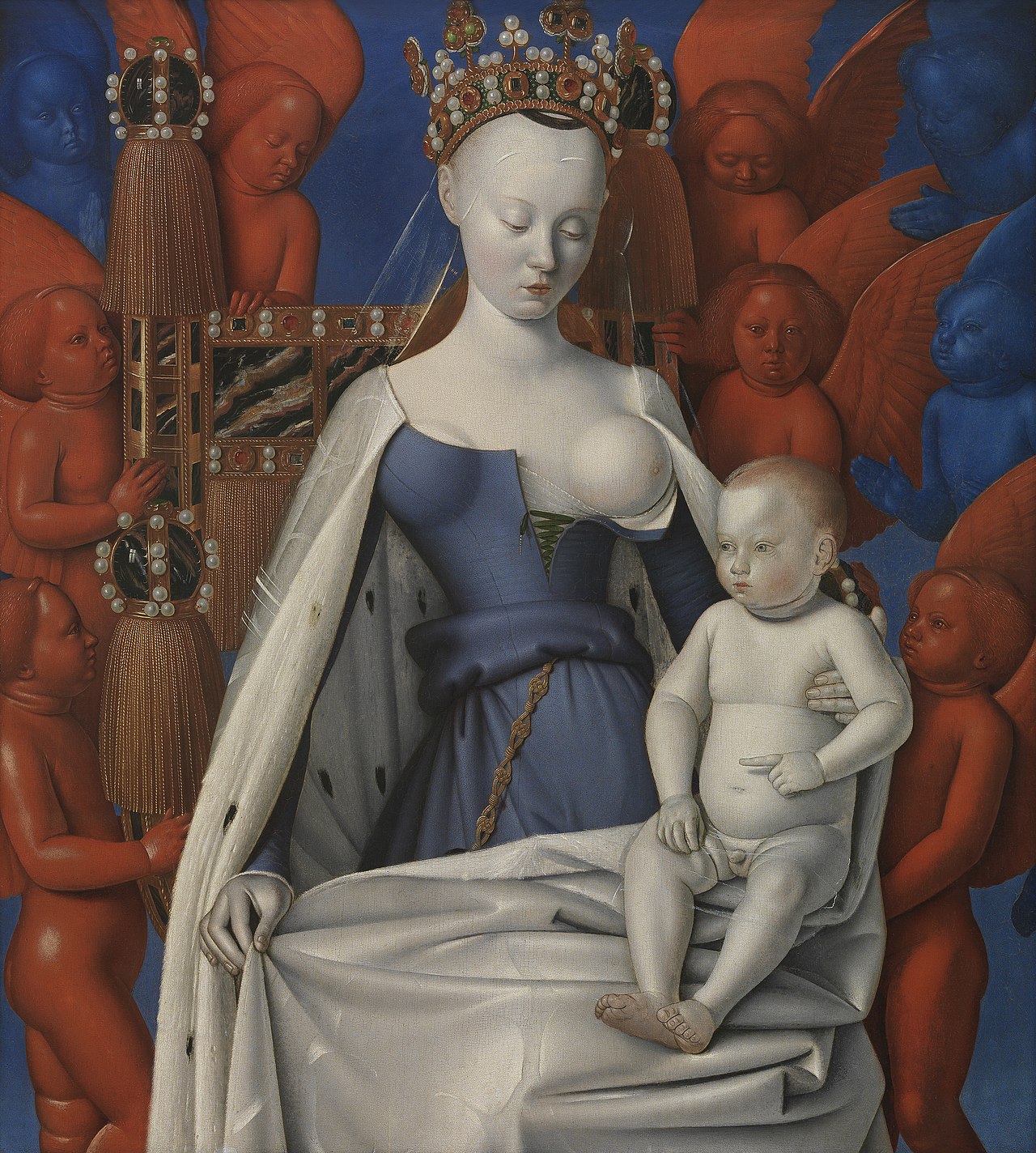
Agnès Sorel was depicted in paintings and artistic works of her day. The celebrated artist Jean Fouquet is associated with an image often identified with her likeness; his Virgin and Child Surrounded by Angels (sometimes referred to as the Virgin of Melun) includes a figure whose features or costume have been linked to Sorel by art historians. Her image contributed to evolving ideals of female beauty in 15th-century French art.
Legacy and notable facts
- She helped make the royal mistress a visible role at court, with social and sometimes political consequences.
- Her fashion — including daring necklines and sumptuous fabrics — was widely remarked upon and copied.
- Her brief life and dramatic death inspired continuing curiosity among historians, writers and artists.
Agnès Sorel remains an emblematic figure of late medieval France: a person at the intersection of court life, cultural change and the public display of royal favour. For further reading on Charles VII and contemporary court culture see sources linked in the article.
Questions and answers
Q: Who was Agnès Sorel?
A: Agnès Sorel was a favourite mistress of King Charles VII of France.
Q: When did she live?
A: She lived from 1421 to 9 February 1450.
Q: What is her connection to King Charles VII of France?
A: She was his favourite mistress and the mother of his three daughters.
Q: How is she remembered today?
A: She is remembered through several contemporary paintings and works of art, including Jean Fouquet's Virgin and Child Surrounded by Angels.
Q: Is there an alternate spelling for her name?
A: Yes, if the character è is unavailable or not wanted, her name may be written as Agnes Sorel.
Author
AlegsaOnline.com Agnès Sorel (1421–1450) Leandro Alegsa
URL: https://en.alegsaonline.com/art/134150