
A.I. Artificial Intelligence (2001 film)
Steven Spielberg's 2001 science-fiction drama about a childlike robot programmed to love, adapted from Brian Aldiss and developed from Stanley Kubrick's project; explores humanity, technology and loss.
A.I. Artificial Intelligence is a 2001 feature film that blends science fiction and drama to tell a speculative story about machines and emotion. Directed by Steven Spielberg, the movie reimagines and expands a short story by Brian Aldiss into a wide-screen parable about identity, family and longing.
The central plot follows David, a highly advanced childlike android uniquely programmed to love the person he calls "mother." The role was played by Haley Joel Osment, whose performance anchors the film's emotional conflicts. Supporting performances include Jude Law, Brendan Gleeson and William Hurt, who portray humans and machines whose relationships with David raise moral and philosophical questions.
Image gallery
6 Images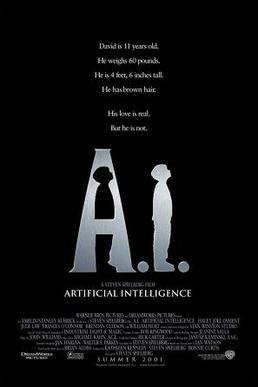


Origins and development
The film grew out of Aldiss's 1969 story "Super-Toys Last All Summer Long" and a long-gestating project associated with Stanley Kubrick. Kubrick developed the idea for decades and eventually entrusted the project to Spielberg after Kubrick's death; Spielberg wrote the screenplay and completed the film. That unusual lineage—Kubrick's conceptual influence and Spielberg's directorial voice—helps explain the film's mix of cool futuristic design and overt sentimental themes.
Production combined practical sets, costume and makeup work with contemporary visual effects to create a near-future world affected by ecological change and economic shifts. The score and sound design, the production design and the casting choices all contribute to an atmosphere that alternates between fairy-tale and dystopia.
Themes and critical reception
A.I. examines what it means to be human through familiar motifs: parental bonds, the quest for identity and the ethical status of created beings. The film deliberately echoes the Pinocchio story—an artificial boy who wishes to become real—and it asks whether programmed affection can be distinguished from genuine feeling. Upon release the film prompted divided reviews, with praise for its ambition and visuals and criticism from some quarters for tonal unevenness. Over time it has been reappraised by critics and audiences who highlight its emotional reach and philosophical ambition.
Key aspects
- Source material: adaptation of Brian Aldiss's short story expanded into a feature-length narrative.
- Creative history: project associated with Stanley Kubrick's development and completed by Spielberg.
- Performance focus: a childlike artificial being (portrayed by Osment) as the film's moral and emotional center.
- Visual and thematic blend: combines futuristic production design with classical storytelling tropes.
As a film, A.I. remains noted for its ambition: it attempts to address timeless human anxieties through the lens of speculative technology, inviting viewers to consider empathy, responsibility and the future of manufactured life.
Questions and answers
Q: Who directed the movie A.I.?
A: The movie A.I. was directed by Steven Spielberg.
Q: What is the source material for the screenplay of A.I.?
A: The screenplay for A.I. was based on the 1969 short story "Supertoys Last All Summer Long" by Brian Aldiss.
Q: Who produced the movie A.I.?
A: The movie A.I. was produced by Kathleen Kennedy, Spielberg and Bonnie Curtis.
Q: Who stars in the movie A.I.?
A: The movie stars Haley Joel Osment, Jude Law, Frances O'Connor, Brendan Gleeson and William Hurt.
Q: When is the setting of A.I.?
A: The setting of A.I is in a futuristic post-climate change society .
Q: What is the main plot of A I?
A: The main plot of AI tells the story of David (Osment), a childlike android uniquely programmed with the ability to love
Author
AlegsaOnline.com A.I. Artificial Intelligence (2001 film) Leandro Alegsa
URL: https://en.alegsaonline.com/art/134006