
2010 (film) — 1984 science fiction sequel to 2001: A Space Odyssey
1984 science-fiction film directed and produced by Peter Hyams, adapted from Arthur C. Clarke’s novel. A direct sequel to Kubrick’s 2001, it received mixed-to-positive reviews and five Academy Award nominations.
Overview
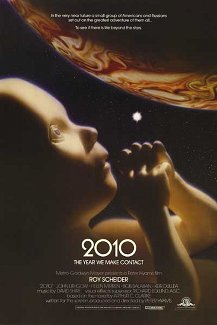
2010, released as 2010: The Year We Make Contact, is a 1984 science fiction film directed by Peter Hyams, who also served as producer of the picture. The screenplay adapts Arthur C. Clarke’s novel 2010: Odyssey Two and functions as a direct sequel to Stanley Kubrick’s 1968 film 2001: A Space Odyssey. The movie was released in December 1984 and was positioned to explain and continue several narrative and thematic threads left open by the earlier, more ambiguous film.
Image gallery
2 Images
Plot summary
The plot follows an international crew aboard a Soviet spacecraft that journeys to Jupiter to investigate the derelict Discovery One and its onboard artificial intelligence, HAL 9000. Driven by diplomatic tensions and scientific curiosity, the mission encounters mysterious phenomena linked to the monoliths introduced in 2001. The story places greater emphasis on human interaction, practical problem solving, and diplomatic cooperation than its predecessor, and it offers a more explicit explanation of certain cosmic events.
Production
Production aimed to balance respect for Kubrick’s visual legacy with a more conventional narrative style. Hyams sought to make Clarke’s ideas accessible to mainstream audiences, using model work, practical sets, and special effects methods prevalent in the mid-1980s. The filmmakers consulted technical advisors and worked to evoke the scale and cold precision associated with the original while adding clearer exposition and character development.
Cast and crew
The film features a principal cast that includes Roy Scheider, John Lithgow, Helen Mirren, Keir Dullea, and Bob Balaban, with Douglas Rain returning as the voice of HAL. Key contributions from the production design, costume, makeup, and visual effects departments shaped the film’s look and atmosphere.
Themes and style
2010 explores themes of contact with nonhuman intelligence, the limits and responsibilities of advanced technology, and the political tensions of the Cold War era refracted through a spacefaring narrative. Compared with 2001’s elliptical and symbolic approach, 2010 offers clearer exposition and emotional accessibility, foregrounding interpersonal dynamics and international cooperation as part of its dramatic thrust.
Reception
Contemporary critical reaction ranged from appreciation for the film’s craftsmanship to reservations about its more literal handling of material that many viewers considered sacrosanct after Kubrick’s film. Aggregated reviews placed the movie in a generally favorable category on some platforms, including a rating reported on Rotten Tomatoes. Professional critics and review roundups collected and analyzed a variety of perspectives catalogued by contemporary sources. Prominent critic Roger Ebert praised the film as a well-made space opera while noting it did not replicate the original’s poetic ambiguity.
Awards and legacy
At the 1985 Academy Awards the film received nominations in five categories, including Best Art Direction, Best Makeup, Best Costume Design, Best Visual Effects, and Best Sound Presentation. While it did not achieve the canonical status of 2001, 2010 remains notable for bringing Clarke’s sequel novel to the screen and for attempting a more literal resolution to some of the earlier work’s mysteries. Its place in film history is often discussed in terms of how sequels handle revered predecessors and how narrative clarity can reshape audience response to speculative ideas.
Further reading and context
- Relation to Clarke’s work: The film adheres to several of Clarke’s narrative decisions while compressing and modifying others for cinematic purposes.
- Comparison with 2001: Viewers and scholars frequently compare the films as contrasting approaches to cinematic science fiction: one symbolic and meditative, the other explanatory and human-centered.
- Impact: 2010 contributed to public conversations about artificial intelligence, extraterrestrial contact, and the role of international cooperation in space exploration.
Questions and answers
Q: What is the name of the movie?
A: The movie is called 2010 (also known as 2010: The Year We Make Contact).
Q: Who directed and produced it?
A: The movie was both directed and produced by Peter Hyams.
Q: When was it released?
A: 2010 was released on December 7, 1984.
Q: What is the film based on?
A: The movie is based on the Arthur C. Clarke novel 2010: Odyssey Two.
Q: How did critics rate the film?
A: Critics gave mixed to positive reviews for the movie, with a 66% rating on Rotten Tomatoes. Movie critic Roger Ebert rated the movie three out of four stars.
Q: Did it get any awards nominations ? A: Yes, in 1985, the movie was nominated for five Academy Awards in various categories such as Best Art Direction, Best Makeup, Best Visual Effects, Best Costume Design and Best Sound Presentation.
Author
AlegsaOnline.com 2010 (film) — 1984 science fiction sequel to 2001: A Space Odyssey Leandro Alegsa
URL: https://en.alegsaonline.com/art/133640