
20,000 Leagues Under the Sea (1954 film)
1954 Walt Disney film adaptation of Jules Verne’s novel directed by Richard Fleischer, noted for its cast, Nautilus design, special effects and status as an early steampunk-influenced cinematic landmark.
Overview
20,000 Leagues Under the Sea is a 1954 American adventure film directed by Richard Fleischer. Produced by Walt Disney Productions, it adapts elements of Jules Verne’s 19th-century novel for a mid-20th-century family audience. The movie follows a small group of characters who encounter the enigmatic submarine Nautilus and its captain during a period of unexplained attacks on ships. The film blends seafaring adventure, speculative technology, and moral conflict, and remains the best-known screen version of Verne’s story.
Image gallery
3 Images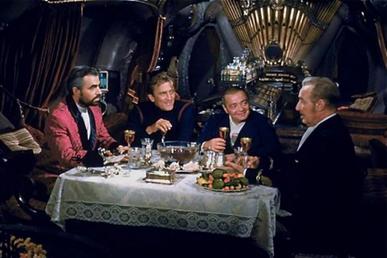


Cast and characters
The film features a notable main cast, led by:
- Kirk Douglas as Ned Land, the pragmatic harpooner and foil to the Nautilus crew.
- James Mason as Captain Nemo, the brooding and cultured commander of the Nautilus.
- Paul Lukas as Professor Pierre Aronnax, the scientist and narrator figure.
- Peter Lorre as Conseil, the professor’s loyal servant and companion.
Production and studio context
This picture was the first significant science fiction feature produced under the Walt Disney studio banner and marks an early instance of Disney tackling more mature, spectacle-driven material while retaining family accessibility; the project is often described as the only science fiction film personally overseen by Walt Disney himself (Walt Disney). It was also the first full-length Disney feature released through the studio’s new distribution arm, Buena Vista Distribution. The production combined studio sets, model work, and sea-based filming to create the movie’s underwater sequences (Disney Productions).
Design, effects and tone
A central element of the film’s lasting appeal is the design of the Nautilus—the interior and exterior styling that evokes both Victorian craftsmanship and futuristic engineering. The screenplay condenses and reorders incidents from Verne’s book to produce a tighter cinematic narrative, emphasizing action sequences such as battles with a giant squid and submarine vignettes while softening darker or more philosophical aspects of the source material. Special effects, model animation and matte paintings were used extensively to suggest large-scale oceanic vistas and the workings of the vessel.
Adaptation, themes and distinctions from the novel
Rather than attempting a literal page-by-page translation of Verne’s novel, the film streamlines the plot and reshapes character motivations for dramatic clarity and audience sympathy. Captain Nemo is presented with more of a tragic, humane dimension than in some literary readings, and the protagonists’ personal conflicts are simplified to support cinematic pacing. The movie omits several episodic adventures from the book and introduces scenes crafted for visual spectacle and suspense.
Reception, legacy and cultural impact
Upon release the film was praised for its production values, performances and imaginative staging, and it has since been recognized as an influential early example of what modern commentators sometimes call steampunk aesthetics—a retrofitted, anachronistic look that melds pre-industrial design with advanced mechanics (steampunk). The motion picture helped cement the Nautilus as an iconic image in popular culture and inspired later adaptations and homages in film, television and theme-park design. As an adaptation of Jules Verne’s work (Verne), it remains a reference point for discussions about how classic science fiction can be reinterpreted for mass audiences.
Film historians and genre scholars point to the movie as a milestone in family entertainment that nonetheless embraced speculative ideas and darker undertones; it is often cited in surveys of cinematic science fiction and is studied for both its technical achievements and its role in shaping mid-century perceptions of underwater exploration (genre studies). For further context on the director and principal performers, contemporary analyses and studio histories provide deeper background (cast and crew), (lead performance), and production details (production notes).
Questions and answers
Q: Who directed the movie 20,000 Leagues Under the Sea?
A: Richard Fleischer.
Q: What is the movie about?
A: It is about a man who goes on a discovery all over the world with Captain Nemo.
Q: Who played the role of Ned Land in the movie?
A: Kirk Douglas.
Q: Who played the role of Captain Nemo in the movie?
A: James Mason.
Q: Which production company produced the movie?
A: Walt Disney Productions.
Q: What was the first science fiction movie produced by Walt Disney Productions?
A: 20,000 Leagues Under the Sea.
Q: What is the movie cited as an early example of?
A: The steampunk genre.
Author
AlegsaOnline.com 20,000 Leagues Under the Sea (1954 film) Leandro Alegsa
URL: https://en.alegsaonline.com/art/133596