
1824 United States presidential election
A four-way contest that produced no Electoral College majority; the House selected John Quincy Adams over Andrew Jackson, an outcome labeled a 'corrupt bargain' that reshaped American politics.
Overview
The presidential election of 1824 is one of the most consequential and unusual contests in early American history. No candidate won a majority of the Electoral College, so the choice passed to the House of Representatives under the Twelfth Amendment. Despite Andrew Jackson winning a plurality of both the popular and electoral votes, the House elected John Quincy Adams president in February 1825. The result provoked sharp accusations of backroom dealing and accelerated the breakup of the dominant political coalition of the era.
Image gallery
10 Images


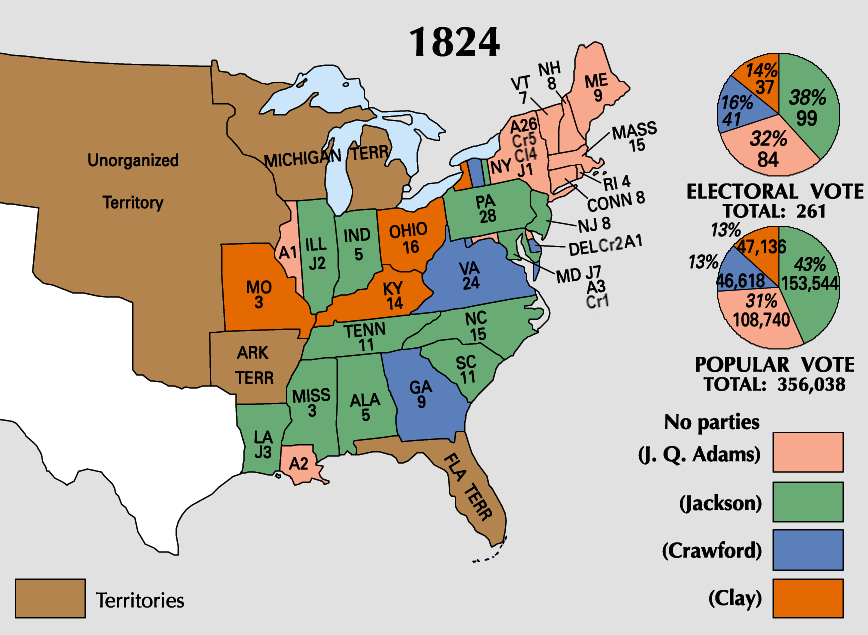

Candidates and electoral result
The race featured four principal presidential contenders who all claimed the legacy of the Democratic-Republican Party: Andrew Jackson, John Quincy Adams, William H. Crawford, and Henry Clay. John C. Calhoun was not a serious contender for the presidency and instead won the vice presidency easily with broad support.
- Andrew Jackson: popular war hero and Tennessee senator; received the largest share of both the popular and electoral votes but lacked an Electoral College majority.
- John Quincy Adams: experienced diplomat and former secretary of state; placed second in the electoral count.
- William H. Crawford: Treasury secretary whose health and political standing had weakened his campaign.
- Henry Clay: Speaker of the House and leader of the western states' interests; finished fourth and thus was excluded from the House contingent election.
Electoral vote totals were: Jackson 99, Adams 84, Crawford 41, and Clay 37. Because none reached a majority of electoral votes, the decision moved to the House.
Contingent election and the role of the House
The Twelfth Amendment requires the House of Representatives to choose the president from among the top three electoral vote-getters when no candidate has a majority. In the House each state delegation casts one vote, and a majority of states is necessary to win. In the contingent election held in February 1825, the House selected John Quincy Adams over Andrew Jackson and William H. Crawford. The vote in the House reflected regional alliances and the influence of congressional leaders rather than the plurality delivered by the nationwide popular returns.
Controversy and political consequences
After the House vote, accusations quickly emerged that Henry Clay had thrown his influence behind Adams in return for a high office; Adams then appointed Clay as his secretary of state. Jackson's supporters charged that this arrangement was a "corrupt bargain." Whether such an explicit deal existed remains debated by historians, but the allegation energized Jackson's followers and became a potent political weapon.
Aftermath and significance
The 1824 election effectively ended the Era of Good Feelings and the single-party dominance of the Democratic-Republicans. It helped forge new political alignments: supporters of Jackson coalesced into a Democratic Party championing popular democracy and expansion, while opponents of Jackson, including many Adams and Clay adherents, formed the foundation of the National Republican and later Whig traditions. Jackson used the 1824 outcome as a rallying cry and won the presidency in a rematch in 1828.
Notable facts
- This was the first presidential election since 1800 to be decided by the House of Representatives.
- The election highlighted tensions between popular voting, regional interests, and constitutional procedures for choosing a president.
- John Quincy Adams was the son of John Adams, the second U.S. president, and his election continued a rare father-son presidential lineage in American history.
Questions and answers
Q: Who was the sixth President of the United States?
A: John Quincy Adams was elected as the sixth President of the United States in 1824.
Q: How many candidates were there for president in 1824?
A: There were five candidates for president in 1824: John Quincy Adams, John C. Calhoun, William H. Crawford , Henry Clay and Andrew Jackson.
Q: Who was by far the most popular candidate?
A: Andrew Jackson was by far the most popular candidate.
Q: How many votes did Jackson win?
A: Jackson won 99 votes in the Electoral College.
Q: What happened when no candidate won a majority of electoral college votes?
A: When no candidate won a majority of electoral college votes, under the Twelfth Amendment to the United States, it went to a vote in House of Representatives from among the top three candidates.
Q: Who won that vote in House of Representatives?
A: John Quincy Adams won by a single vote in February 1825.
Q: What relation did Adams have to another US President? A:John Quincy Adams was son of second President of United States, John Adams
Author
AlegsaOnline.com 1824 United States presidential election Leandro Alegsa
URL: https://en.alegsaonline.com/art/133502