
101955 Bennu — Near‑Earth carbonaceous asteroid and OSIRIS‑REx target
101955 Bennu is a near‑Earth, carbon‑rich asteroid studied by NASA's OSIRIS‑REx mission. It is a small, rubble‑pile body of interest for planetary science and long‑term impact monitoring.
Overview
101955 Bennu (provisional designation 1999 RQ36) is a near‑Earth asteroid notable for its dark, carbon‑rich surface and for being the primary target of NASA's OSIRIS‑REx sample‑return mission. Discovered by the LINEAR program on 11 September 1999, Bennu belongs to the group of Earth‑crossing Apollo asteroids and has been the subject of intensive observation because of both its scientific value and its long‑term impact hazard assessment. It completes an orbit around the Sun in roughly 1.2 years and approaches Earth's neighborhood on a recurring schedule.
Image gallery
10 Images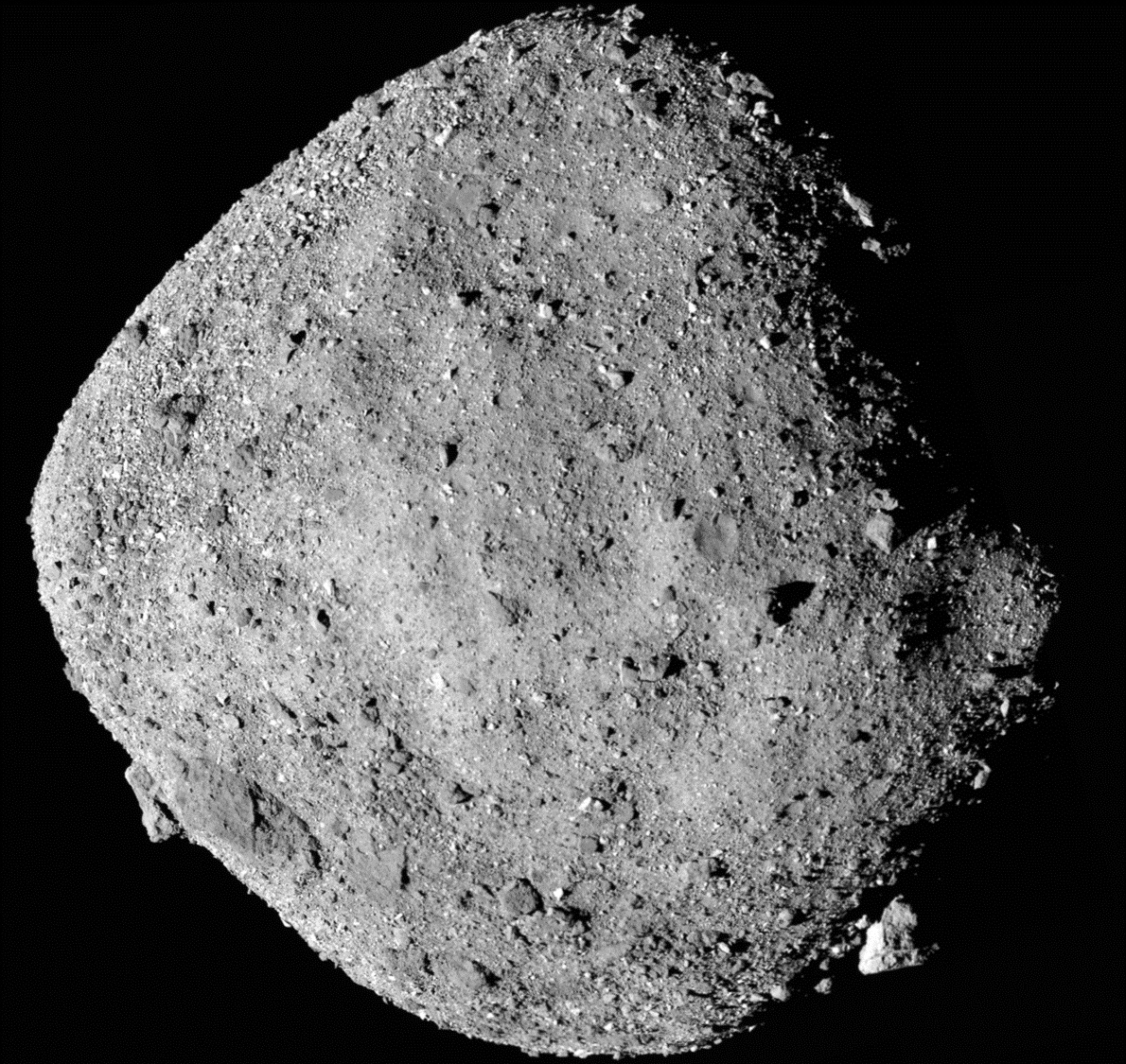


Physical characteristics
Bennu is a relatively small body with an average diameter of about 492 metres. High‑resolution images and measurements taken by OSIRIS‑REx revealed a low‑density, loosely bound or "rubble‑pile" structure with a distinctive top‑shaped profile and an equatorial ridge, features common to several rapidly rotating small asteroids. Its surface is dark and spectrally similar to primitive carbonaceous meteorites, placing it in the broader class of carbonaceous asteroids (more precisely identified as a B‑type in spectral taxonomy). Bennu rotates approximately every 4.3 hours and displays boulders, regolith, and evidence of hydrated minerals and organic compounds.
Origin and orbital evolution
Studies indicate Bennu likely originated in the inner region of the main asteroid belt, possibly as a fragment from a larger parent body produced by a past collision. Dynamical models show that weak forces, resonances, and planetary perturbations — including influences from the giant planets such as Saturn and Jupiter — can move material from the main belt into Earth‑crossing orbits over millions of years. Non‑gravitational effects like thermal forces also played a role in changing Bennu's orbit. Once in an Earth‑approaching path, close encounters and resonant interactions determine its long‑term evolution.
Scientific importance and the OSIRIS‑REx mission
Because Bennu preserves ancient, carbon‑and‑water‑bearing materials, it offers a window into early solar system chemistry and the kinds of organic precursors that may have contributed to the origin of life on Earth. NASA's OSIRIS‑REx spacecraft reached Bennu, mapped its surface in detail, collected a sample from the regolith, and returned material to Earth in 2023 for laboratory study. The returned samples are being analyzed for mineralogy, organic molecules, isotopic compositions, and the record of space weathering. Observations made during the mission also refined estimates of Bennu's mass, density, and porosity, improving models of how rubble‑pile asteroids respond to impacts and tidal forces.
Impact risk and future approaches
Bennu has been closely monitored because its orbit brings it near Earth frequently enough that small uncertainties can grow over time. Early risk assessments highlighted a non‑zero chance of a collision in the late 22nd century — statements such as a roughly 1‑in‑2,700 chance for some dates in the 2175–2199 interval appeared in preliminary predictions — but continual observations and spacecraft tracking have dramatically reduced orbital uncertainties and refined impact probabilities. Astronomers use scales like the Torino and Palermo scales to communicate risk; Bennu has been notable for having one of the higher cumulative Palermo ratings among known near‑Earth objects, though the absolute probability of impact remains low.
Keyhole concept and public concern
A commonly discussed mechanism for long‑term impact risk is the gravitational "keyhole": a small region in space near Earth during a close approach that, if an asteroid passes through it, would perturb the asteroid onto a future collision course. Media and public interest sometimes highlight scenarios in which Bennu might pass near Earth and be deflected into such a pathway. Precise tracking — including radar, optical astrometry, and spacecraft telemetry — is essential to determine whether any past or future close approach would place Bennu within a keyhole. Continuous monitoring reduces uncertainty and allows for more reliable forecasts decades to centuries ahead.
Notable facts and resources
- Discovery: Detected by the LINEAR survey on 11 September 1999.
- Name: Honors the ancient Egyptian mythological bird Bennu, associated with creation and rebirth.
- Orbit and close approaches: Orbital period ~1.2 years; makes periodic close passes to Earth's orbit and is tracked for potential encounters, sometimes noted at distances on the order of a few thousandths of an astronomical unit.
- Scientific return: Returned pristine samples to Earth for laboratory study that are improving our understanding of organic chemistry in the early solar system. Further data and peer‑reviewed analyses are being published as sample studies proceed.
For up‑to‑date orbital solutions, hazard assessments, and scientific results, researchers rely on continued ground‑based observations, radar ranging, and the wealth of data produced by spacecraft missions. These efforts combine to reduce uncertainty about Bennu's path, reveal its composition and structure, and inform planetary defense planning.
Questions and answers
Q: What is Bennu?
A: Bennu is a carbonaceous asteroid in the Apollo group.
Q: When was Bennu discovered?
A: Bennu was discovered by the LINEAR Project on September 11, 1999.
Q: What is the probability of Bennu hitting Earth?
A: Bennu has a 1 in 2,700 chance of hitting Earth between the years 2175 and 2199.
Q: What is Bennu named after?
A: Bennu is named after the Bennu, the ancient Egyptian mythological bird associated with the Sun, creation, and rebirth.
Q: What is the diameter of Bennu?
A: The average diameter of Bennu is 492 metres (1,614 feet).
Q: What is the OSIRIS-REx mission?
A: The OSIRIS-REx mission is intended to return samples of Bennu to Earth in 2023 for further study.
Q: How did Bennu end up in the range of Earth?
A: It is believed that Bennu broke off from another asteroid in the asteroid belt, but the gravitational pull of Saturn dislodged it into the range of Earth.
Author
AlegsaOnline.com 101955 Bennu — Near‑Earth carbonaceous asteroid and OSIRIS‑REx target Leandro Alegsa
URL: https://en.alegsaonline.com/art/133405