
Yoshinori Ohsumi — Autophagy Researcher and Nobel Laureate
Profile of Yoshinori Ohsumi, the Japanese cell biologist awarded the 2016 Nobel Prize for elucidating autophagy: his discoveries, methods, career, and the biomedical importance of autophagy.
Overview
Yoshinori Ohsumi (born 9 February 1945) is a Japanese cell biologist best known for revealing the mechanisms of autophagy, the intracellular recycling process. His work earned the 2016 Nobel Prize in Physiology or Medicine and brought a once-obscure cellular phenomenon to the forefront of modern biology. Ohsumi has held a professorship at the Tokyo Institute of Technology's Frontier Research Center, and earlier received major honors such as the Kyoto Prize in Basic Sciences.
Image gallery
6 Images


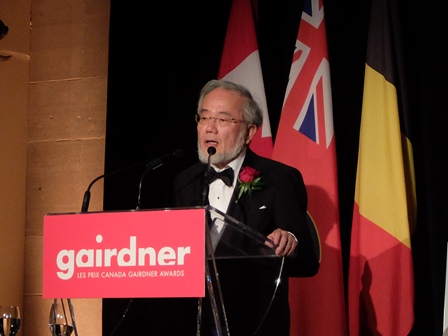
Research and discoveries
Ohsumi established experimental systems that allowed scientists to observe and dissect autophagy at the molecular level. Using baker's yeast as a model organism, he applied genetic screening and microscopy to isolate mutants defective in autophagy and identified a set of essential genes, now commonly referred to as ATG genes. These findings showed how cells enclose material in double-membrane vesicles and deliver it to degradative compartments for recycling, revealing conserved steps and protein complexes that operate across eukaryotic life.
Key contributions
- Development of yeast-based assays that made autophagy experimentally tractable.
- Identification of core autophagy genes and characterization of their roles in vesicle formation and cargo selection.
- Clarification of the relationship between autophagy and cellular organelles involved in degradation and recycling.
Importance and applications
The process Ohsumi elucidated enables cells to remove damaged components and reuse biomolecules, a function crucial for cellular homeostasis during starvation, stress, and development. Dysregulation of autophagy has been linked to many human health issues, including neurodegenerative diseases, infections, cancer, and aging. By defining the molecular machinery, Ohsumi's work opened avenues for therapeutic research aimed at modulating autophagy in disease and for basic studies into cellular quality control.
Career highlights and notable facts
Ohsumi's approach combined classical genetics, careful observation, and biochemical follow-up. His discoveries transformed autophagy from a little-studied phenomenon into a central topic of cell biology. In recognition of this work he received major international awards and continues to be cited for pioneering methods and insights that underpin a large, active field of research.
Selected recognitions:
- 2012 Kyoto Prize (Basic Sciences)
- 2016 Nobel Prize in Physiology or Medicine for discoveries of mechanisms for autophagy
Note: This article summarizes broadly established aspects of Ohsumi's career and the biological process of autophagy without attempting exhaustive bibliographic detail. For further reading, follow institutional and review sources linked above.
Questions and answers
Q: Who is Yoshinori Ohsumi?
A: Yoshinori Ohsumi is a Japanese cell biologist.
Q: What did Yoshinori Ohsumi win the 2016 Physiology or Medicine prize for?
A: Yoshinori Ohsumi won the 2016 Physiology or Medicine prize for his discoveries of how cell autophagy works.
Q: What is autophagy?
A: Autophagy is the process that cells use to break down and recycle cellular components.
Q: What is the result of autophagy?
A: The result of autophagy is the orderly recycling of cellular components.
Q: What is Yoshinori Ohsumi's profession?
A: Yoshinori Ohsumi is a professor in Tokyo Institute of Technology's Frontier Research Center.
Q: When did Yoshinori Ohsumi receive the Kyoto Prize for Basic Science?
A: Yoshinori Ohsumi received the Kyoto Prize for Basic Science in 2012.
Q: What did Yoshinori Ohsumi discover about cell autophagy?
A: Yoshinori Ohsumi discovered how cell autophagy works.
Author
AlegsaOnline.com Yoshinori Ohsumi — Autophagy Researcher and Nobel Laureate Leandro Alegsa
URL: https://en.alegsaonline.com/art/133199