
William Wallace: Scottish leader in the Wars of Independence
William Wallace (c.1270–1305) was a Scottish knight and military leader who resisted English rule during the late 13th and early 14th centuries, remembered for stirring campaigns and a dramatic execution.
Overview
William Wallace was a Scottish landholder and military commander who emerged as a central figure in Scotland's struggle against English domination at the end of the 13th century. Born around 1270, the precise details of his early life are sparse; later chronicles and tradition record him as a mounted knight and leader of irregular forces who opposed the authority claimed by King Edward I of England. His life and actions are often recalled as emblematic of medieval Scottish resistance.
Image gallery
7 Images



Early life and social standing
Contemporary records give little reliable information about Wallace's childhood or family. He is generally described as a lesser noble or freeholder rather than a magnate. Medieval and modern writers sometimes call him a knight, a term that in practice could cover a range of martial roles and social ranks in Scotland. Local tradition and later histories link him to lands in the west of Scotland and the Borders.
Campaigns and military role
Wallace first appears in historical sources during rising unrest following the death of the Scottish king Alexander III and the subsequent English intervention. He helped lead guerrilla-style resistance and achieved a major success at the battle commonly known as the fight at Stirling Bridge in 1297, where Scottish forces inflicted a heavy defeat on an English army. Shortly after that victory he was appointed by some Scots as one of the Guardians of Scotland. A year later his forces were defeated at Falkirk by Edward I, and the dynamics of the struggle shifted.
Capture, trial, and execution
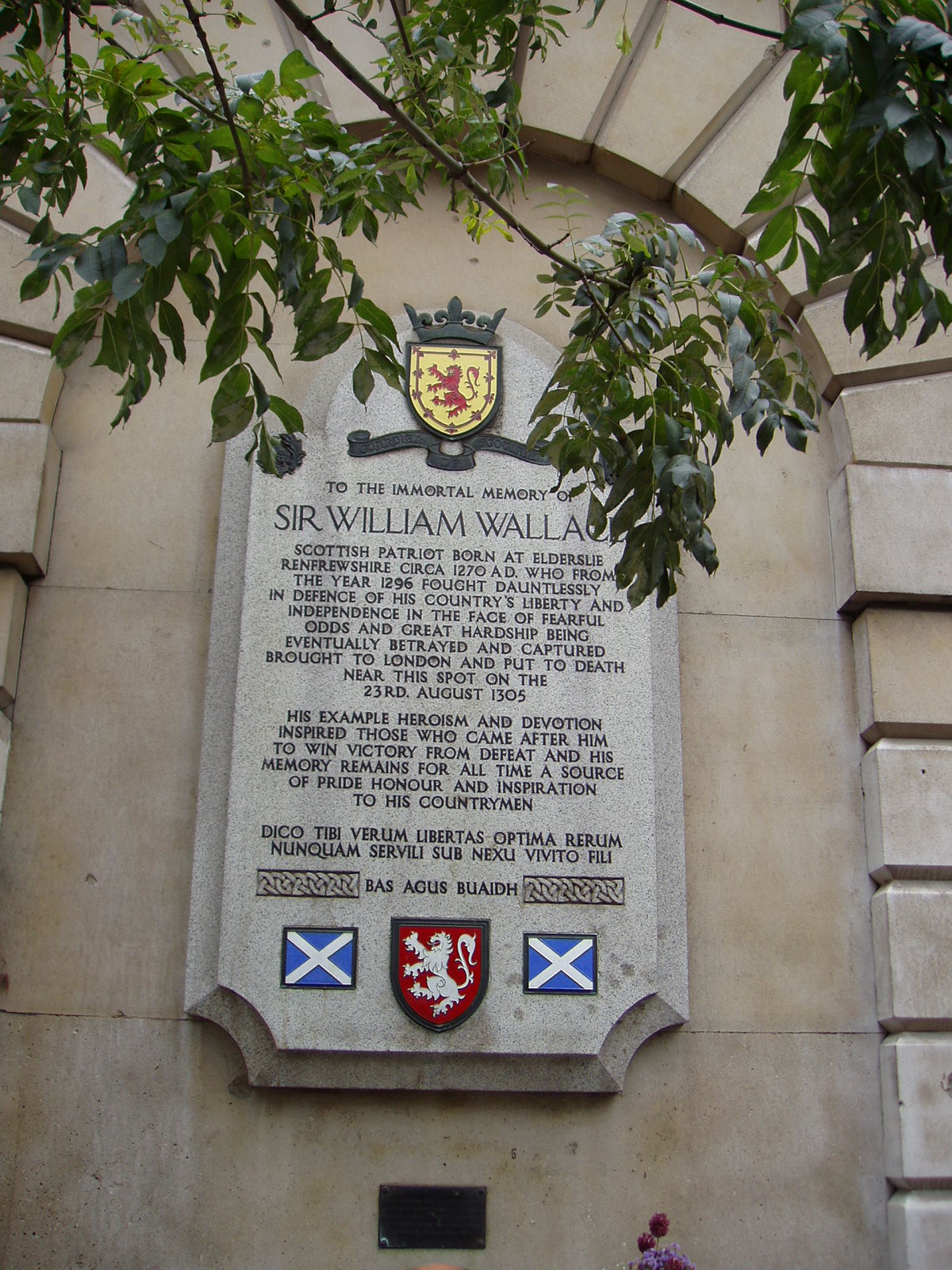
Wallace continued to resist English rule but was captured in 1305. Brought to London, he was tried on charges that included treason against the English king. Found guilty, he was executed on 23 August 1305. Medieval accounts emphasize the severity of the sentence, which was intended as a warning to others who opposed royal authority.
Legacy, memory, and cultural portrayals
William Wallace's reputation grew in the centuries after his death. He features in Scottish chronicles and ballads as a national hero and martyr. Monuments, such as the National Wallace Monument near Stirling, commemorate him and attract interest in Scotland's medieval past. Popular culture has also reshaped his image; dramatic retellings and films have mixed historical fact with legend. For summaries and further reading see biographical sources and general accounts of the era.
Notable facts and distinctions
- Wallace is associated with the broader Wars of Scottish Independence against English authority.
- His military achievements were followed by a high-profile defeat at Falkirk and eventual capture.
- Historian interpretations vary; some emphasize his guerrilla leadership, others his symbolic value as a national figure. See also materials on Edward I and the later leader Robert the Bruce for context.
- For cultural and later historical perspectives consult modern surveys and primary translations available at many research collections (resources).
Although scholarship continues to refine what can be confidently said about Wallace, his role as a focal point of resistance and a lasting symbol of Scottish identity is well established.
Questions and answers
Q: When was William Wallace born?
A: William Wallace was born around 1270.
Q: What is William Wallace known for?
A: William Wallace is known for being a Scottish knight who fought against the King of England in the Middle Ages.
Q: Who did William Wallace refuse allegiance to?
A: William Wallace refused allegiance to Edward I, the King of England.
Q: When was William Wallace executed?
A: William Wallace was executed by the English on August 23, 1305.
Q: Why did William Wallace fight against the King of England?
A: William Wallace fought against the King of England because Scotland had been claimed by Edward I, and he refused to pledge allegiance to him.
Q: Was William Wallace successful in his fight against the King of England?
A: Although William Wallace was ultimately captured and executed, he is still regarded as a Scottish hero for his bravery and leadership in the fight against the English.
Q: What was the political climate like during William Wallace's time?
A: During William Wallace's time, there was conflict between Scotland and England over territorial claims, with the Scottish people seeking independence from English rule.
Author
AlegsaOnline.com William Wallace: Scottish leader in the Wars of Independence Leandro Alegsa
URL: https://en.alegsaonline.com/art/132999