
Walther von der Vogelweide: medieval German Minnesinger and poet
Walther von der Vogelweide (c.1170–c.1230) was the most influential German Minnesinger. He renewed courtly love poetry, wrote political Sprüche, and is known through medieval song manuscripts.
Overview
Walther von der Vogelweide is remembered as the preeminent German Minnesinger of the High Middle Ages. Active around the turn of the 13th century, he composed lyric poetry in Middle High German that reshaped courtly love song and introduced a stronger element of personal voice and political commentary to the tradition. His name, often rendered as Walther von der Vogelweide, can be translated loosely as "Walther of the bird meadow"; whether he adopted that byname himself is uncertain. Biographical details are fragmentary: he is usually assigned a birth date near 1170 and a death date around 1228–1230, possibly in Würzburg.
Image gallery
10 Images



Life and travels
Walther’s early life is poorly documented. Linguistic clues and remarks in his own poetry indicate roots in Bavaria or Austria and a musical and poetic education in the eastern German-speaking lands. At the court of Duke Leopold V of Babenberg in Vienna he emerged as an accomplished singer and participant in poetic contests. After leaving a permanent court position, he became itinerant: for many years he travelled between princely and ducal households across the German lands and beyond, spending weeks or months at individual courts where he performed, received patronage, and exchanged ideas with other poets and patrons. Though he moved through courtly circles, manuscript evidence and his own style suggest he belonged to the lower nobility and sometimes used the honorific Herr.
Works and stylistic features
Walther’s surviving oeuvre consists largely of lyric poems and a group of didactic and political verses known as Sprüche. In the lyrical pieces he renewed the Minnesang tradition by widening its emotional range: alongside refined formulations of courtly love he composed songs that are direct, comic, ironic, sensual, or quietly intimate. One of his best-known lyrics, commonly called "Unter der linden" (Under the linden), exemplifies a new frankness and vividness that were unusual in earlier German court poetry. Walther wrote in Middle High German and habitually claimed to supply both words and music for his songs; however, almost none of his melodies survive written with reliable notation, so modern appreciation rests largely on the texts as transmitted in medieval songbooks.
Political verse and public role
Distinct from many courtly minnesingers, Walther composed Sprüche that engaged directly with contemporary events and rulers. These short, pointed poems functioned as commentary and sometimes as public argument: he addressed questions of imperial authority, papal influence, and the conduct of rulers. In the politically turbulent years after 1198, Walther aligned at times with imperial positions and voiced support for figures such as Emperor Otto IV in disputes with the papacy. His political pieces show how a poet could act as adviser, satirist, and public voice in a period when oral performance and manuscript circulation shaped opinion.
Manuscripts, transmission and legacy
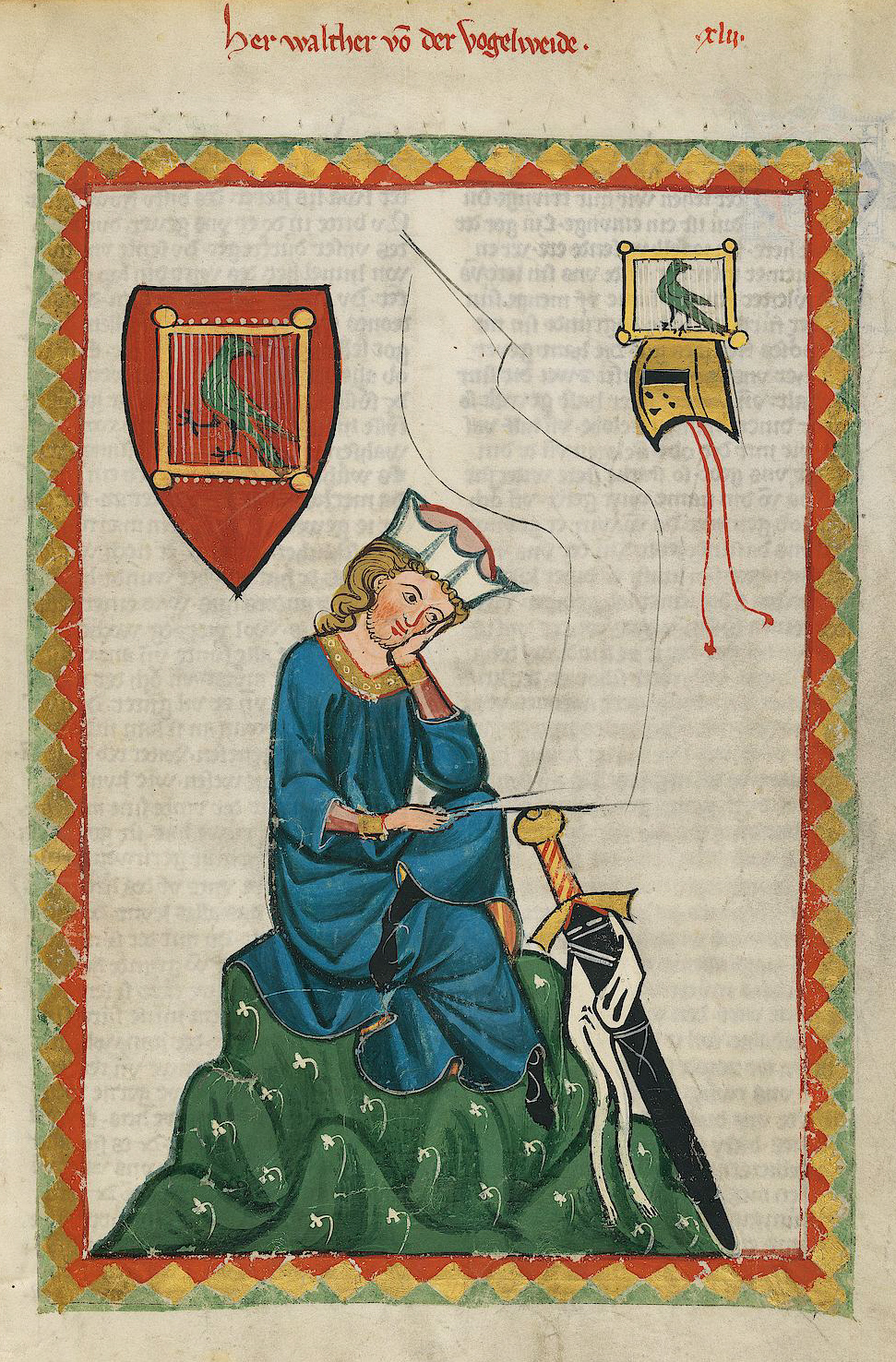
Many of Walther’s texts survive in medieval German song anthologies. The most famous of these compilations preserves both his poems and an illuminated portrait that later medieval readers associated with him. Because most medieval songs were preserved without musical notation or with fragmentary notation, modern readers experience Walther primarily as a poet. His language and approaches had a lasting influence: subsequent German lyric poetry absorbed his blend of lyrical immediacy, wit, and political awareness. From the Renaissance through modern German scholarship, Walther has been treated as a founding figure of German literary identity and as a key witness to the culture of courts and public life in his era.
Characteristics, notable works and distinctions
- Genre: Minnesang (courtly love song) and Spruch (didactic/political poem).
- Language: Middle High German, noted for expressive clarity and varied tone.
- Famous pieces: "Unter der linden" (a vivid love lyric), many shorter Sprüche on politics and morality.
- Performance: Composed for singing; surviving notation is rare, so melodies are mostly lost.
- Manuscript presence: Widely represented in medieval song collections and in an illuminated portrait tradition.
Further reading and online resources
For manuscript images, modern editions, and scholarly introductions consult the following resources and digital collections:
- Würzburg resources and local collections
- General overview of German medieval poetry
- Studies on medieval lyric and Minnesang
- Research on medieval song and music
- Courtly love in medieval literature
- Surveys of medieval musical notation
- Histories of Austria in the High Middle Ages
- Dialect studies for Middle High German
- Bavarian medieval cultural history
- Viennese court and patronage
- Medieval European courts and travel
- Context of 12th–13th century Europe
- Ducal patronage networks
- Princes and cultural sponsorship in the Middle Ages
- Nobility and social rank in medieval society
- Castle life and courtly ceremony
- Conflicts between emperors and the papacy
- Emergence of early national sentiment in medieval literature
- Patriotic themes in medieval poetry
- Examples of Walther’s lyrical innovations
Questions and answers
Q: Who was Walther von der Vogelweide?
A: Walther von der Vogelweide was a famous German poet and composer who lived around 1170-1230. He was the greatest of the German Minnesinger, people who wrote and sang songs about courtly love.
Q: What did Walther add to his name?
A: Walther added "von der Vogelweide" to his name, which means "of the bird meadow".
Q: Where did he learn to sing and write poetry?
A: In a document, Walther wrote that he had learned to sing and write poetry in Austria. The dialect he spoke suggests that he must have come from Bavaria or Austria.
Q: What kind of verses did he write?
A: In addition to courtly love songs, Walther also wrote verses called “Sprüche" ("sayings") about the history of the time as well as a type of love poem which was new in German literature.
Q: How did these Sprüche serve him politically?
A: These Sprüche served as political propaganda and were used in political debates. For example, they helped persuade Emperor Otto IV to go on a crusade which had been forbidden by the pope.
Q: Did Walther ever join Otto IV on this crusade?
A: We do not know whether or not Walther joined Otto IV on this crusade.
Q: What is Unter der Linde?
A: Unter der Linde is one of the most famous poems written by Walther von der Vogelweide; it is a type of love poem which was new in German literature at that time.
Author
AlegsaOnline.com Walther von der Vogelweide: medieval German Minnesinger and poet Leandro Alegsa
URL: https://en.alegsaonline.com/art/132756