
Valya Balkanska — Bulgarian folk singer whose voice went into space
Valya Balkanska (b. 1942) is a Bulgarian folk singer from the Rhodope Mountains, best known for performing 'Izlel je Delyo hajdutin', included on the Voyager Golden Record and carried aboard Voyager probes in 1977.
Overview
Valya Balkanska is a celebrated Bulgarian folk music singer born on January 8, 1942. Her rendition of the traditional song Izlel je Delyo hajdutin is internationally known because a recording of it was placed on the Voyager Golden Record and launched into interstellar space aboard the Voyager 1 and Voyager 2 probes. The inclusion of this performance made Balkanska one of the few regional folk artists whose voice was deliberately sent beyond Earth by NASA.
Image gallery
2 Images
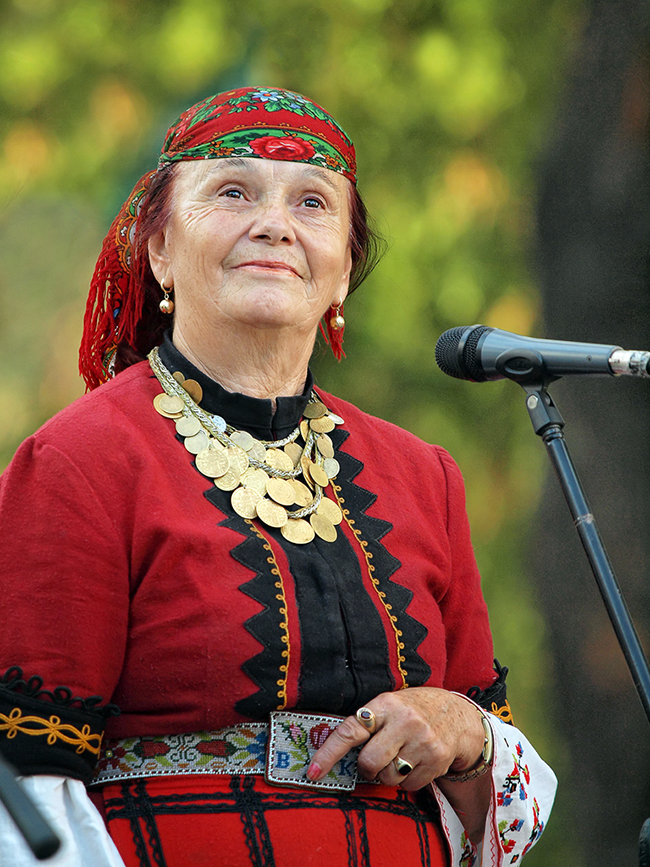
Early life and musical roots
Balkanska grew up in a small hamlet near the village of Arda in the Rhodope Mountains, a region with a distinct vocal tradition. She learned songs from her mother and grandmother and from communal work gatherings where local music and stories were exchanged. In 1960, when she was eighteen, she became the principal soloist of the state-supported Rhodopa Ensemble for Folk Songs and Dances, establishing a professional platform for performing and preserving local repertoire.
Voice, repertoire and collaborators
Balkanska's singing is associated with the low, resonant and ornamented style characteristic of Rhodopean song. Over a long career she recorded and performed more than three hundred songs, drawing on Lamella-like melodies, modal scales and expressive phrasing that reflect the mountainous region's musical language. For many years she performed with traditional instrumentalists, including well-known bagpipers (gaida); one of her regular accompanists was bagpipe player Petar Yanev, and earlier recordings feature Dimitar Petkovski on bagpipe for the famous Voyager track.
Izlel je Delyo hajdutin and the Voyager Golden Record
The song Izlel je Delyo hajdutin tells a hero-inspired tale from Bulgarian oral tradition. A field recording of Balkanska singing this song, with bagpipe accompaniment, was selected in the early 1970s for inclusion on the Voyager Golden Record, a curated collection of music, sounds and images meant to represent Earth. Copies of the record were mounted on the space probes and sent into deep space in 1977 aboard Voyager 1 and Voyager 2. The project, organized by a team that included Carl Sagan, sought to offer a compact cultural snapshot of our world should an advanced civilization encounter the probes.
Recordings, later work and public recognition
In later decades Balkanska continued to perform and to record. A notable release from 2004, titled Glas ot vechnostta (Voice from the Eternity), gathered several of her signature songs, such as "A bre yunache ludo i mlado," "Goro le goro zelena," and "Maychinko stara maychinko." Her association with the Voyager project and long service in the Rhodope ensemble made her a recognizable cultural figure in Bulgaria and among enthusiasts of traditional music abroad.
Notable facts and legacy
Valya Balkanska is often cited as an example of how regional folk traditions can achieve global visibility. Her recording on the Golden Record placed a piece of Balkan vocal art in a unique position: traveling beyond the solar system as part of humanity's symbolic message. She remains an emblematic voice of the Rhodope Mountains and a subject of interest for those studying folk song preservation and cultural representation in international projects.
Selected songs
- Izlel je Delyo hajdutin
- A bre yunache ludo i mlado
- Goro le goro zelena
- Maychinko stara maychinko
For more information about the Voyager mission and the cultural decisions behind the Golden Record, see resources associated with the probes and the agencies involved: Voyager 1, Voyager 2, the Voyager Golden Record project and general materials from NASA. Further reading on Balkan folk music and the Rhodope tradition can be found through regional music archives and ethnographic collections related to the probes' cultural context or specialist sites about traditional instruments such as the gaida.
Questions and answers
Q: When was Valya Mladenova Balkanska born?
A: Valya Mladenova Balkanska was born on January 8, 1942.
Q: What is she most famous for?
A: She is most famous for performing the song Izlel je Delyo hajdutin, which was sent to space on board the Voyager 1 and Voyager 2 probes in 1977.
Q: Where did she grow up?
A: She grew up in a hamlet consisting of seven houses near the village of Arda in the Rhodope Mountains.
Q: How old was she when she became the main soloist of the Rhodopa State Ensemble for Folk Songs and Dances?
A: She was 18 years old when she became the main soloist of the Rhodopa State Ensemble for Folk Songs and Dances.
Q: Who has accompanied her musically for 14 years?
A: The bagpipe player Petar Yanev has accompanied her musically for 14 years.
Q: What is Izlel je Delyo hajdutin?
A: Izlel je Delyo hajdutin is a folk song that Valya Balkanska recorded together with a bagpiper Dimitar Petkovski. It became part of NASA's Voyager Golden Record in 1972.
Q: What other works are included on NASA's Voyager Golden Record?
A: In addition to Izlel je Delyo hajdutin, NASA's Voyager Golden Record includes works from famous composers such as Mozart, Bach, Beethoven, and Stravinsky.
Author
AlegsaOnline.com Valya Balkanska — Bulgarian folk singer whose voice went into space Leandro Alegsa
URL: https://en.alegsaonline.com/art/132454