
Thomas Schelling
American economist and strategist who applied game theory to conflict, bargaining and deterrence; author of influential works and co-winner of the 2005 Nobel Prize in Economics.
Thomas Crombie Schelling (14 April 1921 – 13 December 2016) was an American economist and scholar whose work connected economic reasoning with international security, negotiation, and social behavior. He is best known for applying game-theoretic ideas to practical problems of conflict and cooperation, and for exploring how promises, threats and coordination shape large-scale outcomes.
Image gallery
3 Images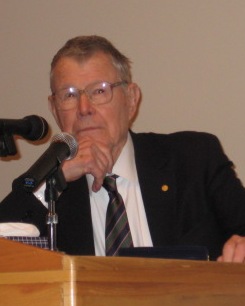


Major works and central ideas
Schelling wrote several widely read books that brought strategic thinking to new audiences. Two of his most influential works are The Strategy of Conflict (1960) and Arms and Influence (1966); later he explored individual choices and collective patterns in Micromotives and Macrobehavior (1978). These books introduced accessible formulations of concepts that became staples in international relations and social science.
- Focal points (Schelling points): the idea that people coordinate on salient solutions when communication is limited.
- Credible commitment and deterrence: how the credibility of threats and promises affects bargaining and conflict.
- Strategic moves and signaling: the value of deliberate actions that change an opponent's expectations or choices.
Career and institutional affiliations
Schelling combined academic appointments with public service. After early government work he joined the economics faculty at Yale University and later became Professor of Economics at Harvard University. In 1969 he moved to the John F. Kennedy School of Government at Harvard, where he taught on topics including national security, nuclear strategy, and arms control. He is often described as a bridge between economic theory and policy practice.
Recognition and later life
For his contributions to the analysis of conflict and cooperation through game theory, Schelling was awarded the Nobel Prize in Economic Sciences in 2005, which he shared with Robert Aumann. He also received honors such as recognition from the National Academy of Sciences and honorary degrees from institutions including the University of Manchester and Yale. Throughout his career he was affiliated with scholarly networks that connected economics, policy, and strategy studies.
Applications and influence
Schelling's ideas have been applied far beyond formal game theory. Policymakers used his reasoning about deterrence and bargaining during the Cold War and in later arms-control debates; social scientists and urban scholars used his models to explain how simple individual preferences can produce segregated neighborhoods. His emphasis on how small strategic moves can change outcomes influenced negotiations, military strategy, and discussions of externalities such as environmental policy.
Notable distinctions and legacy
More than a catalogue of awards, Schelling's legacy rests on clear conceptual tools that help explain when and why people coordinate, compete, or compromise. He wrote for both technical and general audiences, helping to translate abstract models into practical insights. His work remains a reference point for scholars of game theory, negotiation, and international security, and his influence can be traced across fields as diverse as economics, political science, sociology and strategic studies. Readers seeking further details on his thought and writings can consult academic profiles and collected editions of his essays and books via institutional pages and bibliographies in economics and international relations resources (see profile and selected writings).
Questions and answers
Q: Who was Thomas Crombie Schelling?
A: Thomas Crombie Schelling was an American economist and a professor of foreign affairs, national security, nuclear strategy, and arms control.
Q: Where did Schelling work after leaving government in 1953?
A: Schelling left government in 1953 to join the economics faculty at Yale University.
Q: When was Schelling appointed Professor of Economics at Harvard University?
A: Schelling was appointed Professor of Economics at Harvard University in 1958.
Q: Which school at Harvard did Schelling join in 1969?
A: Schelling joined the John F. Kennedy School of Government at Harvard in 1969.
Q: What award did Schelling receive from the National Academy of Sciences in 1993?
A: Schelling received an award from the National Academy of Sciences in 1993.
Q: What was the reason behind Schelling receiving the Nobel Prize in Economics in 2005?
A: Schelling received the Nobel Prize in Economics in 2005 (shared with Robert Aumann) for "having enhanced our understanding of conflict and cooperation through game-theory analysis".
Q: Did Schelling receive any honorary degrees during his lifetime?
A: Yes, Schelling received an honorary doctorate from Yale University in 2009 as well as an honorary degree from the University of Manchester.
Author
AlegsaOnline.com Thomas Schelling Leandro Alegsa
URL: https://en.alegsaonline.com/art/131859