
Tanith Belbin — career and legacy of a Canadian‑American ice dancer
Comprehensive overview of Tanith Belbin: early life, partnership with Benjamin Agosto, citizenship and Olympic story, competitive achievements, skating style, later career and influence on U.S. ice dancing.
Tanith Jessica Louise Belbin (born July 11, 1984) is a Canadian‑born ice dancer who became a leading figure in United States ice dance after forming a partnership with Benjamin Agosto and establishing a career on the international stage. Best known for her technical precision, strong partnering, and expressive programs, Belbin helped restore American prominence in ice dance during the first decade of the 2000s and remains widely cited in discussions of athlete migration, partnership formation, and Olympic eligibility.
Image gallery
3 Images

Early life and training
Belbin was born in Kingston, Ontario, and spent parts of her childhood in Canadian cities before moving to the United States in her early teens to pursue elite-level ice dance. Her move was prompted by the opportunity to train with Benjamin Agosto, a partnership arranged by coach Igor Shpilband. Training in the United States exposed Belbin to a concentrated environment of elite coaching, choreographic resources, and competitive opportunities that accelerated her development from a promising junior into a top-level senior competitor.
Junior career and transition to senior level
On the junior international circuit Belbin and Agosto rose quickly, earning medals at World Junior events and establishing themselves as a pair to watch. Their early success on juniors provided the technical foundation and competitive experience that they carried into the senior ranks. The transition to senior competition brought exposure to Grand Prix assignments, Four Continents, and World Championships, where they became regular contenders and podium challengers.
National titles and international medals
Belbin and Agosto captured their first U.S. national title in 2004 and went on to win multiple national championships. Internationally, they produced a series of strong results across major events. A silver medal at the World Championships in the mid-2000s was particularly significant because it represented a return to the world podium for an American ice‑dance team after a lengthy absence. Their competitive résumé combined technical difficulty, clean edges, and disciplined interpretation, traits that judges and audiences rewarded.
Citizenship and the 2006 Winter Olympics
An important chapter in Belbin's career was the process of obtaining United States citizenship. Olympic rules require athletes to hold the citizenship of the country they represent, and Belbin completed naturalization on December 31, 2005, after a procedure that was expedited so she could compete at the Turin Games. At the 2006 Winter Olympics Belbin and Agosto won the Olympic silver medal in ice dance, the first Olympic ice‑dance medal for the United States since 1976. The result had symbolic and practical value: it raised the profile of American ice dance and inspired a generation of skaters at home.
Skating style and programs
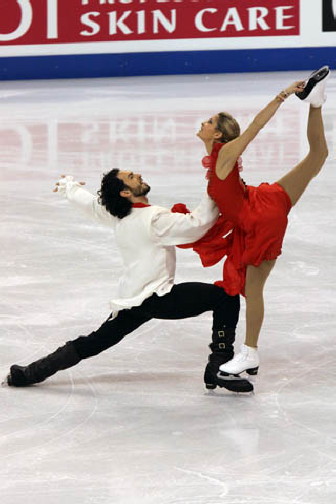
Belbin and Agosto were noted for close unison, intricate footwork, and inventive lifts that emphasized musical phrasing and clean lines rather than purely acrobatic value. Their programs often blended classical and contemporary musical selections and featured choreography designed to showcase precision and connection. Coaches, commentators, and peers frequently praised their ability to maintain technical control while delivering emotionally resonant performances.
Later career, professional work, and legacy
After reaching their competitive peaks, Belbin and Agosto reduced their presence on the top amateur circuit and appeared in professional ice shows, exhibitions, and skating events. Like many elite skaters, Belbin continued to contribute to the sport through coaching, guest appearances, and involvement in skating communities. Her career is frequently cited for its role in re-establishing the United States as a contender in international ice dance and for illustrating how partnerships, coaching decisions, and national eligibility rules can shape elite athletic trajectories.
Context and lasting influence
Belbin's trajectory highlights several broader themes in modern figure skating: the international movement of athletes in search of compatible partners and coaching, the impact of individual naturalization on Olympic competition, and the evolution of ice dance toward greater technical and choreographic integration. Her successes alongside Benjamin Agosto helped open doors for subsequent American teams and contributed to a more competitive and varied field at world events.
Further reading and source links
- Birth date reference
- Year and early records
- Kingston background
- Ontario context
- Canadian origins
- Canadian nationality details
- American nationality information
- Ice dance discipline overview
- Dual citizenship notes
- Information about Benjamin Agosto
- Montreal and early life
- Coach Igor Shpilband profile
- 2002 Winter Olympics context
- 2004 national results
- 2005 season summary
- World and Olympic medal records
- Citizenship application background
- Date of naturalization
- 2006 Winter Olympics results
Questions and answers
Q: What is Tanith Belbin's citizenship?
A: Tanith Belbin is a citizen of both Canada and the United States.
Q: Who paired Belbin and Agosto together?
A: Belbin and Agosto were paired together by their coach, Igor Shpilband.
Q: How many medals did they win at the World Junior Figure Skating Championships between 2000 and 2002?
A: At the World Junior Figure Skating Championships between 2000 and 2002, Belbin & Agosto won a medal of every color.
Q: When did they win their first national title?
A: In 2004, Belbin and Agosto won their first national title.
Q: When did they win their first World medal?
A: In 2005, Belbin and Agosto won their first World medal. This was the first World medal for the United States in ice dancing in 20 years.
Q: Why couldn't they skate for the United States at the 2002 Winter Olympics?
A: In order to skate for the United States at the 2002 Winter Olympics, both partners would need to be citizens of the United States and Belbin had not yet gotten American citizenship.
Q: How was she able to take advantage of a sped-up process so that she could compete in 2006 Olympics?
A: A special law was passed allowing her to take advantage of a sped-up process so that she could compete in 2006 Olympics.
Author
AlegsaOnline.com Tanith Belbin — career and legacy of a Canadian‑American ice dancer Leandro Alegsa
URL: https://en.alegsaonline.com/art/131587