
Bop It (electronic reaction game series)
Bop It is a line of voice‑directed electronic reaction games by Hasbro. Players follow spoken prompts to perform fast physical actions; the series includes many variants, modes and digital adaptations.
Overview
Bop It is a family of handheld and larger electronic games produced and marketed by Hasbro. Each unit issues spoken commands that require the player to make quick, often repeated physical responses. Devices combine recorded voice prompts, lights, sounds and timing to create a test of reflexes, attention and rhythm. Many versions are battery-powered and designed for solo play, cooperative rounds or party-style competition.
Image gallery
4 Images


Gameplay and mechanics
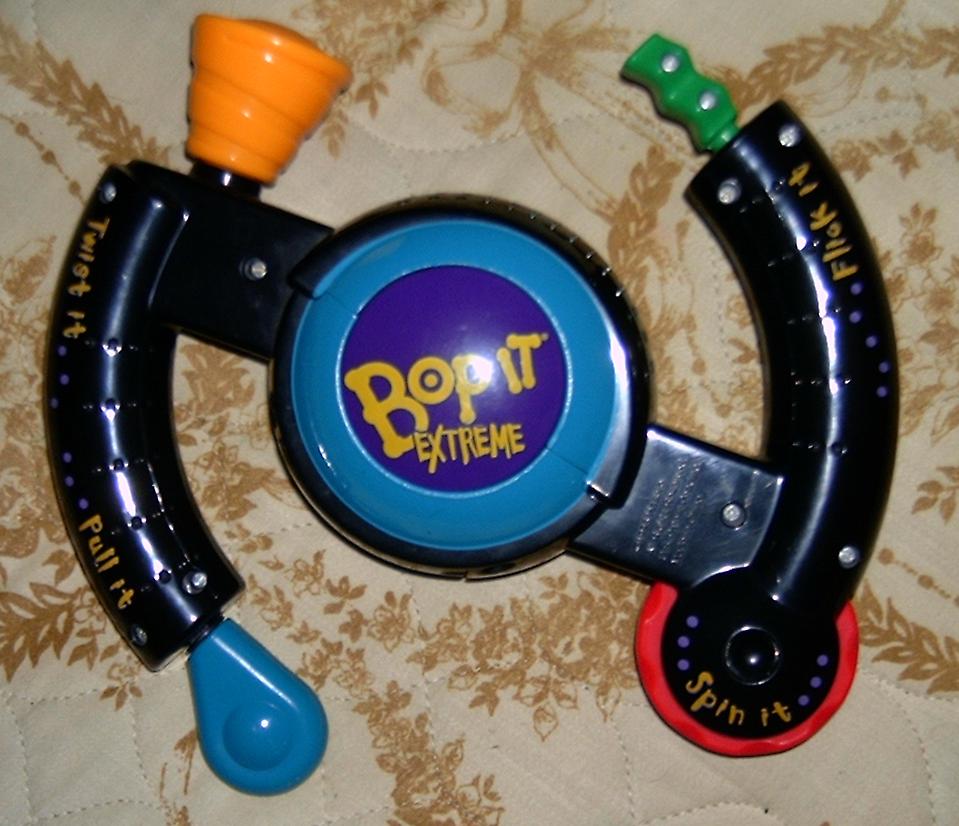
The central mechanic is voice-directed play: the device calls out a command and the player must execute the correct action before time runs out. Commands are usually short imperative phrases—examples include "Bop it," "Twist it" and "Pull it"—and are delivered in random order and increasing tempo. Missing a command or responding incorrectly typically ends the run; many models record a score and accelerate after correct responses or change difficulty through selectable modes.
- Typical commands: "Bop it" (press or hit), "Twist it" (rotate a knob), "Pull it" (tug a lever).
- Later and expanded commands: "Flick it," "Spin it," "Shake it," "Blast it," "Slide it," and others.
- Modes: solo high-score play, rhythm or music modes, memory sequences, timed challenges, and party/cooperative modes.
Design, audio and variants
Designers extended the concept by adding new controls, alternate speaker voices, musical or rhythm-based play, and larger units with many inputs. The brand produced numerous variants aimed at different audiences: compact travel models, larger family editions, music- and dance-themed variants, and licensed or branded versions. The concept also inspired many electronic games that use spoken prompts to guide physical responses or rhythm interaction.
Digital adaptations and cultural impact
Beyond physical toys, adaptations and apps that emulate the voice‑prompt mechanic have appeared on digital platforms. Bop It is often noted for its simple, immediate play loop—short input vocabulary combined with increasing speed—that makes it accessible yet challenging. The series has been used informally in party play, classroom warm-ups and coordination exercises, and it remains a recognizable example of audio-driven interactive toys in mass-market play.
Significance and longevity
Part of the franchise's appeal is its compact hardware and replayability: a small set of mechanical controls and a recorded voice produce varied, fast-paced games that encourage repeated attempts. That combination has helped the line remain present in toy catalogs and collections, with new editions and special releases appearing periodically to refresh command sets, voices and play modes.
For more information about the manufacturer and product lines, see the producer page at Hasbro or general listings of electronic games. Many consumer descriptions note that individual units are battery-powered and designed for a wide age range.
Questions and answers
Q: What is Bop It?
A: Bop It is a series of electronic battery-powered games made by Hasbro.
Q: Who makes Bop It?
A: Hasbro makes Bop It.
Q: How does one play the game?
A: The rules of the game vary depending on which version you have, but generally players must follow instructions given by the device and act quickly to complete tasks.
Q: Is there more than one version of Bop It?
A: Yes, there are several versions of Bop It available from Hasbro.
Q: Does it require batteries?
A: Yes, Bop It requires batteries in order to operate.
Q: Is it suitable for all ages?
A: Yes, most versions of Bop It are suitable for all ages although some may be better suited for older children or adults due to their complexity.
Q: Where can I buy a copy of the game?
A: You can purchase copies of the game online or at many retail stores that sell toys and games.
Related articles
Author
AlegsaOnline.com Bop It (electronic reaction game series) Leandro Alegsa
URL: https://en.alegsaonline.com/art/13056
Sources
- hasbro.com : Bop It!
- books.google.com : The Game Makers: The Story of Parker Brothers From Tiddledy Winks to Trivial Pursuit
- emarketing.net.cn : The Use of Focus Groups in Toy Testing
- v3.espacenet.com : US 6086478
- v3.espacenet.com : US 6210278 · web.archive.org
- engadget.com : "Bop It! 2016 is more complicated than you remember"
- bestofama.com : "IAmA Voice Actor: George Fortnum. Voice of Bop It!, characters in the Borderlands video game (Robot Revolution) and hundreds of radio and TV commercials. AMAA!"
- hasbro.com : hasbro.com/common/documents/87e9fbe8d56fe1124784f6d2788f8ce8/421AEB0819B9F36910B5745D91F9…
- hasbro.com : Bop It! Bounce
- hasbro.com : Bop It! XT
- clairejustineoxox.com : "Bop It Beats Game Review"
- engadget.com : "Bop It! Maker edition will get your creative juices flowing"
- youtube.com : Bop It!- Smyths Toys