
Sacagawea: Lemhi Shoshone interpreter and guide of the Lewis and Clark expedition
Sacagawea, a Lemhi Shoshone woman, accompanied the Lewis and Clark Expedition (1804–1806) as an interpreter and cultural intermediary; her presence aided negotiation, travel and the expedition's public image.
Sacagawea (c. 1788 – c. December 1812) was a Lemhi Shoshone woman best known for her role with the Lewis and Clark Expedition. She joined the Corps of Discovery and traveled with Meriwether Lewis and William Clark from the upper Missouri River to the Pacific coast between 1804 and 1806. During the journey she is widely described as an interpreter, cultural intermediary and a pragmatic symbol of peaceful intent. Her life and service are central to discussions of Native American involvement in early American exploration.
Image gallery
7 Images
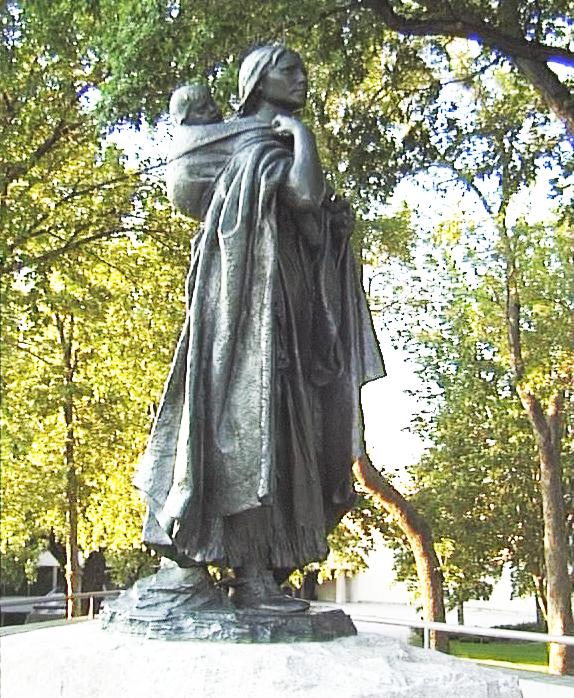


Early life
Accounts indicate Sacagawea was born among the Lemhi (Agaidika) Shoshone in territory now associated with parts of Idaho. As a young teenager she was captured in a raid and taken to Hidatsa villages on the Missouri River. There she became associated with Toussaint Charbonneau, a French-Canadian fur trader, who lived among the Hidatsa and later became her husband. In late 1804 or early 1805 she gave birth to a son, Jean Baptiste (often called "Pomp" or "Pompy"), who accompanied her on parts of the expedition and later lived for a time in St. Louis under the care of William Clark.
Role on the expedition
Lewis and Clark recruited Charbonneau in part because he and Sacagawea knew local languages and customs. Sacagawea's knowledge of Shoshone language and certain regional landscapes proved valuable when the Corps sought horses and guides. Her presence as a woman traveling with an infant also carried symbolic weight: war parties of the period rarely traveled with infants, so meeting a party with a woman and baby often signaled peaceful intentions. Historians note that while the extent of her directional guidance is debated, her contributions as interpreter, negotiator and cultural broker are well documented in expedition journals and later histories.
Contributions and notable incidents
- Interpreting between members of the expedition and Shoshone speakers during critical negotiations for horses and safe passage.
- Helping identify edible plants, resources, and safe river crossings in unfamiliar terrain.
- Serving as a living demonstration of non-hostile intent, which assisted encounters with several Native groups.
- Assisting in locating a Shoshone group whose assistance allowed the Corps to cross mountain passes and continue westward.
Later life and contested accounts
The documentary record of Sacagawea's later life is limited and has produced differing accounts. Some contemporary records note her death in late 1812 while she lived among Hidatsa or in the upper Missouri region. Other oral traditions within Shoshone communities claim she returned to her people and lived many years longer. Because primary documents are scarce and sometimes ambiguous, historians treat details of her later life with caution.
Legacy and cultural significance
Sacagawea has become an enduring symbol in American memory. Her image appears on the United States Sacagawea dollar coin (first issued in 2000) and she has been commemorated with statues, place names, schools and stamps. Her name appears in variant spellings — including Sacajawea and Sakakawea — reflecting different transliterations and tribal pronunciations. Scholars emphasize that interpretations of her role have evolved: she is remembered both for concrete contributions to the expedition and for what she came to represent in later public history.
For introductory information about the expedition and the regions traversed, see materials on the Lewis and Clark Expedition and the broader history of the western United States. To follow the route across modern geography, consult regional sources covering areas from North Dakota to the Pacific Ocean. Studying Sacagawea's life highlights the roles Indigenous people played as intermediaries and the complexities of reconstructing individual biographies from limited evidence.
Her story continues to inspire scholarship, public commemoration and discussion about representation, memory and the multiple perspectives that shape an understanding of early American exploration.
Questions and answers
Q: Who was Sacagawea?
A: Sacagawea was a Lemhi Shoshone woman who accompanied the Lewis and Clark Expedition as an interpreter and guide.
Q: What was the Lewis and Clark Expedition?
A: The Lewis and Clark Expedition was an exploration of the Western United States led by Meriwether Lewis and William Clark between 1804 and 1806.
Q: What was Sacagawea's role in the Lewis and Clark Expedition?
A: Sacagawea served as an interpreter and guide for the Lewis and Clark Expedition.
Q: Where did the Lewis and Clark Expedition travel to?
A: The Lewis and Clark Expedition traveled thousands of miles from North Dakota to the Pacific Ocean.
Q: When did Sacagawea live?
A: Sacagawea lived around the late 18th century to the early 19th century, from c. 1788 to c. December 20, 1812.
Q: What was Sacagawea's ethnicity?
A: Sacagawea was a Lemhi Shoshone woman.
Q: How long did the Lewis and Clark Expedition last?
A: The Lewis and Clark Expedition lasted for two years, from 1804 to 1806.
Author
AlegsaOnline.com Sacagawea: Lemhi Shoshone interpreter and guide of the Lewis and Clark expedition Leandro Alegsa
URL: https://en.alegsaonline.com/art/130289