
Afrovenator — Middle Jurassic African theropod
Afrovenator was a mid-Jurassic bipedal carnivorous dinosaur from northern Africa known from a largely complete skeleton; important for understanding megalosaurian theropods and Jurassic African ecosystems.
Overview
Afrovenator (name meaning "African hunter") is a genus of carnivorous dinosaur described from a nearly complete skeleton recovered in Niger. It lived during the Jurassic period and is best known from a single well-preserved specimen that has informed much of what we know about mid-Jurassic theropods in Africa. The animal is interpreted as a bipedal predator with blade-like teeth and a body plan typical of medium-to-large meat-eating dinosaurs such as the theropod group.
Image gallery
10 Images


Physical characteristics
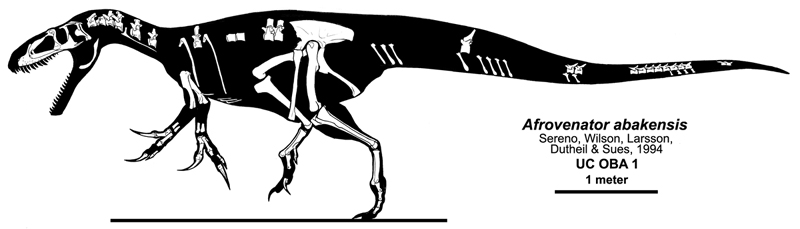
Afrovenator shows the anatomy expected of an active predator: long hind limbs for running, grasping forelimbs, a long tail for balance, and serrated, laterally compressed teeth suitable for slicing flesh. The species most commonly associated with the genus is Afrovenator abakensis. Size estimates based on the skeleton place it as a medium-sized theropod, often reported at roughly several metres in length, though precise figures can vary with different interpretations of the material.
Discovery and geological context
The nearly complete specimen was discovered in 1993 near Abaka in what is now northern Niger. The find was notable because relatively complete dinosaur skeletons are rare in African deposits; this specimen remains one of the most complete theropod fossils from the continent. Early reports of the strata were updated after study of the rock layers, and the age of the fossil-bearing units has been described as mid-Jurassic rather than previously suggested ages. The locality lies within the broader region of the Abaka, Niger area and the specimen was recovered from rocks outcropping in the southern Sahara desert region.
Classification and relationships
Afrovenator is usually placed among the megalosaurian lineages of theropods, a group sometimes referred to informally as the Megalosaurs. Its exact placement has been refined as new fossils and analyses have appeared; some studies consider it part of Megalosauridae or the broader Megalosauroidea, while others treat its relationships with caution because of changes in theropod phylogeny. The animal is unambiguously a dinosaur and a member of the carnivorous clade of saurischians that dominated many Jurassic ecosystems. The fossils come from strata now correlated with the Middle Jurassic interval, which helps place Afrovenator in time and compare it with contemporaneous taxa elsewhere.
Significance and paleoecology
The Afrovenator specimen contributes important information about predator diversity and distribution in Jurassic Africa. Because the skeleton is relatively complete, it has been used to study limb proportions, skull structure, and feeding adaptations among early tetanuran theropods. Paleoecological reconstructions suggest Afrovenator inhabited semi-arid to seasonal environments that supported a range of vertebrates; as an active predator it would have been a key component of local food webs. Comparative study helps paleontologists understand how megalosaurian theropods evolved and dispersed between landmasses.
Notable facts and further reading
- Holotype locality: near Abaka, Niger, in deposits reinterpreted as mid-Jurassic in age.
- Significance: one of the most complete African theropod skeletons known, important for reconstructing Jurassic African faunas.
- Biogeography: provides evidence for the presence of megalosaur-related theropods in Gondwanan landmasses during the Jurassic era, complementing finds from other regions of Africa and beyond.
For summaries and taxonomic overviews, consult specialist sources and paleontological reviews that discuss Jurassic theropod diversity and megalosaurian relationships (theropod resources, dinosaur databases, and regional geological summaries at Middle Jurassic references). Additional locality-based information and geologic background can be found in compilations covering the Sahara desert fossil localities and Niger's paleontological record. For taxonomy and clade discussions see materials concerning the Megalosaurs.
Questions and answers
Q: What is Afrovenator?
A: Afrovenator is a theropod dinosaur from the Middle Jurassic of northern Africa.
Q: What kind of predator was it?
A: It was a bipedal meat-eating predator with long bladelike teeth.
Q: Where were the fossils of Afrovenator found?
A: The fossils of Afrovenator were found in Abaka, Niger in the southern Sahara desert.
Q: When was a nearly complete Afrovenator found?
A: A nearly complete Afrovenator was found in 1993.
Q: What is the significance of the discovery of Afrovenator?
A: The discovery of Afrovenator is significant because it is one of the most complete dinosaurs found in Africa so far.
Q: What group of theropods is Afrovenator a part of?
A: Afrovenator is in a group of theropods which are known as the Megalosaurs.
Q: When were the rocks where Afrovenator was found redescribed?
A: The rocks where Afrovenator was found were redescribed as "mid-Jurassic" after the discovery had been announced.
Related articles
Author
AlegsaOnline.com Afrovenator — Middle Jurassic African theropod Leandro Alegsa
URL: https://en.alegsaonline.com/art/1302
Sources
- species.wikimedia.org : Afrovenator