
Afrotheria: the African-rooted clade of placental mammals
Afrotheria is a clade of placental mammals with African origins, united by molecular evidence. It includes elephants, manatees, hyraxes, aardvarks, elephant shrews, tenrecs and golden moles and informs mammal evolution.
The term Afrotheria denotes a clade of placental mammals that share a common ancestry traced back to Africa. The grouping was established mainly on the basis of molecular data rather than obvious external similarity, and it brings together a diverse set of animals that include tiny, insectivorous forms as well as very large herbivores. For an overview of the group and its members see Afrotheria (overview).
Image gallery
10 Images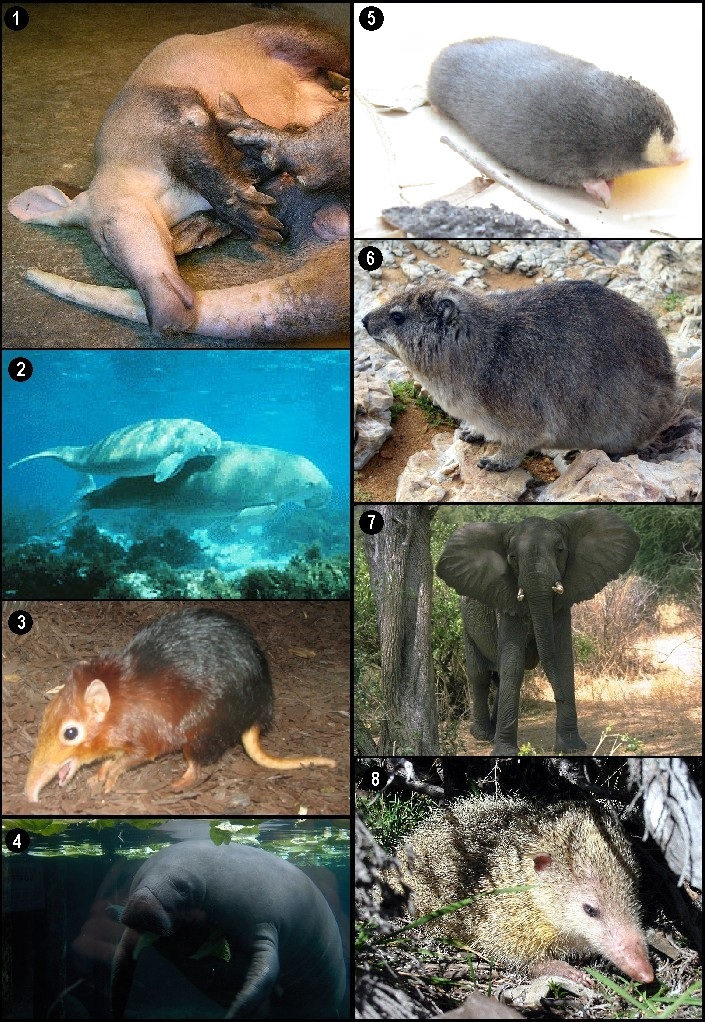


Members and distinguishing features
Major lineages traditionally placed in Afrotheria include the golden moles (golden moles), elephant shrews or sengis (elephant shrews), tenrecs (tenrecs), the aardvark (aardvark), hyraxes, elephants (elephants) and the sea cows or manatees (manatees). Morphologically these animals vary widely: some are small, nocturnal insectivores with reduced eyes, while others are large, long-lived herbivores with complex social systems. What unites them is shared ancestry revealed by genetic comparisons rather than a single obvious physical trait.
Evidence and origins
The concept of Afrotheria arose when analyses of DNA and related molecular markers showed consistent relationships among these orders. Early studies of nuclear and mitochondrial DNA and subsequent sequence analyses supported a clade that contrasted with other placental groups. Afrotheres are one of the principal components of the placental mammals, the Eutheria, and the name reflects their likely geographic origin: "Afro" for Africa and "theria" for mammals.
Phylogenetic context and ongoing research
More recent genomic studies have refined relationships at the base of the placental tree and suggest that Afrotheria may be sister to Xenarthra, the South American group containing sloths, anteaters and armadillos, implying an early split among placental mammals during the initial phases of the placental mammal radiation. Whole-genome and multi-locus genomics continue to improve resolution, but some internal relationships within Afrotheria remain debated and subject to additional sampling and analysis.
Importance and notable facts
Afrotheria illustrates how molecular methods can reveal deep evolutionary relationships that are not obvious from anatomy alone. The group contains striking convergences: for example, the aquatic manatees demonstrate adaptations to marine life that are very different from their terrestrial relatives, while small insectivorous afrotheres evolved features similar to unrelated insectivores elsewhere. Comparative studies of afrotheres therefore contribute to understanding of continental biogeography, adaptive evolution and mammalian diversification.
Representative orders
- Macroscelidea: the elephant shrews or sengis (elephant shrews).
- Afrosoricida: tenrecs and golden moles (tenrecs, golden moles).
- Tubulidentata: the aardvark (aardvark).
- Hyracoidea, Proboscidea, Sirenia: hyraxes, elephants (elephants) and manatees (manatees).
For detailed genetic and fossil evidence consult specialized sources and databases linked here: DNA studies, sequence analyses, genomic syntheses at genomics resources and broader context in the placental mammal literature (Eutheria, radiation, Xenarthra). Further reading on biogeographic origins is available via regional and paleontological reviews (Africa).
Questions and answers
Q: What is Afrotheria?
A: Afrotheria is a group of mammals, including elephant shrews, tenrecs, aardvarks, hyraxes, elephants, manatees, and golden moles.
Q: How did biologists identify the Afrotheria group?
A: Biologists identified the Afrotheria group based on DNA sequence analysis.
Q: What is the meaning of Afrotheria?
A: The term Afrotheria means "African animals", with "afro" referring to Africa and "theria" meaning animals.
Q: What are the four major groups in the Eutheria?
A: The four major groups in the Eutheria are placental mammals.
Q: What is the recent genomic study on Afrotheria and Xenarthra?
A: Recent genomics has suggested that Afrotheria and Xenarthra are sister taxa at the base of the placental mammal radiation.
Q: Who seem to be related according to recent findings on Afrotheria?
A: According to recent findings, manatees and elephants seem to be related, as well as aardvarks and elephant shrews.
Q: What is still being studied about Afrotheria?
A: The relations between the various afrotherian orders are still being studied.
Tags
Related articles
Author
AlegsaOnline.com Afrotheria: the African-rooted clade of placental mammals Leandro Alegsa
URL: https://en.alegsaonline.com/art/1300
Sources
- species.wikimedia.org : Afrotheria
- pnas.org : pnas.org/content/95/17/9967
- afrotheria.net : "Afrosoricida"
- plosone.org : plosone.org/article/info:doi/10.1371/journal.pone.0089739
- biomedcentral.com : "A new estimate of afrotherian phylogeny based on simultaneous analysis of genomic, morphological, and fossil evidence"
- doi.org : 10.1186/1471-2148-7-224
- ncbi.nlm.nih.gov : 2248600
- pubmed.ncbi.nlm.nih.gov : 17999766