
Richard Thaler: Pioneer of Behavioral Economics and Nobel Laureate
American economist Richard H. Thaler, a leading figure in behavioral economics, is known for work on mental accounting, the endowment effect, and popularizing the concept of 'nudge'. He won the 2017 Nobel Prize.
Overview
Richard H. Thaler (born September 12, 1945) is an American economist recognized for integrating psychological insights into economic theory. He helped show how systematic departures from purely rational choice affect markets, savings, and everyday decision making. For more on his career and public profile see additional information.
Image gallery
4 Images


Key contributions
Thaler introduced and developed several concepts that have become central to behavioral economics. He explored how people mentally organize money and choices (often called mental accounting), documented how ownership changes perceived value (the endowment effect), and described internal conflicts between long‑run planners and short‑run doers. Together with collaborators he also promoted the idea of libertarian paternalism, which supports designing choices to nudge people toward better outcomes without eliminating freedom of choice.
Career and development
Thaler spent decades combining empirical observation, laboratory experiments, and theoretical modeling to demonstrate where traditional economic assumptions fail and how theories can be adjusted. He has been a prominent figure at a major U.S. business school and has taught generations of students about the impact of human behavior on finance and policy.
Major works and public influence
Thaler is the author and co‑author of books and papers intended both for specialists and a wider audience. His 2008 book co‑written with Cass Sunstein popularized the concept of the nudge and influenced policymakers and organizations that apply behavioral ideas to increase retirement savings, improve public health campaigns, and simplify forms and choices. His 2015 book recounts the emergence of behavioral economics and its challenges to standard theory.
Recognition and legacy
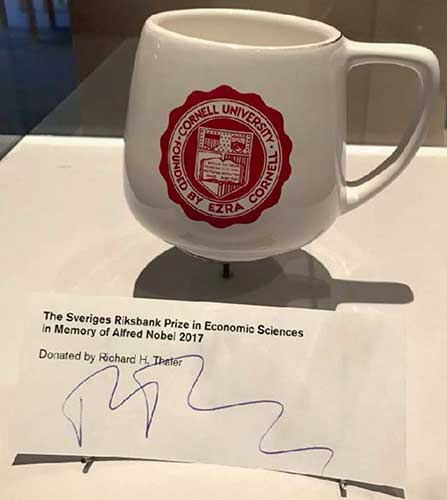
In 2017 Thaler received the Nobel Prize in Economic Sciences for his contributions to behavioral economics, a milestone that highlighted the field's maturation and practical relevance (Nobel citation). His work continues to shape research agendas, public policy teams, and business practices that account for human biases and heuristics.
Notable facts
- Thaler's research emphasizes testable anomalies and real‑world behavior rather than abstract perfection of rational choice.
- His ideas spurred the formation of teams and units within governments and organizations that apply behavioral insights to policy design and implementation.
- He is widely cited for making economics more empirically grounded and accessible to non‑specialists.
Author
AlegsaOnline.com Richard Thaler: Pioneer of Behavioral Economics and Nobel Laureate Leandro Alegsa
URL: https://en.alegsaonline.com/art/129559