
Pocahontas: her life, encounters with Jamestown, and legacy
Pocahontas (c.1595–1617), daughter of Powhatan, is known for contacts with Jamestown colonists, a contested rescue tale of John Smith, her capture and conversion, marriage to John Rolfe, and her trip to England.
Pocahontas (born c. 1595; buried 21 March 1617) was a Native American woman associated with the leadership of the Powhatan peoples in what is now eastern Virginia. She is best known in popular history for her early contacts with English colonists who established the Jamestown settlement on the James River. Over the course of her life she moved between Indigenous and English worlds and became a focal point for later stories, art, and historical debate.
Image gallery
10 Images
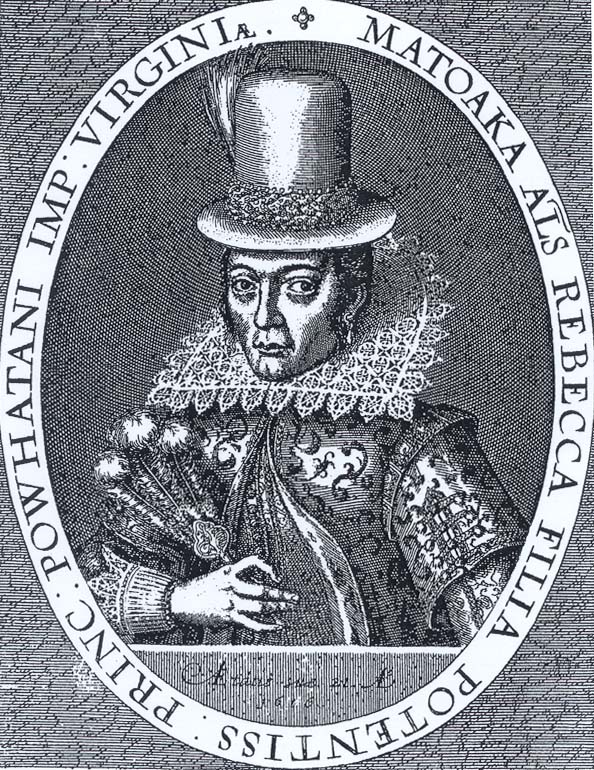


Early life and role
Pocahontas was a daughter of Wahunsenacawh, commonly called Powhatan, the leader of a network of tribes and villages often referred to as the Powhatan chiefdom. As a young woman she appears in English records as an intermediary who helped maintain relations between the colonists and local Indigenous communities. The famous account that she saved the life of John Smith when he was supposedly about to be executed by Powhatan became a central story of her legend; historians note that contemporary accounts and later retellings differ and that the event has been interpreted in multiple ways.
Capture, conversion, and marriage
During renewed armed conflict between colonists and Indigenous groups Pocahontas was taken captive by the English and held for a time as a hostage and bargaining figure (ransom and captivity). While in English custody she was instructed in Christian teachings, was baptized with the name Rebecca, and learned to speak and read some English. In 1614 she married the tobacco planter John Rolfe, a union that helped produce a period of relative peace between the settlers and many of Powhatan’s communities. Rolfe and Pocahontas had a son, Thomas, who was raised partly in the English colonial milieu; the tobacco crop that underpinned much colonial Virginia’s economy is often associated with Rolfe (tobacco).
Visit to England and death
In 1616 Pocahontas, Rolfe, and their young son traveled to London where she was presented to English society and court circles. Accounts from the voyage and from English observers describe her as attracting considerable public attention; she was sometimes portrayed as a living example of the possibility of converting Indigenous peoples and of Anglo-Indigenous amity. Soon after the family prepared to return to Virginia, Pocahontas became ill and died at Gravesend in March 1617. She was buried in England, and her death ended a short but historically resonant life.
Legacy, interpretation, and notable facts
Pocahontas’s story has been retold in many forms: as a heroic rescue, as a diplomatic marriage, and as a symbol used for differing political or cultural agendas. Scholars emphasize that popular versions, especially those created centuries later, often simplify or romanticize complex relationships among Indigenous peoples and English settlers. Important distinctions in modern accounts include separating documented events from later legend and recognizing Pocahontas’s role in cross-cultural contact rather than reducing her to a single anecdote.
- Historical records place her birth around 1595 and her burial on 21 March 1617.
- Her marriage to John Rolfe in 1614 briefly influenced peace between many Virginia groups and the colony.
- The celebrated rescue of John Smith is contested by historians and appears in varying versions.
- Pocahontas’s visit to London made her a notable figure in England and increased awareness of events in Virginia among Europeans.
For further reading, consider sources that distinguish primary colonial records from later narratives and that place Pocahontas within the broader history of the Indigenous peoples of the Chesapeake region and early English colonization. Additional contextual material may be found through regional histories and specialist studies of the Powhatan communities and the early Virginia colony (Virginia Native peoples, Jamestown settlement).
Questions and answers
Q: Who was Pocahontas?
A: Pocahontas was a Native American who maintained relations between the Indians of Virginia and the colonists who built a fort and settlement on the James River called Jamestown in 1607.
Q: What legend is associated with Pocahontas and John Smith?
A: Legend says she saved John Smith's life when her father, Powhatan, was about to kill him.
Q: What happened to Pocahontas during a war with the Indians?
A: During a war with the Indians, she was captured and held for ransom.
Q: What was Pocahontas' English name?
A: She was baptized Rebecca and improved her English language skills during captivity.
Q: Whom did Pocahontas marry and what event took place in 1616?
A: In 1614 she married tobacco planter John Rolfe, and in 1616 the family went to London.
Q: How did Pocahontas become a celebrity in London?
A: Pocahontas became a celebrity after arriving in London with her husband and son.
Q: When and where did Pocahontas die?
A: Pocahontas died at Gravesend and was buried in England on 21 March 1617.
Author
AlegsaOnline.com Pocahontas: her life, encounters with Jamestown, and legacy Leandro Alegsa
URL: https://en.alegsaonline.com/art/128814