
Bone Wars: The Cope–Marsh rivalry and its impact on paleontology
Late-19th-century feud between Edward Drinker Cope and Othniel Charles Marsh that transformed fossil hunting, produced many dinosaur discoveries, and left a mixed legacy of scientific progress and misconduct.
Overview
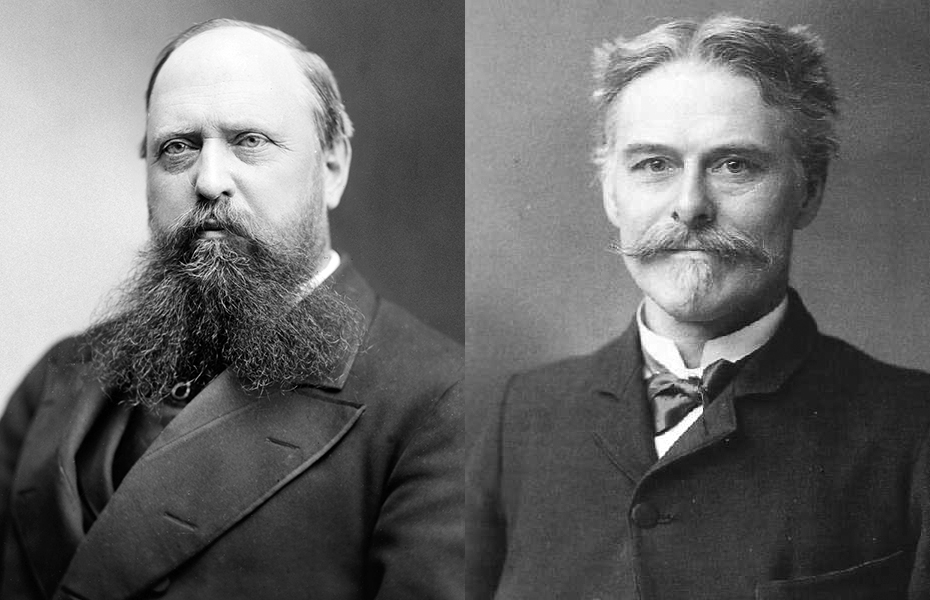
The term "Bone Wars" describes a bitter and productive period of vertebrate fossil collecting and scientific rivalry in the United States during the late 19th century. Most activity occurred between roughly 1877 and 1892 in the fossil-rich badlands and sedimentary formations of the American West, including areas of Colorado, Nebraska, and Wyoming. The conflict chiefly involved two leading paleontologists, Edward Drinker Cope and Othniel Charles Marsh, who represented competing institutions and different professional networks.
Image gallery
8 Images





Key figures and institutions
Cope was connected with the Academy of Natural Sciences in Philadelphia, while Marsh worked through the newly established Peabody Museum of Natural History at Yale. Both men sought fame and scientific priority: their public disputes and private campaigns involved hiring field collectors and building large comparative collections. The rivalry has been widely discussed as an example of how personal ambition and institutional competition shaped early scientific practice in the United States.
Rival methods and misconduct
Although the work of both men produced important specimens and descriptions, the Bone Wars are also remembered for unethical behavior. Historical accounts record episodes of bribery, theft of field finds, and deliberate damage to exposed bones to deny them to rivals. The rush to secure and name specimens sometimes came at the expense of careful excavation, stratigraphic documentation, or thorough description. At the same time, the intense competition drove unprecedented field activity and a rapid increase in museum holdings.
Discoveries and scientific output
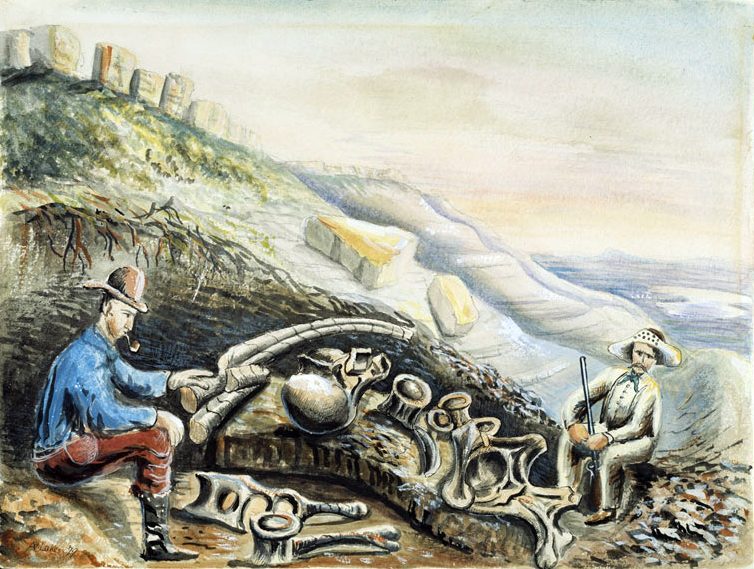
Collecting expeditions and the teams working for Cope and Marsh returned vast quantities of material to eastern institutions. Their combined efforts resulted in the description of many new taxa; contemporary tallies often cite some 142 new species attributed to the era, many classed as dinosaurs. Subsequent taxonomic revision has shown that many names were redundant or invalid, and a smaller number are retained as valid today. Nevertheless, the specimens, illustrations, and comparative work produced an essential foundation for later research in paleontology. Their search for fossils took them across the western United States, where they exposed and collected from rich "bone beds" that remain scientifically important.
Sites and geology
Some localities first exploited during the Bone Wars are still among the best known for Late Jurassic and Cretaceous vertebrates. The Morrison Formation, exposed at places such as Como Bluff, became a primary source of large Jurassic dinosaur fossils and extends across many western states. Work in these formations contributed to a broader mapping of fossil-bearing strata and spurred later regional geological and paleontological field programs across North America.
Personal and professional consequences
By the end of the confrontation both Cope and Marsh had suffered financial loss and reputational damage; their conflict exhausted funds and diverted attention from collaborative science. Still, their legacy is mixed: despite the personal costs and procedural flaws, the volume of material they collected allowed museums and later scientists to study vertebrate evolution in far greater detail than before.
Legacy, reassessment, and lessons
Modern paleontology has taken practical and ethical lessons from the Bone Wars era. Present-day fieldwork emphasizes careful stratigraphic control, conservation, lawful collecting, and open scientific collaboration. Collections assembled during the Bone Wars continue to be reexamined with contemporary methods, yielding new insights from old specimens. Popular interest in dinosaurs, helped by dramatic discoveries and museum displays originating in that period, also contributed to long-term public support for natural history institutions.
Further context
Readers seeking more detail can consult biographies of Cope and Marsh, institutional histories of the Academy of Natural Sciences and the Peabody Museum, and regional studies of fossil sites in Colorado, Nebraska, and Wyoming. Scholarly reviews of the period place its scientific advances in the context of the evolving norms of research ethics and museum practice; these assessments draw on archival letters, field notes, and the very collections the Bone Wars helped create.
For introductions to the era and its outcomes, historians and popular authors have documented how rapid discovery, institutional rivalry, and human fallibility combined to shape a formative chapter in the history of American science.
Questions and answers
Q: What was the Bone Wars?
A: The Bone Wars was a period of fossil finding and discovery in the U.S.A during the late 19th century, characterized by a heated rivalry between Edward Drinker Cope and Othniel Charles Marsh. They used bribery, theft, and destruction of bones as they sought to discredit each other's work and ruin their credibility.
Q: Where did most of the action take place?
A: Most of the action took place in Colorado, Nebraska, and Wyoming.
Q: Who were Edward Drinker Cope and Othniel Charles Marsh?
A: Edward Drinker Cope was from the Academy of Natural Sciences in Philadelphia, while Othniel Charles Marsh was from the Peabody Museum of Natural History at Yale. Both paleontologists used their wealth and influence to fund their own expeditions for dinosaur bones from fossil hunters.
Q: How many species of dinosaurs were discovered during this time?
A: 142 new species of dinosaurs were discovered during this time, though today only 32 are valid names.
Q: What effect did it have on public interest in dinosaurs?
A: The products of the Bone Wars increased our knowledge of prehistoric life, sparking public interest in dinosaurs which led to more fossil excavation in North America in subsequent decades.
Q: What is the Morrison Formation?
A: The Morrison Formation is one of several famous fossil sites discovered by Cope and Marsh during this period located at Como Bluff, Wyoming that extends into 13 states which is still being searched wherever it outcrops onto the surface.
Related articles
Author
AlegsaOnline.com Bone Wars: The Cope–Marsh rivalry and its impact on paleontology Leandro Alegsa
URL: https://en.alegsaonline.com/art/12877