
Phillip A. Sharp — Nobel-winning molecular biologist and RNA splicing pioneer
Biography and contributions of Phillip A. Sharp (born 1944), American geneticist who co-discovered RNA splicing and advanced understanding of gene structure and alternative protein production.
Overview
Phillip Allen Sharp (born June 6, 1944) is an American geneticist and molecular biologist who played a central role in reshaping how scientists understand eukaryotic genes and RNA processing. He is widely known for co-discovering that genes in higher organisms are interrupted by noncoding segments and that pre-messenger RNA can be processed in different ways to produce diverse proteins from the same DNA template. Sharp's work was recognized with the 1993 Nobel Prize in Physiology or Medicine, shared with Richard Roberts.
Image gallery
4 Images


Scientific contributions
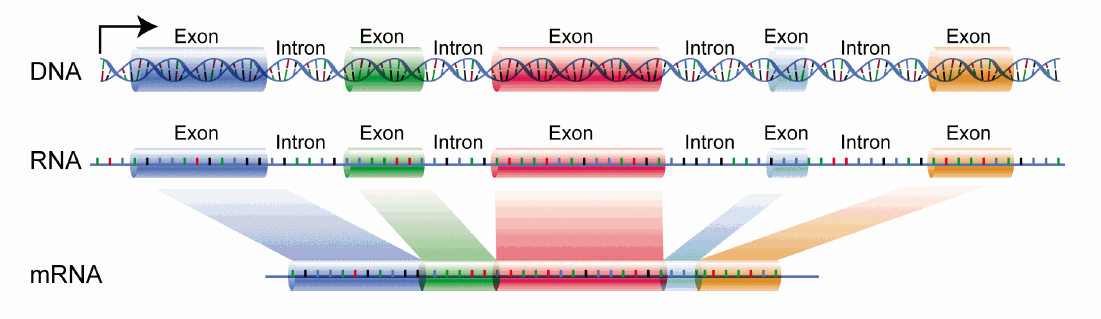
The key finding associated with Sharp is the demonstration that eukaryotic genetic information is not a single uninterrupted string: coding regions (exons) are separated by intervening sequences (introns), which are removed by a process called RNA splicing. This discovery clarified how one gene can give rise to multiple protein products through alternative splicing, a mechanism that increases proteomic complexity without requiring more genes. His papers and laboratory studies helped establish the biochemical steps of splicing and connected these events to regulation of gene expression and cellular function.
Education and career
Sharp was born in Falmouth, Kentucky. He earned a Ph.D. in chemistry from the University of Illinois at Urbana-Champaign in 1969 and undertook postdoctoral research at the California Institute of Technology, where he studied plasmids and early molecular genetics. He later worked at Cold Spring Harbor Laboratory on gene expression in human cells. In 1974 he joined the faculty at the Massachusetts Institute of Technology after being recruited by Salvador Luria. At MIT he held leadership roles including director of the Center for Cancer Research (now part of the Koch Institute), head of the Department of Biology, and director of the McGovern Institute for Brain Research.
Positions and roles
- Recruited to MIT by Salvador Luria
- Director, MIT Center for Cancer Research (1985–1991)
- Head, MIT Biology Department (1991–1999)
- Director, McGovern Institute for Brain Research (2000–2004)
Recognition and impact
Sharp's discovery changed molecular biology and biotechnology by revealing fundamental principles of gene architecture and RNA processing, influencing research in genetics, developmental biology and medicine. For this work he and Richard Roberts were awarded the Nobel Prize in 1993, cited for showing that genes in eukaryotes contain introns and that splicing produces different proteins from the same DNA sequence. His career bridged fundamental discovery, mentorship of new scientists, and institutional leadership that fostered interdisciplinary research.
Further reading and context
For introductions to related topics, see entries on genetics, molecular biology, and overviews of RNA splicing. Historical and technical discussions of his early laboratory work mention studies on plasmids and subsequent investigations into gene expression. Biographical notes often cite his Kentucky origins (Falmouth) and his postdoctoral affiliation at Caltech.
The influence of Sharp's findings extends into clinical research and biotechnology, where understanding of splicing pathways informs studies of genetic disease, cancer biology and therapeutic approaches that target RNA processing. Scholars continue to study alternative splicing as a major source of biological diversity and regulatory control in eukaryotic organisms.
Questions and answers
Q: What is Phillip Allen Sharp known for?
A: Phillip Allen Sharp is an American geneticist and molecular biologist who co-discovered gene splicing, and shared the 1993 Nobel Prize in Physiology or Medicine with Richard Roberts for "the discovery that genes in eukaryotes are not contiguous strings but contain introns, and that the splicing of pre-messenger RNA to delete those introns can occur in different ways, yielding different proteins from the same DNA sequence".
Q: Where was Phillip Allen Sharp born?
A: Phillip Allen Sharp was born in Falmouth, Kentucky.
Q: When did he complete his PhD?
A: He completed his PhD in chemistry at the University of Illinois at Urbana-Champaign in 1969.
Q: What research did he do after completing his PhD?
A: After completing his PhD he worked at the California Institute of Technology until 1971, where he studied plasmids and, later, gene expression in human cells at the Cold Spring Harbor Laboratory under James Watson.
Q: How did he end up at MIT?
A: In 1974 he was offered a position at MIT by biologist Salvador Luria.
Q: What positions has Philip held at MIT?
A: He was director of MIT's Center for Cancer Research (now the Koch Institute for Integrative Cancer Research) from 1985 to 1991; head of the Biology department from 1991 to 1999; and director of the McGovern Institute for Brain Research from 2000 to 2004.
Author
AlegsaOnline.com Phillip A. Sharp — Nobel-winning molecular biologist and RNA splicing pioneer Leandro Alegsa
URL: https://en.alegsaonline.com/art/128692