
Bombyliidae (bee flies): biology, life cycle, and ecological role
Bombyliidae, or bee flies, are a diverse family of nectar‑feeding, often bee‑mimicking flies. Adults pollinate flowers; larvae are commonly parasitoids. Many species and life histories remain poorly known.
Overview
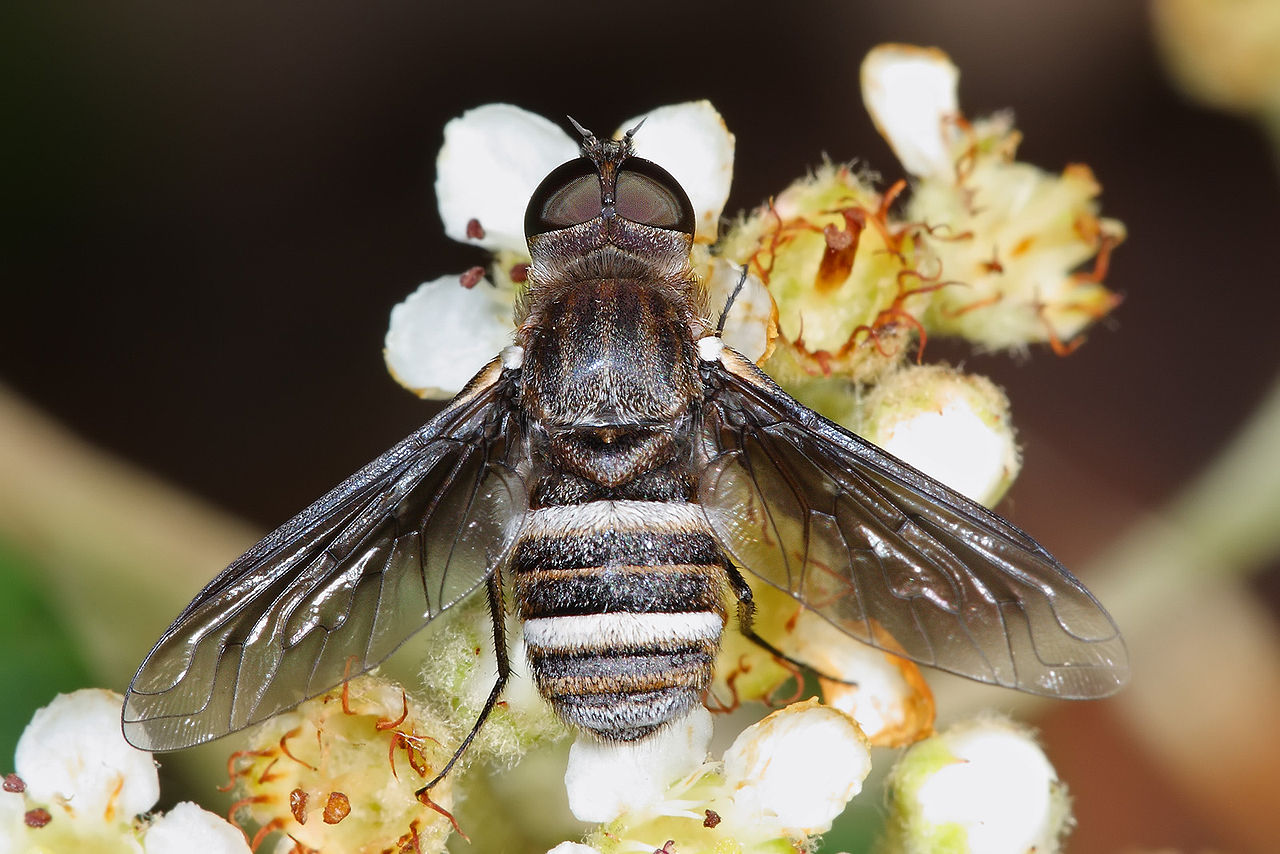
The Bombyliidae are a widespread family of true flies (order Diptera) commonly called bee flies. They are notable for their often hairy bodies and bee‑like appearance, which can mimic bees and wasps. The family contains many genera and species; estimates place the number of described species in the thousands and suggest still more await discovery. For general identification and common names see bee flies and for lists of genera consult genera lists.
Image gallery
10 Images




Physical characteristics
Bombyliids vary in size from very small to relatively large for flies. Common features include a dense covering of hairs or scales, a robust body, and wings often held outstretched at rest. Many species have a long, forward‑projecting proboscis suited to reaching nectar in tubular flowers; classic examples of proboscis specialization are discussed at proboscis adaptations. Adults typically feed on nectar and pollen, a behavior outlined at nectar feeding and pollen feeding.
Life cycle and behavior
Life histories of many bombyliids are incompletely documented and remain an active area of research (life cycles). In well‑studied cases the larvae are parasitoids or predators of other insects, especially solitary bees, wasps, beetles and butterfly or moth larvae. Female bee flies often lay eggs close to the nests or activity sites of hosts, and some species exhibit remarkable behaviors such as flicking eggs toward host burrows. Adults are frequently seen hovering while probing flowers with their proboscis, a motion that aids both feeding and pollination.
Ecology and importance
Bombyliids play dual ecological roles: as adult pollinators and as larval regulators of other insect populations. Their visits to flowers can transfer pollen between plants, and species with very long proboscises are associated with flowers that have long corolla tubes. Because many species are active in arid and semi‑arid habitats, they can be important pollinators in environments where bees are less active. For more on their ecological roles see nectar feeding and studies summarized at research overview.
Taxonomy, distribution and research
Bombyliidae are globally distributed, with highest diversity in dry, sunny regions where many adults are conspicuous on flowers. Taxonomic work has described several thousand species, but experts note that many taxa remain undescribed and that relationships within the family are complex. For a snapshot of described diversity and species information consult species lists.
Notable facts and distinctions
- Common name: "bee flies" because of their resemblance to bees and their pollinating habits — see bee flies.
- Adult diet: primarily nectar and pollen, contributing to pollination (nectar feeding, pollen feeding).
- Larval ecology: many are parasitoids of other insects; details are often poorly known (life cycles).
- Research gap: despite their diversity and ecological roles, Bombyliidae remain one of the less thoroughly documented fly families (research overview).
For further reading and species accounts, authoritative catalogues and regional keys are recommended; online resources and museum collections provide genus‑level listings and images (genera lists, species lists).
Questions and answers
Q: What is the common name for the Bombyliidae family of flies?
A: The common name for the Bombyliidae family of flies is bee flies.
Q: How many genera are there in the Bombyliidae family of flies?
A: The Bombyliidae family of flies has hundreds of genera.
Q: Are the life cycles of most species from the Bombyliidae family of flies well known?
A: No, the life cycles of most species from the Bombyliidae family of flies are known poorly, or not at all.
Q: What is the size range of bee flies?
A: Bee flies can range in size from very small at 2 mm in length to very large for flies with a wingspan of up to 40 mm.
Q: What do adult bee flies normally feed on?
A: Adult bee flies normally feed on nectar and pollen.
Q: Which plants do bee flies with a long proboscis prefer to feed on?
A: Bee flies with a long proboscis are adapted to plants, such as Lapeirousia, which have long, narrow floral tubes.
Q: Approximately how many species of Bombyliidae flies have been described?
A: There are at least 4,500 described species within the Bombyliidae family of flies, and there are likely thousands still to be described.
Related articles
Author
AlegsaOnline.com Bombyliidae (bee flies): biology, life cycle, and ecological role Leandro Alegsa
URL: https://en.alegsaonline.com/art/12834
Sources
- archive.org : archive.org/details/beefliesofworl2861973hull