
Paul J. Flory — Pioneer in Polymer Chemistry
Paul J. Flory (1910–1985) was an American chemist whose theoretical and experimental work on polymers earned him the 1974 Nobel Prize in Chemistry. He shaped modern understanding of macromolecular behavior.
Paul John Flory (June 19, 1910 – September 9, 1985) was an American chemist and Nobel laureate noted for establishing the theoretical foundations of polymer science. His research combined statistical mechanics and careful experiments to explain how long-chain molecules behave in solution, in bulk, and at interfaces. In 1974 he received the Nobel Prize in Chemistry "for his fundamental achievements, both theoretical and experimental, in the physical chemistry of macromolecules."
Image gallery
2 Images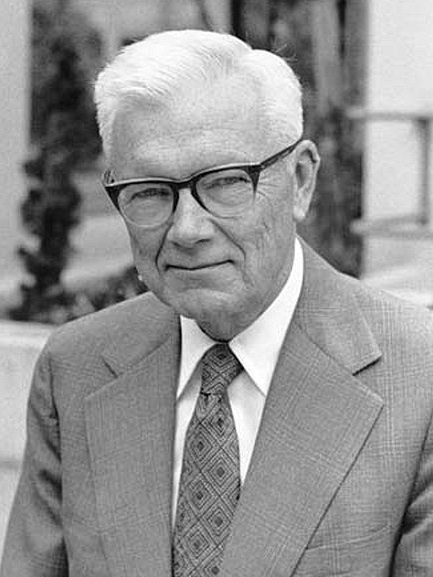

Major contributions
Flory developed a set of concepts and quantitative relations that remain central to polymer chemistry and physics. Key ideas associated with his work include:
- Chain dimensions and the Flory radius: scaling laws to predict the average size of a polymer coil in different solvents.
- Excluded volume and the Flory exponent: the notion that segments of a polymer cannot occupy the same space, altering chain statistics compared with ideal chains.
- Flory–Huggins solution theory: a mean-field model for polymer-solvent mixing that explains phase behavior and miscibility of macromolecules.
- Theta conditions: concepts describing solvent conditions where a polymer behaves approximately like an ideal chain.
Approach and methods
Flory is widely admired for uniting abstract theoretical reasoning with experimentally testable predictions. He used mathematical models from statistical physics and then compared them with measurements of viscosity, light scattering, and osmotic pressure to verify assumptions about chain conformation and interactions. His style emphasized physical intuition and simple, broadly applicable results rather than purely formal complexity.
Impact and applications
The frameworks Flory introduced underpin practical work across materials science and chemistry. Understanding polymer solution behavior and phase separation informs the design and processing of plastics, rubbers, fibers, adhesives and coatings, and contributes to fields as diverse as drug delivery and biopolymer research. His ideas continue to guide numerical simulations and experimental design in soft-matter science.
Legacy and further reading
Flory helped transform the study of long-chain molecules into a quantitative science. He trained students, published influential textbooks and papers, and received numerous honors in addition to the Nobel Prize. For concise overviews and archival material see general biographies and collections of his papers: consult library guides and dedicated summaries such as introductory profiles, specialized entries on macromolecules, and prize citations or historical commentaries at award archives.
Notable fact: many terms used in polymer science today—Flory exponent, Flory radius, Flory–Huggins parameter—reflect his lasting influence on how chemists and physicists describe macromolecular matter.
Questions and answers
Q: Who was Paul Flory?
A: Paul John Flory was an American chemist and Nobel laureate who worked in the field of polymers, or macromolecules.
Q: What was Paul Flory's area of expertise?
A: Paul Flory's area of expertise was the field of polymers, or macromolecules.
Q: What did Paul Flory pioneer?
A: Paul Flory was a leading pioneer in understanding how polymers dissolve in solutions.
Q: What did Paul Flory win the Nobel Prize in Chemistry for?
A: Paul Flory won the Nobel Prize in Chemistry in 1974 "for his fundamental achievements, both theoretical and experimental, in the physical chemistry of macromolecules."
Q: When was Paul Flory born and when did he pass away?
A: Paul Flory was born on June 19, 1910 and passed away on September 9, 1985.
Q: Why did Paul Flory win the Nobel Prize in Chemistry?
A: Paul Flory won the Nobel Prize in Chemistry for his fundamental achievements, both theoretical and experimental, in the physical chemistry of macromolecules.
Q: How did Paul Flory contribute to the field of polymers?
A: Paul Flory was a leading pioneer in understanding how polymers dissolve in solutions, making significant contributions to the field of polymers.
Author
AlegsaOnline.com Paul J. Flory — Pioneer in Polymer Chemistry Leandro Alegsa
URL: https://en.alegsaonline.com/art/128264