
Bombardier beetle
A group of ground beetles (Carabidae) known for ejecting a hot, pulsed chemical spray in defense; over 500 species worldwide and important in studies of animal defense and biomimetics.
The bombardier beetle is a common name for several hundred species of ground beetles, insects in the family Carabidae. These beetles are best known for a dramatic defensive behavior: when threatened they expel a hot, noxious chemical spray in short pulses. Members of this group are often cited in discussions of animal defense, evolutionary adaptation, and applied research into directed spray mechanisms.
Image gallery
1 Image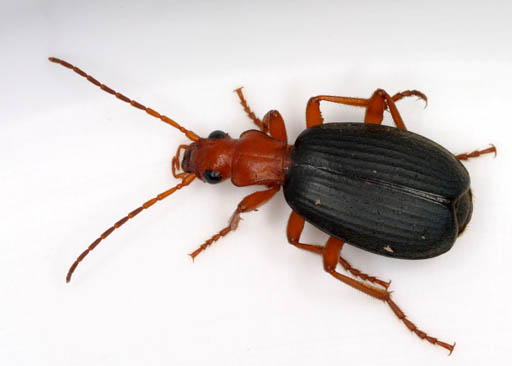
General description and diversity
Bombardier beetles belong to many genera and include more than 500 species worldwide; some of the better-known genera include Brachinus and Pheropsophus. Most are active ground-dwelling predators and are placed among the broader category of ground beetles. While many species prefer warm, moist habitats and are common in rainforests, others occur in temperate grasslands, scrub and desert margins.
Defense mechanism and anatomy
The hallmark trait is a specialized abdominal apparatus with secretion glands and a reaction chamber. Chemicals stored in one gland are mixed with oxidizing agents and enzymes in the reaction chamber to produce a rapid exothermic reaction. The resulting mixture is expelled in repeated pulses as a hot, irritating spray that can be accurately aimed at predators. These secretions are chemically active and sometimes described as poisonous or strongly deterrent; they are released from paired glands in the abdomen, often with an audible pop when ejected.
Ecology, behavior, and interactions
Bombardier beetles are primarily nocturnal hunters, feeding on other invertebrates. Their defensive spray is effective against a variety of small predators — amphibians, birds and mammals — and enables the beetle to survive encounters that might otherwise be lethal. Their behavior and chemistry have attracted attention from educators, naturalists and engineers interested in biomimicry.
History, scientific importance and notable facts
- These beetles have long been studied as an example of a complex, well-integrated defense system.
- Research into their chemistry clarified the role of stored precursors and enzymatic catalysis in controlled, repeated discharges.
- The mechanism has inspired simple engineering models for pulsed spray and temperature-control systems.
For further reading on their classification and natural history, consult specialist sources on the family Carabidae and surveys that list species diversity. Naturalists observing these beetles should respect their defensive capabilities and avoid handling them directly.
Questions and answers
Q: What is a bombardier beetle?
A: A bombardier beetle is a ground beetle known for its unique defense mechanism, which involves squirting a poisonous chemical spray from special glands in its abdomen.
Q: How many species of bombardier beetles are there?
A: There are more than 500 species of bombardier beetles.
Q: What is notable about the habitat of most bombardier beetles?
A: Most bombardier beetles are found in rainforests.
Q: What happens when a bombardier beetle is disturbed?
A: When a bombardier beetle is disturbed, it squirts a poisonous chemical spray from special glands in its abdomen, making a popping sound in the process.
Q: How does a bombardier beetle's defense mechanism work?
A: A bombardier beetle's defense mechanism involves squirting a poisonous chemical spray from special glands in its abdomen when it is disturbed.
Q: What family do bombardier beetles belong to?
A: Bombardier beetles belong to the family Carabidae.
Q: What body part do bombardier beetles use to create their defense mechanism?
A: Bombardier beetles use special glands in their abdomen to create their defense mechanism.
Related articles
Author
AlegsaOnline.com Bombardier beetle Leandro Alegsa
URL: https://en.alegsaonline.com/art/12822