
Norman Tindale: Australian anthropologist, collector and mapper of Indigenous Australia
Concise biography and assessment of Norman Tindale (1900–1993), his mapping of Aboriginal group territories, museum career, methods, major works, criticisms and continuing legacy.
Norman Barnett Tindale (12 October 1900 – 19 November 1993) was an Australian anthropologist, archaeologist and ethnologist whose long career combined museum curation, fieldwork and synthesis. He spent almost fifty years at the South Australian Museum and compiled one of the most influential attempts in the 20th century to map the distribution of Indigenous Australian cultural groups. His work shaped scholarly and popular understandings of Aboriginal social geography, while later scholarship and Aboriginal communities have re-evaluated and revised many of his conclusions. For more on his life see biographical notes.
Image gallery
1 Image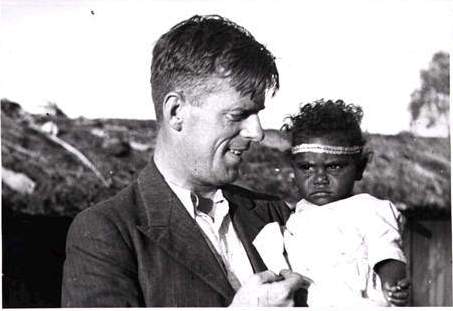
Early life and museum career
Tindale was born in Perth, Western Australia. As a child his family lived in Tokyo, where he attended the American School in Japan; they returned to Australia in the 1910s and later settled in Adelaide. He joined the South Australian Museum in 1919 as an assistant to entomologist Arthur Mills Lea and developed wide interests in entomology, ornithology and anthropology. Before completing his Bachelor of Science at the University of Adelaide in 1933 he had already published extensively. The museum post provided access to collections, library resources and opportunities for field collecting that influenced his later syntheses.
Mapping Aboriginal territories
A defining episode in Tindale's career came during fieldwork on Groote Eylandt in 1921–22, where an Anindilyakwa man described clearly defined family lands. This challenged the then-common view among many Europeans that Aboriginal people were wholly nomadic and lacked attachment to particular areas. Tindale spent decades assembling place-names, genealogies, linguistic clues and environmental data to produce regional maps purporting to show the boundaries and names of Aboriginal groups. His mapping effort is often summarized in his major synthetic work, commonly cited as Aboriginal Tribes of Australia. His approach and conclusions are discussed in later studies; see general commentaries at mapping resources and studies of Indigenous societies at Indigenous Australian studies.
Methods, publications and collections
Tindale combined museum collections, interviews, place-name lists and historical documents. He recorded languages, kinship terms and ecological associations to infer traditional territories and social organization. His publications include field reports, catalogues and large synthetic volumes; interested readers can consult library and archival guides at academic records. He resisted a narrow specialization and drew on multiple disciplines to produce broad maps and interpretations.
Reception, critique and legacy
Tindale's maps were widely used by governments, scholars and the public but have been substantially revised. Critics argue that fixed boundary lines can misrepresent fluid, overlapping and seasonally mobile Aboriginal land use and social belonging. Subsequent researchers and Indigenous organizations have produced alternative maps that incorporate oral histories, legal findings and local knowledge; for example, national mapping projects and community-based studies have amended, refined or replaced aspects of his work. Contemporary commentary treats Tindale's corpus as historically important but imperfect; consult critical overviews at anthropological reviews and cartographic critiques at case studies.
Later life and teaching
After retiring from the South Australian Museum Tindale taught for a period in the United States, including a post at the University of Colorado, and continued research and writing. He died in Palo Alto, California, aged 93; biographical summaries and legacy projects are available through museum and university archives—see institutional pages at archives, museum collections and contextual histories. His field notebooks, specimen lists and maps remain a resource for historians, anthropologists and Indigenous communities who engage with and reinterpret the evidence today—see curated guides at regional holdings and further reading at scholarly portals.
- Major themes: territory, kinship, language, environment.
- Enduring importance: extensive data collection and a stimulus for later research and legal claims.
- Important caveat: maps are one interpretation among many and should be used alongside community knowledge and updated scholarship.
Questions and answers
Q: What was Norman Tindale's profession?
A: Norman Tindale was an Australian anthropologist, archaeologist and ethnologist.
Q: Where was he born?
A: He was born in Perth, Western Australia.
Q: When did his family move to Tokyo?
A: His family moved to Tokyo in 1907 when he was a young boy.
Q: What job did he get at the South Australian Museum?
A: He got a job at the South Australian Museum as entomologist's assistant to Arthur Mills Lea.
Q: How many papers had he published before receiving his Bachelor of Science degree from the University of Adelaide?
A: He had already published thirty-one papers on entomological, ornithological and anthropological subjects before receiving his Bachelor of Science degree at the University of Adelaide in March 1933.
Q: What sparked Norman Tindale's interest in mapping cultural groupings of Indigenous Australians?
A: His interest in this began during a research trip to Groote Eylandt in 1921–1922 where an Anindilyakwa man gave him detailed descriptions of which land belonged to his family and which land did not.
Q: Where did Norman Tindale live after his retirement from the South Australian Museum?
A: After his retirement from the South Australian Museum, Tindale began teaching at the University of Colorado and lived there until his death, aged 93, in Palo Alto, California.
Tags
Related articles
Author
AlegsaOnline.com Norman Tindale: Australian anthropologist, collector and mapper of Indigenous Australia Leandro Alegsa
URL: https://en.alegsaonline.com/art/127768