
Noam Chomsky
American linguist, cognitive scientist, philosopher, and political writer known for generative grammar, universal grammar, the Chomsky hierarchy, and outspoken political criticism.
Avram Noam Chomsky (born December 7, 1928) is an American linguist, philosopher, author and public intellectual. He served for decades at the Massachusetts Institute of Technology and holds the title of Institute Professor and professor emeritus of linguistics. Chomsky's work spans formal theories of language, cognitive science, and sustained commentary on politics and media.
Image gallery
10 Images
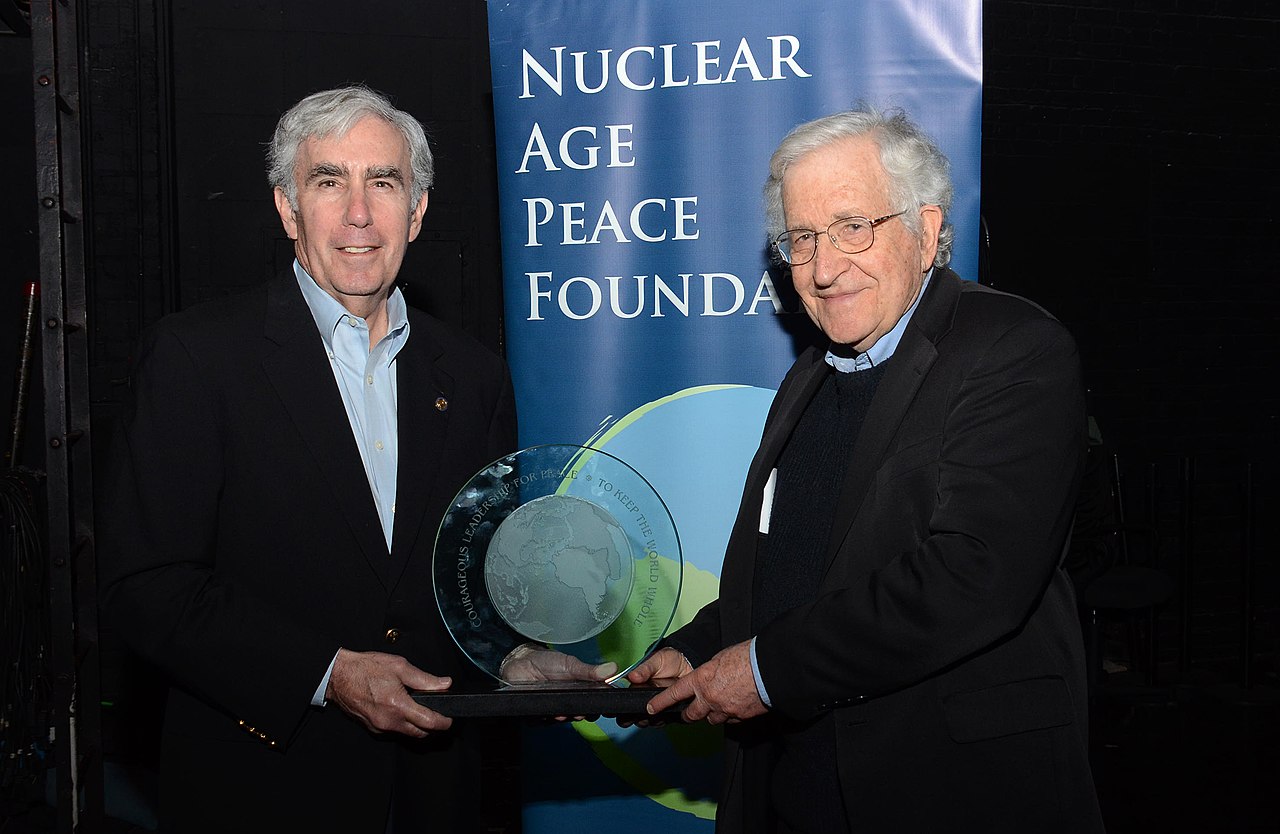





Overview and central contributions
In linguistics Chomsky is best known for founding transformational-generative grammar and proposing that human language is guided by an innate structure often called "universal grammar." His ideas shifted the study of language from behaviorist descriptions toward a mentalist, competence-based approach that treats grammar as a component of the human mind. In theoretical computer science and formal language theory he influenced the classification of formal grammars, commonly referenced as the Chomsky hierarchy.
Key ideas and works
- Generative and transformational grammar: analysis of syntax as rule-based structures.
- Universal grammar: hypothesis of inborn linguistic capacity in humans.
- Chomsky hierarchy: formal classification of grammars and languages.
- Notable books: early technical texts and later public-facing works on politics and media.
Beyond technical scholarship, Chomsky became widely known for his political writing and activism. From the 1960s onward he criticized state power, Cold War policies, military interventions, and the role of mass media in shaping public consent. His collaborations and essays argued that elite interests and institutional constraints shape mainstream news and foreign policy, themes many readers first encountered through accessible polemical books and lectures.
History and influence
Chomsky's academic career, beginning in the mid-20th century, helped establish modern linguistics as a scientific discipline connected to psychology and brain science. Students and critics alike engaged with his theories, producing a large body of follow-up research, reformulations, and challenges. His political work made him a central figure in intellectual debates on democracy, empire, and the ethics of power.
Criticism and legacy
Chomsky's linguistic theories have been revised and contested over time; alternatives emphasize usage, social interaction, or statistical learning. His political analyses have aroused strong supporters and detractors, and debate continues about the empirical claims and normative conclusions he advances. Regardless, his combined influence on linguistics, cognitive science, philosophy, and public discourse remains substantial, making him one of the most cited and debated figures in contemporary intellectual life.
For introductions to his scholarly and political writings, see major collections, technical overviews, and accessible anthologies that survey his ideas and the responses they generated.
Questions and answers
Q: Who is Noam Chomsky?
A: Noam Chomsky is an American linguist, philosopher, political activist, author, and lecturer.
Q: When was Noam Chomsky born?
A: Noam Chomsky was born on December 7, 1928.
Q: What is Noam Chomsky's position at Massachusetts Institute of Technology?
A: Noam Chomsky is an Institute Professor and professor emeritus of linguistics at the Massachusetts Institute of Technology.
Q: What are Noam Chomsky's areas of expertise?
A: Noam Chomsky is an expert in linguistics, philosophy, and politics.
Q: What is Noam Chomsky known for?
A: Noam Chomsky is known for his groundbreaking work in language acquisition and for his political activism.
Q: What is Noam Chomsky's academic history?
A: Noam Chomsky received a PhD in linguistics from the University of Pennsylvania and went on to teach at the Massachusetts Institute of Technology.
Q: What is Noam Chomsky's legacy?
A: Noam Chomsky's legacy includes his contributions to the field of linguistics, his political activism, and his influence on the development of cognitive psychology.
Author
AlegsaOnline.com Noam Chomsky Leandro Alegsa
URL: https://en.alegsaonline.com/art/127719