
Michael Praetorius: German composer, organist, and music theorist
Michael Praetorius (1571–1621) was a German composer, organist and writer on music. His chorale settings, dance collection Terpsichore and the treatise Syntagma Musicum influenced early Baroque performance and Lutheran worship.
Overview
Michael Praetorius was one of the most influential German musical figures around the turn of the 17th century. Born in Creuzburg near Eisenach on 15 February 1571, he is remembered as a prolific composer, an accomplished organist and an important author of musical theory. Praetorius combined practical court and church work with a broad interest in contemporary performance practice, producing both large collections of sacred music and a landmark treatise that documents instruments and notation of his era.
Image gallery
2 Images
Life and career
Born Michael Schultze (also spelled Schulze) and later Latinized to Praetorius, he grew up during a period of intense religious change in Germany; his family were devout Lutherans. After attending a Latin school in Torgau, he studied at the University of Frankfurt an der Oder and graduated in divinity. He took a long-term position as organist at the court of Brunswick-Wolfenbüttel, where he worked for many years. He also spent time in Dresden and Magdeburg, where he encountered contemporaries such as Heinrich Schütz and Samuel Scheidt. Praetorius married in 1603 and had two sons; failing health in later years did not prevent him from remaining productive. He died in Wolfenbüttel on 15 February 1621, leaving bequests to the poor.
Compositional output and musical style
Praetorius wrote a wide range of music: settings of Lutheran chorales, polychoral works for festive occasions, smaller vocal pieces and numerous instrumental arrangements. Much of his sacred output is based on Protestant hymn tunes, which he treated in diverse textures from simple harmonizations to elaborate multi-voice concertato arrangements. His style shows a transition from late Renaissance polyphony toward the early Baroque emphasis on contrast, clarity of text and varied instrumental color.
Syntagma Musicum and Terpsichore
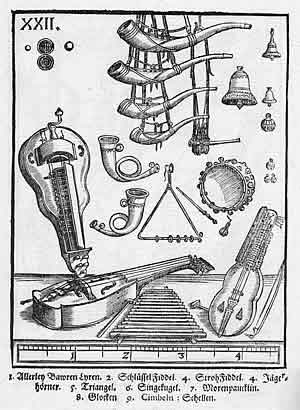
Praetorius is especially renowned for his Syntagma Musicum, a multi-volume musical handbook that discusses notation, instruments and performance practice. This work is a primary source for modern understanding of early 17th-century instruments, organ building and ensemble practice. Equally famous is his Terpsichore (published 1612), a collection of dance tunes and instrumental arrangements that preserved many secular dances of the period and has become a frequent source for performers of early dance music.
Importance and legacy
Praetorius played a central role in shaping Lutheran church music of his time; his chorale settings influenced liturgy and congregational singing. As a theorist and cataloguer of instruments, he provided subsequent generations with practical guidance for performing early music. During the 20th- and 21st-century early-music revival, his works and his descriptions of instruments and practice regained wide interest among scholars and performers seeking historically informed approaches.
Selected works and further references
Representative titles and topics connected with Praetorius include:
- Syntagma Musicum — treatise on notation and instruments.
- Terpsichore (1612) — collection of instrumental dances.
- Various collections of chorale settings and liturgical music for Lutheran worship.
For concise online guides, archival entries and library catalogs consult the following references and local resources: Creuzburg / Eisenach information, birth records and dates, Wolfenbüttel archives, biographical summaries, list of compositions, organist appointments, music-theory writings, chorale sources, religious context in Germany, Reformation background, family and social history, Torgau Latin school information, University of Frankfurt an der Oder, marriage and family notes, connections in Dresden, contacts in Magdeburg.
Praetorius remains an essential figure for anyone studying the transition from Renaissance to Baroque practice in German-speaking lands: his music is performed both in liturgical contexts and by early-music ensembles, while his theoretical observations continue to inform historically informed performance.
Questions and answers
Q: Who was Michael Praetorius?
A: Michael Praetorius was a German composer, organist and music theorist. He was one of the most important composers of his day and he wrote lots of different kinds of music. A lot of his music is based on hymns of the Protestant church.
Q: What is known about the date of his birth?
A: We are not quite certain about the date of his birth, but it is thought to have been 15 February 1571.
Q: What kind of education did Praetorius receive?
A: Praetorius went to the Lateinschule (“Latin School”) in Torgau where he had music lessons from Michael Voigt. He then went to the University of Frankfurt an der Oder, graduating in divinity.
Q: What job did he take after university?
A: After university, Praetorius found a job as organist to the Duke of Brunswick-Wolfenbüttel and soon earned a good salary.
Q: Did he marry and have children?
A: Yes, Praetorius married in 1603 and had two sons.
Q: Where else did he work besides Wolfenbüttel?
A: Besides Wolfenbüttel, Praetorius also worked a lot in Dresden where he met Heinrich Schütz and in Magdeburg where he met Samuel Scheidt.
Q: Why might his health have been poor during this time period?
A: His health may have been poor due to working so hard for many years without taking breaks or vacations for rest or relaxation.
Author
AlegsaOnline.com Michael Praetorius: German composer, organist, and music theorist Leandro Alegsa
URL: https://en.alegsaonline.com/art/126797