
Boeing 720: short‑range derivative of the 707 jet airliner
A single‑aisle jet introduced in 1960 as a lighter, shorter version of the Boeing 707. Built in two main variants (720 and 720B), 154 were produced for medium‑range airline routes.
The Boeing 720 is a narrow‑body, single‑aisle jet airliner developed by Boeing in the late 1950s as a shorter, lighter derivative of the Boeing 707. Intended to serve medium‑range routes that did not require the range of the 707, the 720 retained many systems and design features of its larger sibling to reduce development cost and speed entry into service. Its first flight took place in November 1959 and it entered airline service in 1960.
Image gallery
10 Images
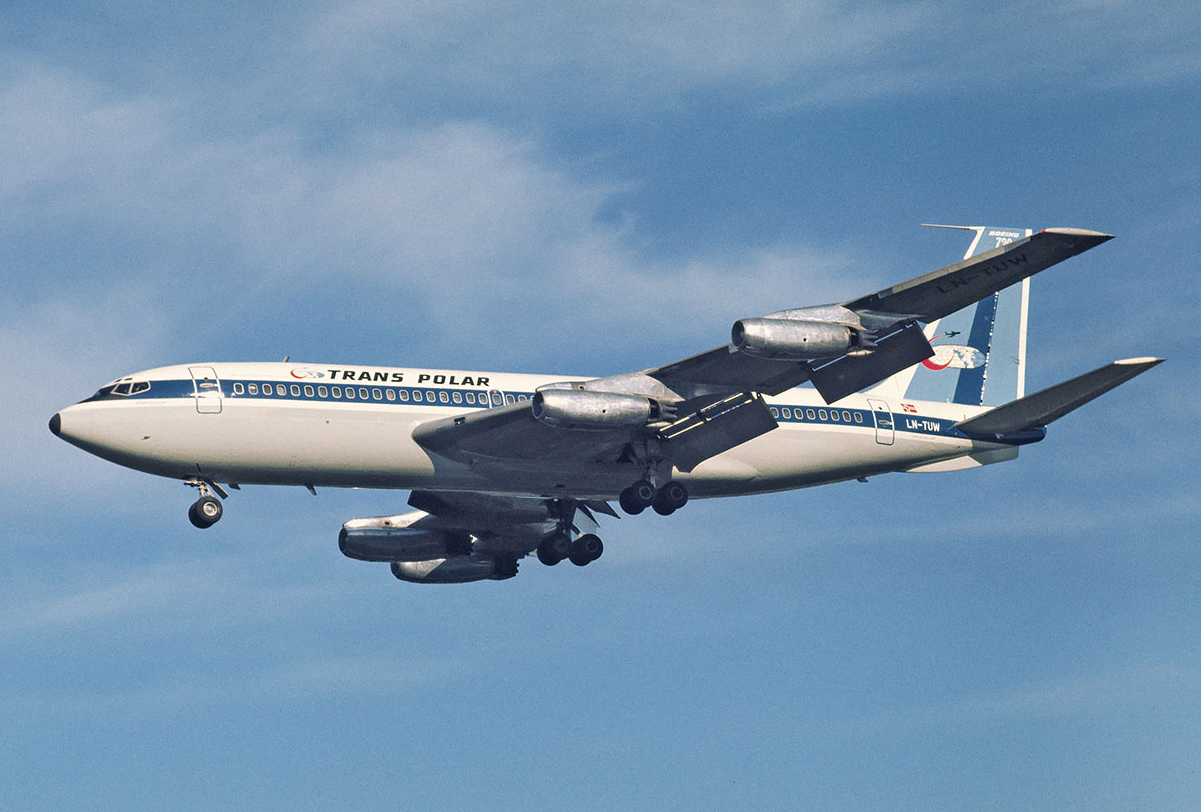


Design and characteristics
The 720 is distinguished from the 707 primarily by a shortened fuselage and weight‑saving modifications to wings and structure. It is a four‑engine jet that was offered with two powerplant families: early examples used Pratt & Whitney JT3C turbojets, and later versions were equipped with more efficient JT3D turbofans. Typical cabin arrangements were single‑aisle seating suitable for short to medium sectors. The aircraft featured tricycle landing gear, a pressurized cabin, and the aerodynamic layout common to first‑generation jet airliners.
- Engines: JT3C turbojets (original) and JT3D turbofans (720B).
- Configuration: narrow‑body, single aisle; four wing‑mounted engines.
- First flight / service: November 1959; entered airline service in 1960.
- Production: 154 aircraft built.
Development and variants
Boeing designed the 720 to capture traffic on shorter routes where the 707’s longer range and higher operating weight were unnecessary. The initial model carried the original turbojet engines. Responding to demand for better fuel economy and quieter operation, Boeing introduced the 720B variant fitted with Pratt & Whitney JT3D turbofan engines; many original 720s were later modified to 720B standard. The commonality with the 707 meant the 720 could be certified and fielded rapidly and inexpensively relative to an entirely new airframe.
Operational use and legacy
The 720 served with a number of airlines on domestic and regional international routes during the 1960s and into the following decades. Its role as a medium‑range airliner was gradually taken over by subsequent designs such as the Boeing 727 and later narrow‑body jets, which offered improved economics, higher capacity, or better short‑field performance. Despite a modest production run, the 720 contributed to Boeing’s early jetliner lineup by filling a specific market niche and by leveraging parts commonality to limit development expense.
Notable distinctions
Key points that distinguish the 720 include its shorter fuselage compared with the 707, the existence of the turbofan‑equipped 720B upgrade, and its status as a transitional design that bridged the gap between first‑generation long‑range jets and the emerging family of medium‑capacity airliners. For further technical summaries and historical overviews see the Boeing 720 general page: Boeing 720 overview, the parent model Boeing 707, airline service histories airline operations, the original turbojet type Pratt & Whitney JT3C and the turbofan upgrade Pratt & Whitney JT3D.
Questions and answers
Q: What type of aircraft is the Boeing 720?
A: The Boeing 720 is a jet airliner.
Q: How many rows of seats does it have?
A: The Boeing 720 has two rows of seats, making it a narrow-body airliner.
Q: How many engines does the plane have?
A: The Boeing 720 has four engines.
Q: When was the first version of the plane used?
A: The first version of the Boeing 720 with Pratt & Whitney JT3C turbojet engines was first used in 1960.
Q: When did airlines begin to use it?
A: Airlines began to use the Boeing 720 in July 1960.
Q: What is the second version called and when was it introduced?
A: The second version of the plane is called the 720B and it has Pratt & Whitney JT3D turbofan engines. It was first used in 1961.
Q: How many planes were built and how much money did this make for Boeing?
A: Only 154 Boeing 720s were built, but they still made a lot of money for Boeing because they didn't cost much to design.
Related articles
Author
AlegsaOnline.com Boeing 720: short‑range derivative of the 707 jet airliner Leandro Alegsa
URL: https://en.alegsaonline.com/art/12638
Sources
- boeing.com : "Boeing 720"
- boeing.com : "The first KC-135 rolled out 50 years ago this month."
- airliners.net : "Boeing 720"
- boeing.com : "Boeing 707/720 Short History."
- flightglobal.com : "The Boeing 720"
- airlinercafe.com : The Ultimate Boeing 707 Guide
- visitingphx.com : "Resident Boeing 720B."
- avweb.com : "Last Boeing 720 Retired."
- trentonian.ca : "Historic landing a success | Local | News | Trenton Trentonian"
- aviation-safety.net : aviation-safety.net
- boeing.com : "Boeing 720."
- boeing.com : "707 Airplane Characteristics: Airport Planning."
- boeing.com : "Boeing 707 Family."