
Boeing 707: Pioneering Commercial Jet Airliner
Comprehensive overview of the Boeing 707: design origins, main variants, engines, operational history, civil and military roles, retirement and lasting influence on commercial aviation.
Overview
The Boeing 707 is a four‑engine, narrow‑body jet airliner produced by Boeing Commercial Airplanes between 1958 and 1979. It helped establish jet service as the standard for higher‑speed, longer‑range passenger transport and played a central role in the expansion of long‑distance airline networks in the 1960s and 1970s. Typical passenger layouts accommodated roughly 140–189 people and published range figures vary by model, commonly cited between about 2,500 and 5,750 nautical miles (approximately 4,600–10,650 km). The type is widely classified as a jet airliner and remains one of the most influential early jetliners in civil aviation history.
Image gallery
10 Images




Design and development
The 707 grew from Boeing's proof‑of‑concept prototype, the Boeing 367‑80, often called the "Dash 80"; that prototype demonstrated the feasibility and commercial potential of a pure‑jet transport (Boeing 367‑80). The production 707 adopted a low‑wing, swept planform with four podded engines under the wings and a fuselage cross‑section designed for two‑abreast seating on each side of a single aisle. Initial production models were powered by Pratt & Whitney turbojet engines such as the JT3C and later JT3D turbofans; early engine development and types are summarized in sources on the JT3C and related powerplants (prototype and engine histories).
Variants and characteristics
Boeing offered several civil and military variants to meet different range, capacity and mission needs. Major civil versions included the 707‑120 (original production), the stretched, long‑range 707‑320 series, and the shorter 707‑138 produced for specific airline customers. A related derivative, the Boeing 720, was marketed as a lighter, medium‑range model and shared many systems with the 707 (Boeing 720). The 707‑420 used Rolls‑Royce Conway turbofan engines on some production aircraft, reflecting the period’s transition from turbojets to more efficient turbofan types.
- 707‑120: original production transoceanic model.
- 707‑320: stretched, higher‑capacity long‑range version.
- 707‑138: shortened, lighter high‑range subvariant for selected operators.
- Boeing 720: medium‑range derivative with reduced weight and range.
Operational history
Pan American World Airways inaugurated scheduled 707 passenger service on October 26, 1958, helping inaugurate the modern jet age for touring and transoceanic airline travel; Pan Am was a key launch customer and promoter of jet routes (Pan American). During the 1960s the 707 became a mainstay of many major carriers, enabling faster schedules and reshaping airline route planning. Over time, the type was supplanted on primary trunk routes by larger widebody jets and by newer, more fuel‑efficient narrow‑body types.
Military and special‑mission uses
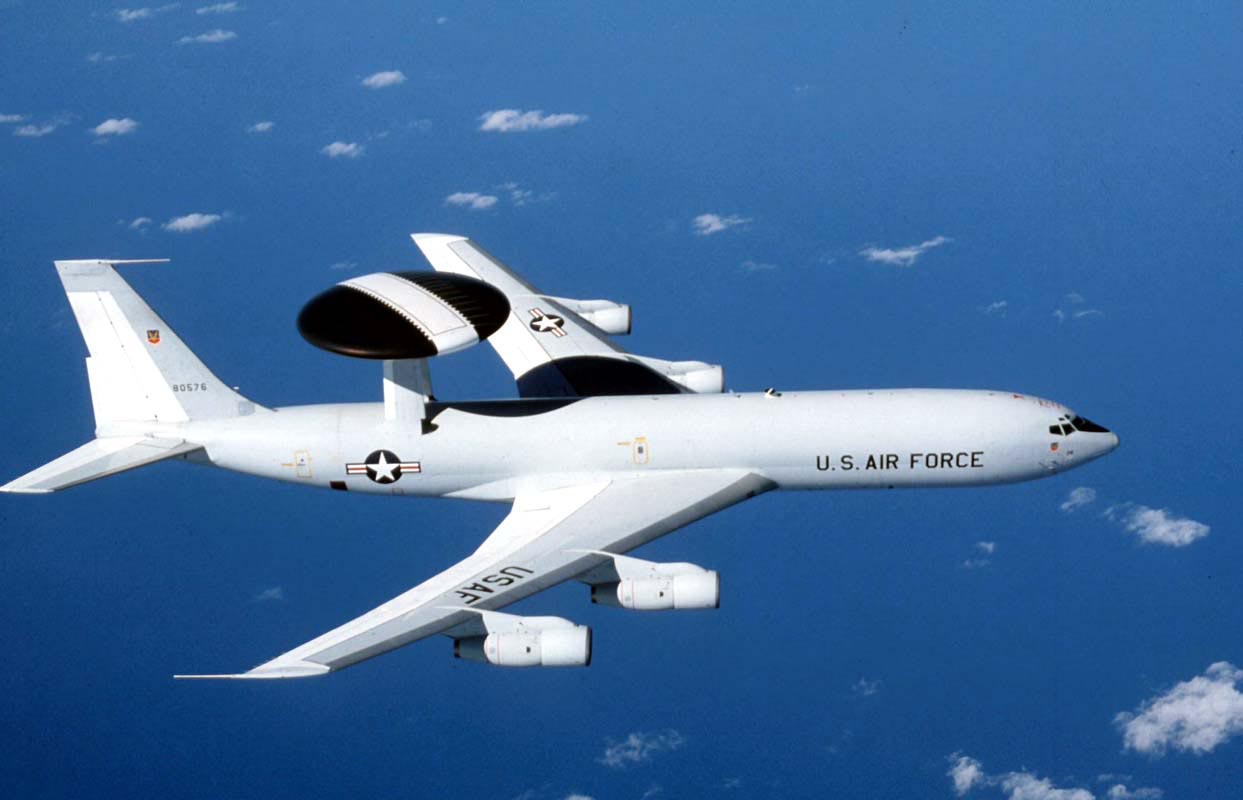
Beyond scheduled passenger service, the 707 platform proved highly adaptable and was converted for a variety of military and special‑mission roles. Notable military derivatives include the E‑3 Sentry airborne warning and control system (AWACS) and the C‑137 Stratoliner, used for VIP and governmental transport. These variants feature significant structural and systems modifications while retaining the basic 707 airframe and handling characteristics.
Production and later service
Boeing produced aircraft of the 707/720 families through the 1950s–1970s period; commonly cited production totals place the series at about 1,011 airframes including the 720 derivative. In addition, numerous airframes were converted or completed for military, governmental and freight roles by Boeing and other contractors. Passenger 707s were progressively retired from major airline fleets from the 1970s onward, though some examples persisted in freight, military and governmental service for many decades.
Technical features
The 707 introduced several features that became common on jetliners: a pressurized cabin for comfortable high‑altitude flight, a swept wing for higher cruise speeds, and podded turbojet/turbofan engines under the wing for easier maintenance and improved aerodynamics. Cockpit layouts and systems on early 707s reflected contemporary analog technology and required three‑ or four‑person flight crews on many models; later avionics upgrades and conversion programs modernized some airframes for extended service lives.
Retirement, preservation and legacy
With production ending in 1979, most passenger 707s were retired in favor of more efficient designs, but the type left a lasting legacy. It helped establish Boeing as a leading commercial manufacturer and launched the company’s family‑naming convention that included the later 727, 737 and 757 lines (727, 737, 757). A number of preserved 707s are held in museums and by historical collections worldwide, and specialized military and governmental variants continued in service long after the type’s civilian retirement. Contemporary fleet tallies showed only a handful of 707s in airline use into the 2010s before those examples too were withdrawn (airline fleet records).
Further reading
For detailed technical histories, production lists and variant descriptions consult authoritative monographs on the Dash‑80 and 707 development programs, studies of early jet propulsion (early jet airliners) and manufacturer archives. Additional information is available in museum catalogs, operator histories and specialized publications that document specific engines, production runs and conversion programs for cargo and military roles.
Questions and answers
Q: What type of aircraft is the Boeing 707?
A: The Boeing 707 is a jet airliner.
Q: How many rows of seats does it have?
A: The Boeing 707 only has two rows of seats, making it a narrow-body plane.
Q: How many engines does it have?
A: The Boeing 707 has four engines.
Q: How many passengers can the different types of 707 hold?
A: Different types of the Boeing 707 can hold from 140 to 189 passengers.
Q: What was the first jet airliner made by Boeing Commercial Airplanes?
A: The first jet airliner made by Boeing Commercial Airplanes was the Boeing 707.
Q: What other planes are based on parts of its design?
A: Other planes based on parts of the design for the Boeing 707 include the 737,727 and757.
Q: What type of flights has it been used for?
A: The Boeing 707 has been used for various types of flights, including those operated by militaries such as E-3 Sentry and C-137 Stratoliner.
Related articles
Author
AlegsaOnline.com Boeing 707: Pioneering Commercial Jet Airliner Leandro Alegsa
URL: https://en.alegsaonline.com/art/12636
Sources
- aviation-history.com : "Boeing 707 Jet Transport."
- active.boeing.com : "707 Model Summary"
- airlinercafe.com : "Boeing 707."
- boeing.com : "Tech data sheet at Boeing.com"
- boeing.com : boeing.com
- flightglobal.com : "World Airliner Census"
- time.com : "Gamble in the Sky."
- aviation-safety.net : Accident description
- time.com : "Jets Across the U.S."
- books.google.com : The Royal Navy in the Falklands Conflict and the Gulf War: Culture and Strategy (British Politics and Society).
- time.com : "Farewell Flight."
- air-and-space.com : "Boeing 707."
- globalsecurity.org : "KC-135E."
- ch-aviation.ch : "Aircraft and Fleet Lists"