
Bobsleigh: Winter sliding sport, equipment, tracks, and history
Bobsleigh is a winter team sport where crews race down iced courses in streamlined sleds. This article explains equipment, tracks, events, origins, governance and how competitions are run.
Bobsleigh (also bobsled) is a high-speed winter sport in which small teams race down frozen courses in purpose-built sleds. Originating as a recreational pursuit in alpine resort towns, it is now contested internationally and at the Winter Olympic Games. Modern competition emphasizes a rapid synchronized start, precise piloting through banked turns, and carefully engineered equipment.
Image gallery
10 Images


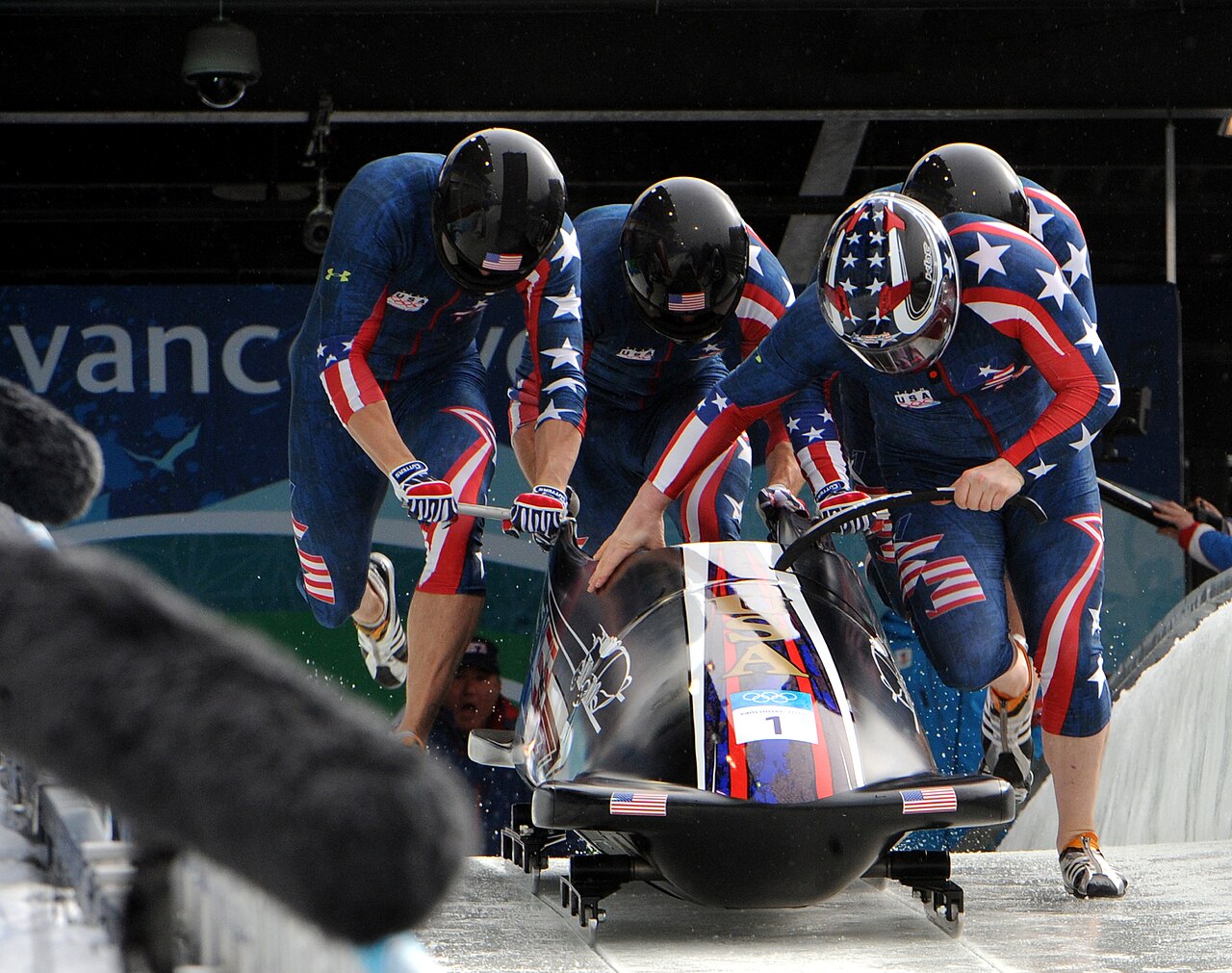


Equipment and crew
The vehicle, commonly called a sled, has a rigid aerodynamic hull, metal runners, and space for a pilot and one or more crew members. Typical events are two-person and four-person races, and a women's two-person discipline is also widely contested. Crews include a pilot who steers, push athletes who provide an explosive start, and a brakeman who controls deceleration after the finish line. Teams work to minimize weight where rules permit and to maximize the efficiency of the push and the line through curves.
Tracks and surfaces
Races take place on specially prepared iced courses. Modern tracks are usually constructed from reinforced concrete or similar materials and then coated with a layer of ice to form the racing surface; many tracks also use refrigeration systems to keep conditions consistent. Natural-ice courses still exist and are used for training and some competitions; the combination of steep drops, long straights and tight banked turns creates a demanding technical environment for crews.
Course design, start timing and aerodynamics all affect final times. Teams push the sled for several meters to gain initial velocity before mounting; the quality of this start often determines podium positions at high levels, where finishes are decided by hundredths of a second.
Events are organized internationally under a governing federation, now known as the International Bobsleigh and Skeleton Federation (IBSF), historically called the Fédération Internationale de Bobsleigh et de Tobogganing (FIBT). The sport has a calendar of World Cup events and world championships leading up to major multisport tournaments such as the Olympics.
Historically, bobsleigh began in late 19th-century alpine resorts. The first sleds were built and used in places like St. Moritz, where British tourists converted toboggans into steerable sleds, an activity encouraged by hotel proprietors. From those origins the sport developed standardized sled designs, formal rules and purpose-built tracks. Its appeal combines teamwork, engineering and the raw experience of speed, making it one of the most recognizably dramatic disciplines of winter sport.
- Typical race formats: two-person, four-person, and women's events.
- Key skills: explosive start, precise steering, sled setup and track reading.
- Governing body and event information: see federation calendars and rulebooks for specifics (team sport resources or Winter Olympic Games pages).
Questions and answers
Q: What is bobsleigh?
A: Bobsleigh, also known as bobsled, is a team sport played during Winter Olympic Games where players ride on iced tracks with a sled.
Q: What are modern bobsleigh tracks made of?
A: Modern bobsleigh tracks are made of concrete coated with ice.
Q: Are artificial bobsleigh tracks available?
A: Yes, artificial bobsleigh tracks are also available.
Q: Who governs international bobsled competitions?
A: International bobsled competitions are governed by the Fédération Internationale de Bobsleigh et de Tobogganing (FIBT).
Q: Where were the first bobsleds built?
A: The first bobsleds were built in St. Moritz, Switzerland in the late 19th century.
Q: Who built the first bobsleds?
A: The first bobsleds were built by rich tourists from Britain who were staying at the Palace Hotel owned by Caspar Badrutt.
Q: What did the rich tourists from Britain do at the Palace Hotel in St. Moritz?
A: The rich tourists from Britain who were staying at the Palace Hotel in St. Moritz built the first bobsleds in the late 19th century.
Related articles
Author
AlegsaOnline.com Bobsleigh: Winter sliding sport, equipment, tracks, and history Leandro Alegsa
URL: https://en.alegsaonline.com/art/12575