
Moons of Uranus: names, categories, and a complete list
Overview and organized listing of Uranus' 27 known moons, their origins, discovery history, categories, and notable features.
Uranus has 27 confirmed natural satellites, a collection that ranges from large, geologically complex bodies to tiny irregular capture objects. The ensemble is conventionally catalogued by orbital distance or orbital period; many popular lists are ordered by how long each moon takes to complete one orbit (orbital period). Unlike the mythological names used for many other planets’ satellites, Uranus’ moons are named after characters from works of literature — principally plays by William Shakespeare and characters from Alexander Pope — a convention reflected in scientific catalogs and public references (naming).
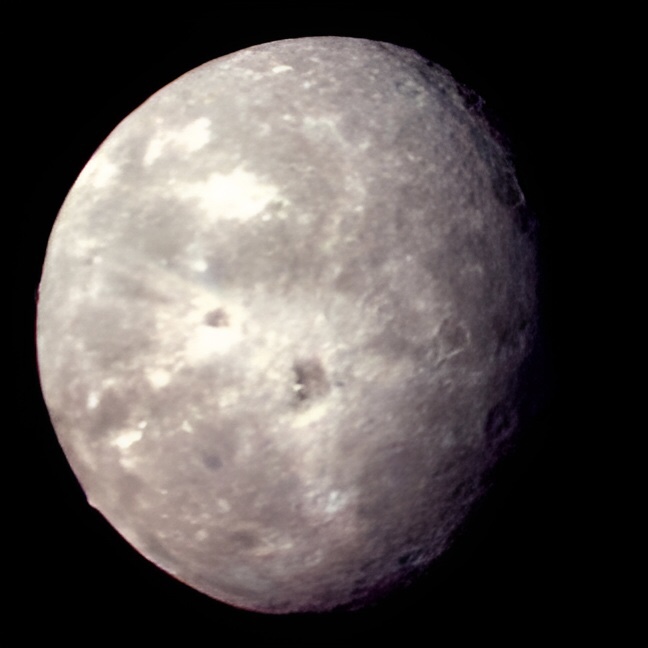
Characteristics: Five principal moons — Miranda, Ariel, Umbriel, Titania and Oberon — dominate by size and retain varied terrains indicating past geological activity on some. These larger moons are composed mainly of water ice mixed with rock. The remaining satellites fall into two broad groups: a set of small inner moons that orbit close to Uranus and interact with its ring system, and a population of distant irregular moons with eccentric, often retrograde orbits that are likely captured objects.
Discovery and exploration: The first of Uranus’ satellites were found in the late 18th and 19th centuries: Titania and Oberon were reported by William Herschel in 1787, Ariel and Umbriel by William Lassell in 1851, and Miranda by Gerard Kuiper in 1948. The Voyager 2 flyby in 1986 provided the only close-up imagery to date, revealing details of surfaces and discovering additional small moons. Many tiny outer moons were identified with improved ground-based telescopes and space-based instruments in the late 20th and early 21st centuries.
Image gallery
10 Images




Grouped list of Uranus' 27 moons
- Inner shepherds and ring moons: Cordelia, Ophelia
- Other inner and classical small moons: Bianca, Cressida, Desdemona, Juliet, Portia, Rosalind, Belinda, Puck, Mab, Perdita, Cupid
- Five large principal moons: Miranda, Ariel, Umbriel, Titania, Oberon
- Irregular outer moons (distant, often captured): Francisco, Caliban, Sycorax, Prospero, Setebos, Stephano, Trinculo, Ferdinand, Margaret
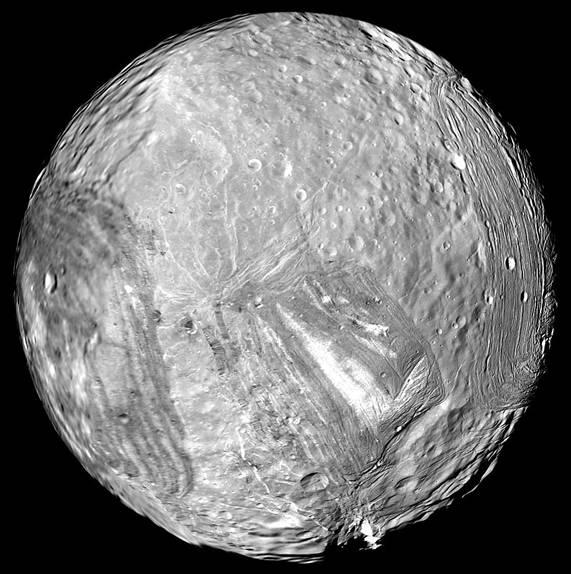
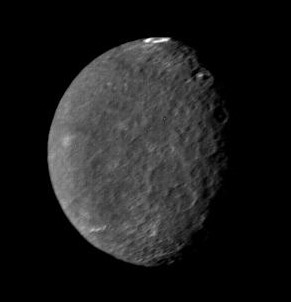
Notable facts and distinctions: Miranda is remarkable for dramatic canyons and patched terrains that suggest extensive resurfacing. Ariel shows evidence of relatively young surface regions; Umbriel appears darker and heavily cratered. Titania and Oberon are the largest and show more ancient, cratered terrains. Several small moons act as shepherds for parts of Uranus’ ring system. The outer irregular satellites are diverse in orbit and origin and help astronomers study capture processes and the early Solar System’s dynamical history.
Because the naming draws from literary characters rather than ancient deities, Uranus’ satellite nomenclature is distinctive among the giant planets. Ongoing observations continue to refine orbital parameters and occasionally reveal additional tiny objects; for current mission data and listings consult the major planetary data services and observatory catalogs (orbital lists) or naming references (names).
Questions and answers
Q: How many moons does Uranus have?
A: Uranus has 27 moons.
Q: How are Uranus' moons listed?
A: Uranus' moons are listed by how long they take to orbit Uranus.
Q: Are all of Uranus' moons named after the same thing?
A: Yes, all of Uranus' moons are named after characters created by William Shakespeare and Alexander Pope.
Q: Who are the characters that Uranus' moons are named after?
A: Uranus' moons are named after characters created by William Shakespeare and Alexander Pope.
Q: Do Uranus' moons have unique names?
A: Yes, each of Uranus' moons has a unique name based on a character from Shakespeare or Pope's work.
Q: Is there a specific order to Uranus' moons?
A: Yes, Uranus' moons are listed in order of how long they take to orbit Uranus.
Q: How does the number of Uranus' moons compare to the number of moons that other planets have?
A: Uranus has 27 moons, which is less than some other planets like Saturn and Jupiter, but more than others like Earth and Mars.
Related articles
Author
AlegsaOnline.com Moons of Uranus: names, categories, and a complete list Leandro Alegsa
URL: https://en.alegsaonline.com/art/125216