
List of Neptune's moons
Overview and list of Neptune’s 14 known moons, their discovery history, categories (inner, outer, irregular), notable features such as Triton’s retrograde orbit, and naming origins.
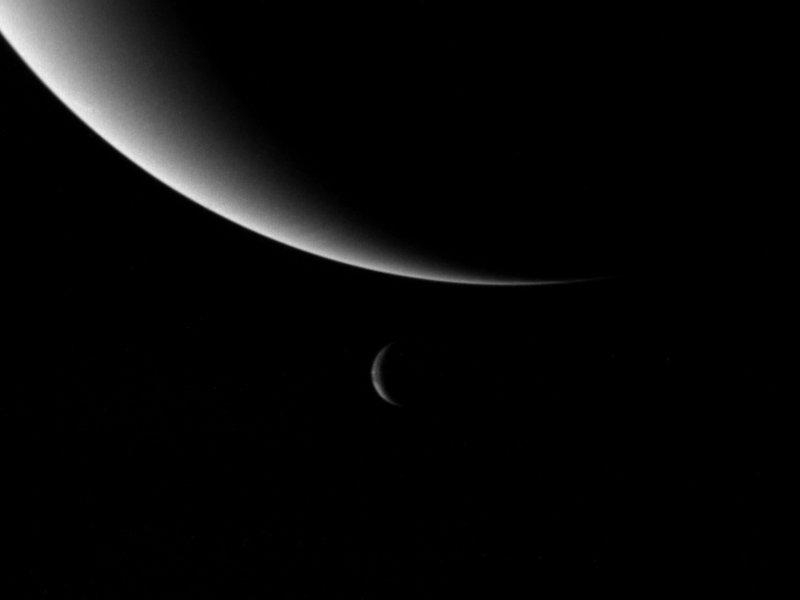
Neptune has a family of 14 confirmed natural satellites. The largest and most prominent is Triton, discovered soon after Neptune itself. Triton is unique among major moons because it follows a retrograde, inclined orbit and shows signs of geological activity. The remaining satellites are much smaller; many are irregular, distant objects, while a group of close-in moons orbit near Neptune’s ring system.
Image gallery
10 Images




Characteristics and grouping
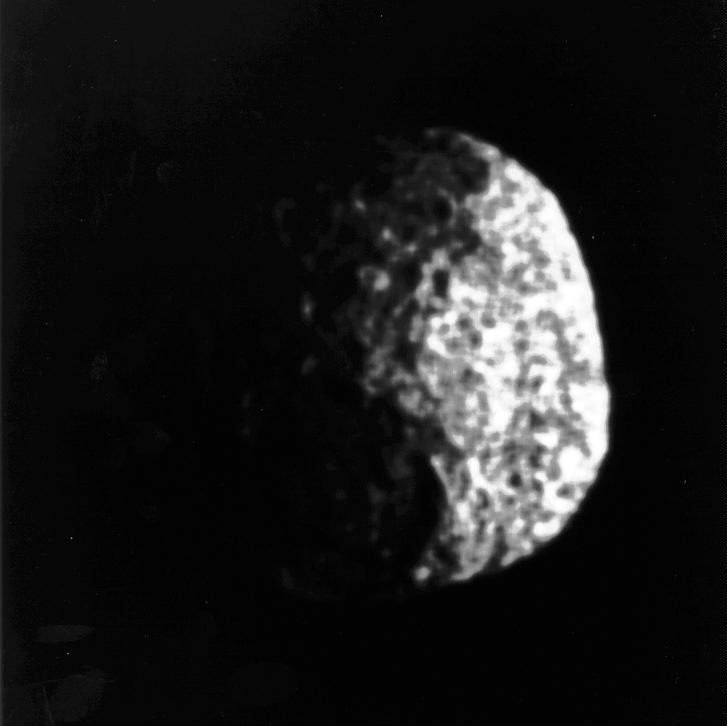
The moons of Neptune fall into two broad categories: small inner satellites that move on close, nearly circular prograde orbits, and a number of distant, irregular satellites with eccentric or inclined orbits. Triton stands apart as a large, retrograde moon that is widely considered a captured object, probably originating in the Kuiper belt. Another notable object, Nereid, has an unusually elongated orbit compared with the inner moons.
- Naiad
- Thalassa
- Despina
- Galatea
- Larissa
- Proteus
- Triton
- Nereid
- Halimede
- Sao
- Laomedeia
- Psamathe
- Neso
- Hippocamp
Discovery and exploration
The first moon discovered was Triton by astronomer William Lassell just seventeen days after Neptune’s identification in 1846. For nearly a century Neptune had only that single known satellite until the detection of Nereid in the mid-20th century. A major step in understanding Neptune’s system came when the Voyager 2 spacecraft flew past Neptune in 1989, revealing several small inner moons and providing close images of Triton’s surface. Later, improvements in telescopes and imaging, including the Hubble Space Telescope, revealed additional distant and faint moons; one small inner moon was identified in Hubble images and announced in 2013 as the system’s fourteenth discovery.
Importance and notable facts
Triton’s retrograde motion and active geology make it a particularly important object for planetary science: its surface shows nitrogen geysers and a young, varied terrain, indicative of internal or seasonal processes. The irregular outer moons are believed to be captured objects, fragments left over from collisions, or bodies perturbed into distant, eccentric orbits. Some of the inner moons interact gravitationally with Neptune’s rings and help shape ring arcs and structure.
Naming conventions for Neptune’s satellites draw on mythic figures associated with the sea. Most of the moons bear names of sea nymphs and water spirits from classical mythology; the practice reflects Neptune’s role as the Roman sea god and helps provide a consistent thematic system for names (naming conventions). Ongoing observations continue to refine orbital details and may reveal still smaller moons or transient phenomena in Neptune’s complex satellite system.
Questions and answers
Q: How many moons does Neptune have?
A: Neptune has a total of 14 known moons.
Q: Who discovered Triton, Neptune's largest moon?
A: William Lassell discovered Triton, Neptune's largest moon.
Q: How long after Neptune was discovered was Triton found?
A: Triton was discovered just seventeen days after Neptune was found.
Q: When was the second moon, Nereid, found?
A: The second moon, Nereid, was found one hundred years after Triton's discovery.
Q: Who found the 14th moon of Neptune?
A: The Hubble Telescope found the 14th moon of Neptune in 2013.
Q: Are Neptune's moons named after sea animals?
A: No, Neptune's moons are named after sea nymphs.
Q: What is the largest moon of Neptune called?
A: The largest moon of Neptune is called Triton.
Tags
Related articles
Author
AlegsaOnline.com List of Neptune's moons Leandro Alegsa
URL: https://en.alegsaonline.com/art/124869
Sources
- bbc.co.uk : "Nasa's Hubble telescope discovers new Neptune moon"
- spaceplace.nasa.gov : "How Many Moons?"
- adsabs.harvard.edu : "A dynamical history of the inner Neptunian satellites"
- astro.umd.edu : (pdf)
- arxiv.org : preprint
- cfa-www.harvard.edu : Final preprint(pdf)
- planetarynames.wr.usgs.gov : "Planet and Satellite Names and Discoverers"
- ssd.jpl.nasa.gov : Jacobson, R.A. (2008) NEP078 - JPL satellite ephemeris
- skyandtelescope.com : "Neptune's Newest Moon"