
Medal of Honor recipients in World War I
Overview of United States Medal of Honor awards during World War I: context, numbers by service, notable recipients, dual awards and the award's legacy.
World War I created new forms of combat and new opportunities for individual acts of gallantry. When the United States entered the conflict in 1917, Americans serving on land, at sea and in the air performed deeds that were later recognized by the nation's highest military decoration, the Medal of Honor. The award honors members of the U.S. armed forces who distinguish themselves by conspicuous gallantry and intrepidity at the risk of life beyond the call of duty in action against an enemy.
Image gallery
10 Images


Wider context of the conflict
The Great War, commonly called World War I, pitted the Entente and the Central Powers against each other in a global struggle that reshaped international politics. The assassination of Archduke Franz Ferdinand helped trigger the chain of events that led to large-scale mobilization across Europe; maritime warfare, including attacks by German U-boats and incidents such as the sinking of the Lusitania, contributed to the shifting stance of neutral countries. Political leadership in the United States, exemplified by President Woodrow Wilson, moved from neutrality to active participation as strategic and humanitarian concerns changed public and governmental opinion.
Purpose, criteria and administration of the award
The Medal of Honor was first established during the American Civil War as a formal recognition of extreme valor. By World War I the award was regulated by department procedures: the Army, the Navy and—through the Department of the Navy—the Marine Corps each processed recommendations under their own authorities. The medal is presented for actions that involve clear risk of life and extraordinary heroism in combat. Because such actions frequently involve loss of life, many Medals of Honor are awarded posthumously.
Numbers, distribution and general character of citations
At the close of the war, 119 Americans had been awarded the Medal of Honor for actions in World War I; 33 of those awards were made posthumously. The distribution by service is commonly reported as 90 to the Army, 21 to the Navy, and 8 to the Marine Corps. Army citations often relate to infantry assaults against fortified positions, leadership under fire, or rescues of wounded comrades. Navy citations may reflect heroism in shipboard combat, damage control, or lifesaving at sea. Marine honorees were recognized for both ground combat and aviation-related exploits, reflecting the Corps’ diverse employment.
- Infantry: storming enemy trenches and neutralizing machine-gun positions.
- Artillery and support arms: leadership that enabled successful maneuvers under fire.
- Naval service: damage control, rescue, and actions in convoy and anti-submarine operations.
- Aviation: aerial combat and rescue in a new, perilous operational domain; some recipients were noted flying aces.
Notable recipients and illustrative examples
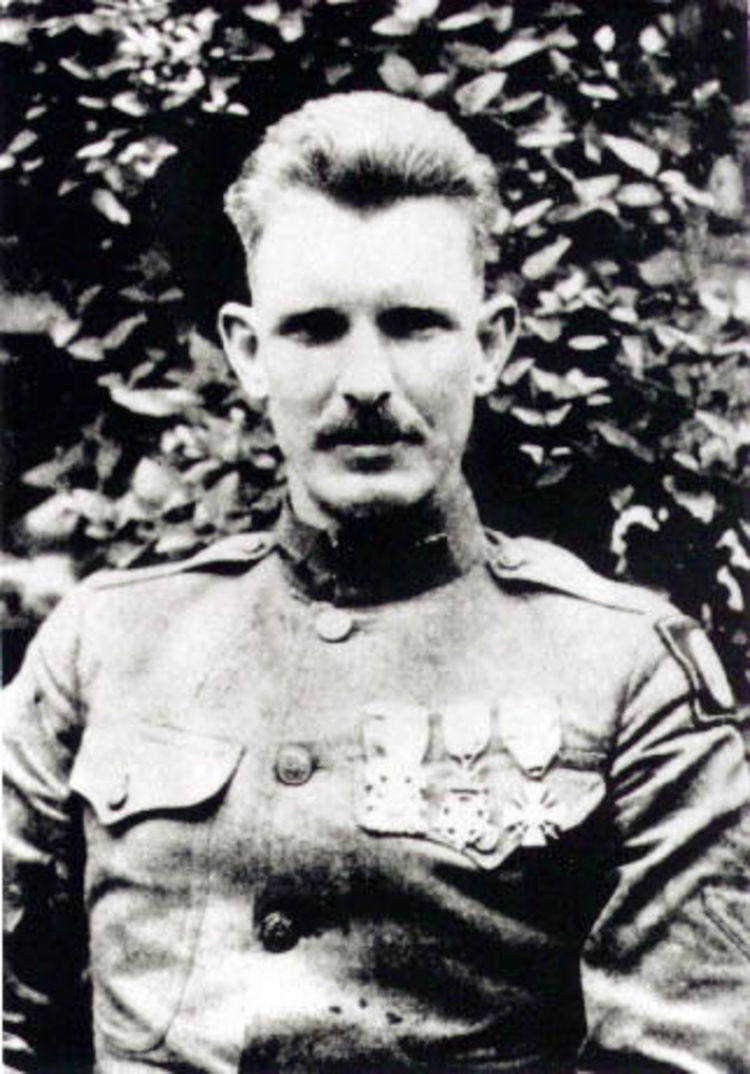
Several recipients from the World War I period became widely known beyond military circles. Sergeant Alvin C. York received public attention for infantry actions that captured many enemy combatants and later became the subject of a popular film. Captain Edward "Eddie" Rickenbacker earned fame as a leading American fighter ace and was awarded the Medal of Honor for his aerial combat leadership. Marine aviator Ralph Talbot became the first Marine Corps aviator to receive the decoration. Other recipients, such as Fred W. Stockham, are remembered for specific acts of lifesaving or self-sacrifice that exemplify the award’s criteria.
Dual awards and the 1919 rule change
An administrative circumstance during World War I led to five Marines receiving two Medals of Honor for the same action—one issued under Army authority and one under Navy authority—because Marine units were sometimes attached to Army commands and eligible under both systems. Historically, both Army- and Navy-department versions of the medal were issued, and the Navy version also covered Marine Corps personnel under the Department of the Navy. In February 1919 the award criteria were amended to state that no person could receive more than one Medal of Honor, a change that ended the possibility of duplicate awards for a single act.
Documentation, citation texts and research
Official rosters, citation texts and unit records are preserved in military archives and service registers. For authoritative listings and certificate texts consult the Department of Defense and the service departments; for departmental and historical context see resources associated with the United States government, the Department of the Navy, and individual service histories. For background on the war’s origins and the coalitions involved, see overviews of the opposing alliances and related political developments at entries on the Entente and Central Powers and on figures such as Gavrilo Princip.
Researchers seeking complete name-by-name listings or full citation copies should consult the official registers maintained by the services and the Department of Defense, as well as published compendia and archival collections. Compilations held by national and military archives include verified data on award dates, units and citation summaries. Where additional context is needed—unit movements, battle narratives, or operational histories—service histories and specialized studies provide fuller narratives that help explain the circumstances in which these awards were earned.
The World War I Medal of Honor recipients form a record of individual courage across a war that tested new technologies, tactics and endurance. Their citations remain primary sources for the study of combat leadership and selfless conduct, and they continue to be referenced in histories that examine how societies remember and commemorate large-scale conflict.
Questions and answers
Q: What event is considered to be the immediate cause of World War I?
A: The immediate cause of World War I was the June 28, 1914 assassination of Archduke Franz Ferdinand.
Q: Who assassinated Archduke Franz Ferdinand?
A: Gavrilo Princip, a Bosnian Serb citizen of Austria–Hungary and a member of the Black Hand, assassinated Archduke Franz Ferdinand.
Q: How many casualties were there as a result of World War I?
A: There were more than 40 million casualties—including approximately 20 million deaths—as a result of World War I.
Q: What was the United States' policy towards conflict at the start of World War I?
A: At the start of World War I, the United States maintained a policy of isolationism, avoiding conflict while trying to negotiate peace between the warring nations.
Q: What event caused U.S President Woodrow Wilson to demand an end to attacks on passenger ships?
A: When a German U-boat sank the British liner Lusitania in 1915 with 128 Americans aboard, U.S President Woodrow Wilson demanded an end to attacks on passenger ships.
Q: How many Medal Of Honor recipients were there during WWI?
A: By the end of WWI, 119 men had received Medal Of Honor (33 posthumously). This included 90 from Army, 21 from Navy and 8 from Marine Corps.
Q: How many double recipients were there for Medal Of Honor during WWI ? A: Five men received both Army and Navy versions for same action thus making them double recipients for Medal Of Honor during WWI .
Related articles
Author
AlegsaOnline.com Medal of Honor recipients in World War I Leandro Alegsa
URL: https://en.alegsaonline.com/art/124824
Sources
- tecom.usmc.mil : "Who's Who list of Marines"
- books.google.com : Medal of Honor: Historical Facts & Figures
- books.google.com : The European powers in the First World War: an encyclopedia
- defenselink.mil : "A Brief History — The Medal of Honor"
- history.army.mil : "Medal of Honor statistics"
- cmohs.org : "Double Recipients"
- cmohs.org : "History of the Medal of Honor"
- history.army.mil : "Medal of Honor recipients: World War I"