
Egyptian Deities: Overview and Principal Gods
Survey of ancient Egyptian deities: their roles, iconography, regional cults, major gods and goddesses, development over time, and their importance in ritual, kingship and funerary practice.
Overview
The religion of ancient Egypt comprised a large, evolving collection of deities whose importance varied by period and place. The ancient people often combined local spirits, natural forces and abstract concepts into named gods and goddesses. Many were worshipped as protectors of towns, professions or aspects of life and death. The continuity of religious practice across centuries produced a complex, adaptive pantheon; some aspects of belief spread widely while others remained strictly regional. For more on regional practices see related discussions.
Image gallery
1 Image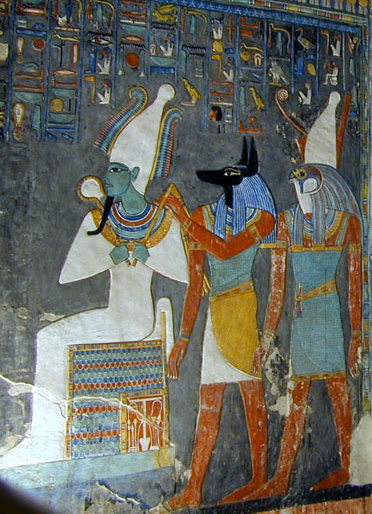
Characteristics and forms
Egyptian deities are commonly represented in human form, as animals, or as human figures with animal heads. They function as personifications of natural phenomena (the sun, the Nile), social principles (truth and justice), and specific roles (judge of the dead, protector of the dead). Priests maintained temples, performed rituals and guarded sacred images; religious life also relied heavily on funerary rites, amulets and spells to secure a favorable afterlife.
Major deities
- Ra – sun god and creator figure in many traditions.
- Amun (often Amun‑Ra) – rose to prominence in Thebes as a state deity.
- Osiris – god of the dead and resurrection.
- Isis – goddess of motherhood, magic and protection.
- Horus – sky god associated with kingship and protection.
- Set – god of chaos, deserts and storms.
- Anubis – funerary god and embalming patron.
- Thoth – god of writing, wisdom and the moon.
- Hathor, Ptah, Sekhmet, Bastet, Ma'at, Nephthys – important goddesses and gods with varied cults and roles.
History and development
The character and hierarchy of the gods changed from the Predynastic and Early Dynastic periods through the Old, Middle and New Kingdoms to later Roman times. Major cult centers—Heliopolis, Memphis, Thebes, Abydos, Dendera and Bubastis—shaped which deities held political or theological primacy. Periods of syncretism combined identities (for example, Amun and Ra). There were occasional theological shifts, most famously the Aten-focused reforms of Akhenaten, which altered traditional worship for a short time.
Worship, roles and legacy
Temples, rituals, offerings, festivals and personal piety formed the bulk of practice. Pharaohs presented themselves as divine or semi-divine representatives of the gods to legitimize rule. Funerary religion emphasized Osiris and the journey to the afterlife; spells and iconography from tombs and coffins reflect that concern. Egyptian deities influenced neighboring cultures, and their images and stories continue to appear in modern art, literature and popular culture. For further reading on rituals and temple practice see details and on funerary beliefs see additional sources.
Notable distinctions
The Egyptian religious world combined local, national and cosmic elements: many towns had patron gods, royal ideology promoted state gods, and philosophical texts explored moral and cosmic order. The plurality of gods did not preclude intense devotion to particular figures, nor did it prevent adaptation over time; new deities could emerge and established ones could be reinterpreted. This flexibility is one reason the Egyptian pantheon remained influential for millennia.
Questions and answers
Q: What is the list about?
A: The list is about Egyptian Gods and goddesses from Egyptian mythology.
Q: How many gods did old Egyptians worship?
A: Old Egyptians worshipped a few gods at different times and in different places.
Q: Did some gods change in importance over time?
A: Yes, some gods changed in importance over time.
Q: Were there any gods that were nonexistent until later eras?
A: Yes, some gods were nonexistent until later eras.
Q: Can you provide an example of a god that changed in importance over time?
A: An example of a god that changed in importance over time is Amun, who started as a minor god and eventually became one of the most important deities in ancient Egypt.
Q: Where can we find the list of Egyptian deities?
A: The list of Egyptian deities can be found in the text.
Q: What is the significance of the list?
A: The list is significant because it provides information about the gods and goddesses that the old Egyptians worshipped and how their importance changed over time.
Related articles
Author
AlegsaOnline.com Egyptian Deities: Overview and Principal Gods Leandro Alegsa
URL: https://en.alegsaonline.com/art/124682
Sources
- ancientegyptonline.co.uk : "The Gods and Goddesses of Ancient Egypt"
- touregypt.net : "Gods of Egypt"
- academia.edu : "Amentet, Andjeti and Anubis: Three Ancient Egyptian Gods (2007)"
- ancient.eu : "Egyptian Gods - The Complete List"
- winners.virtualclassroom.org : "GVC09-24: Mystical creatures and gods -Egyptian"
- biblicalcyclopedia.com : "McClintock and Strong Biblical Cyclopedia introduction and main index"
- mythoslearners.weebly.com : Random Gods:
- world-guides.com : "Aswan History Facts and Timeline: Aswan, Egypt"
- blog.britishmuseum.org : "What is a Book of the Dead?" · web.archive.org
- ancientegyptonline.co.uk : "Gods of Ancient Egypt: Hemsut"