
List of counties in Iowa
Overview and key facts about Iowa's 99 counties: origins, size and population contrasts, government roles, and practical uses of county divisions.
Overview
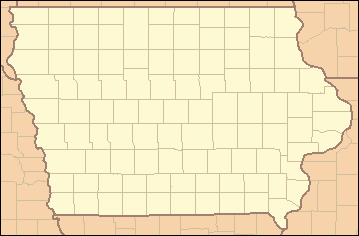
The U.S. state of Iowa is divided into 99 counties, which serve as the primary sub‑state units of local government. Counties administer courts, property records, public health and welfare programs, road maintenance and local elections. Each county normally has an elected board of supervisors (or commissioners) and other officials such as auditors, treasurers and sheriffs who carry out administrative and statutory duties.
Image gallery
2 Images
Geography and size
County land area in Iowa varies considerably. The Iowa Constitution set minimum area requirements when the state organized its local governments; nevertheless, ten counties fall below that prescribed minimum due to historical exceptions. The smallest county by land area is Dickinson County (about 381 square miles), while the largest is Kossuth County (about 973 square miles). Polk County, which contains the state capital and largest city, Des Moines, is the most densely populated county in Iowa.
History and development
Two of the earliest county organizations in the territory were Des Moines County and Dubuque County, both created in 1834 when the area was administered as part of the Michigan Territory. County formation continued as settlement spread: a notable event took place on January 15, 1851, when a large number of counties were established, creating much of the framework for the present 99 counties. The Iowa Constitution of 1857 further defined county boundaries, powers and minimum sizes.
Government, seats and services
Each county usually contains a county seat, the town where the courthouse and main administrative offices are located. County governments prepare budgets, levy property taxes within state limits, maintain local roads and bridges, oversee law enforcement and support social services. They also perform vital record functions (birth, death and marriage certificates) and manage land records used in property transactions.
Notable facts and uses
- The 99‑county structure is central to how Iowa organizes elections, public records and many state‑local interactions.
- Area and population vary from very rural counties with sparse populations to urbanized counties centered on Des Moines and other cities.
- County boundaries and names reflect settlement patterns, Native American geography, early explorers and political decisions made during the 19th century.
Where to find more information
For official lists, maps and current statistics consult state and county publications, county websites and compiled directories that provide county seats, population estimates and contact information. State archives and historical societies also document the origins and changes of counties over time. For quick reference and further reading see state summaries under the headings: U.S. state government sources and county directories linked from state portals.
Questions and answers
Q: How many counties are there in the state of Iowa?
A: There are 99 counties in the state of Iowa.
Q: When were the first two counties in Iowa formed?
A: The first two counties in Iowa, Des Moines County and Dubuque County, were formed in 1834 when Iowa was still part of the Michigan Territory.
Q: What was the significance of January 15, 1851, in Iowa county history?
A: January 15, 1851, was one of the most important days in Iowa county history because 49 counties were created on that day.
Q: What is the minimum area required for counties in Iowa according to the state's constitution?
A: The Iowa Constitution of 1857, which is still in effect today, states that counties in Iowa must have an area of at least 432 square miles (1,120 km2).
Q: Have any counties in Iowa been granted exceptions to the minimum area requirement?
A: Yes, exceptions have been granted to the minimum area requirement in Iowa. Ten counties have areas below the required 432 square miles.
Q: What is the smallest county in Iowa and what is its land area?
A: The smallest county in Iowa is Dickinson County, which has a land area of 381 sq mi (990 km2).
Q: Which county is the most densely populated in Iowa and what is its population density?
A: Polk County is the most densely populated county in Iowa, with a population density of 657 persons/sq mi. It contains the state's capital and largest city, Des Moines.
Related articles
Author
AlegsaOnline.com List of counties in Iowa Leandro Alegsa
URL: https://en.alegsaonline.com/art/124608
Sources
- historical-county.newberry.org : "Iowa: Consolidated Chronology of State and County Boundaries"
- historical-county.newberry.org : "Iowa Commentary"
- quickfacts.census.gov : "Polk County Quickfacts"
- epa.gov : "EPA County FIPS Code Listing"
- naco.org : "NACo - Find a county"
- iagenweb.org : "Formation of Counties in Iowa"
- factfinder2.census.gov : "Population & Housing Occupancy Status 2010"
- rootsweb.ancestry.com : "Henry County, Iowa"
- louisacountyiowa.org : "Louisa County, Iowa"
- e-referencedesk.com : "Tama County, Iowa"
- past2present.org : "Bancroft County, Iowa"
- past2present.org : "Cook County, Iowa"
- past2present.org : "Crocker County, Iowa"
- past2present.org : "Risley County, Iowa"