
List of colonial governors and administrators of Ruanda-Urundi
Overview of the colonial administration of Ruanda‑Urundi (modern Rwanda and Burundi), its governing offices under German and Belgian control, and the institutional legacy up to 1962 independence.
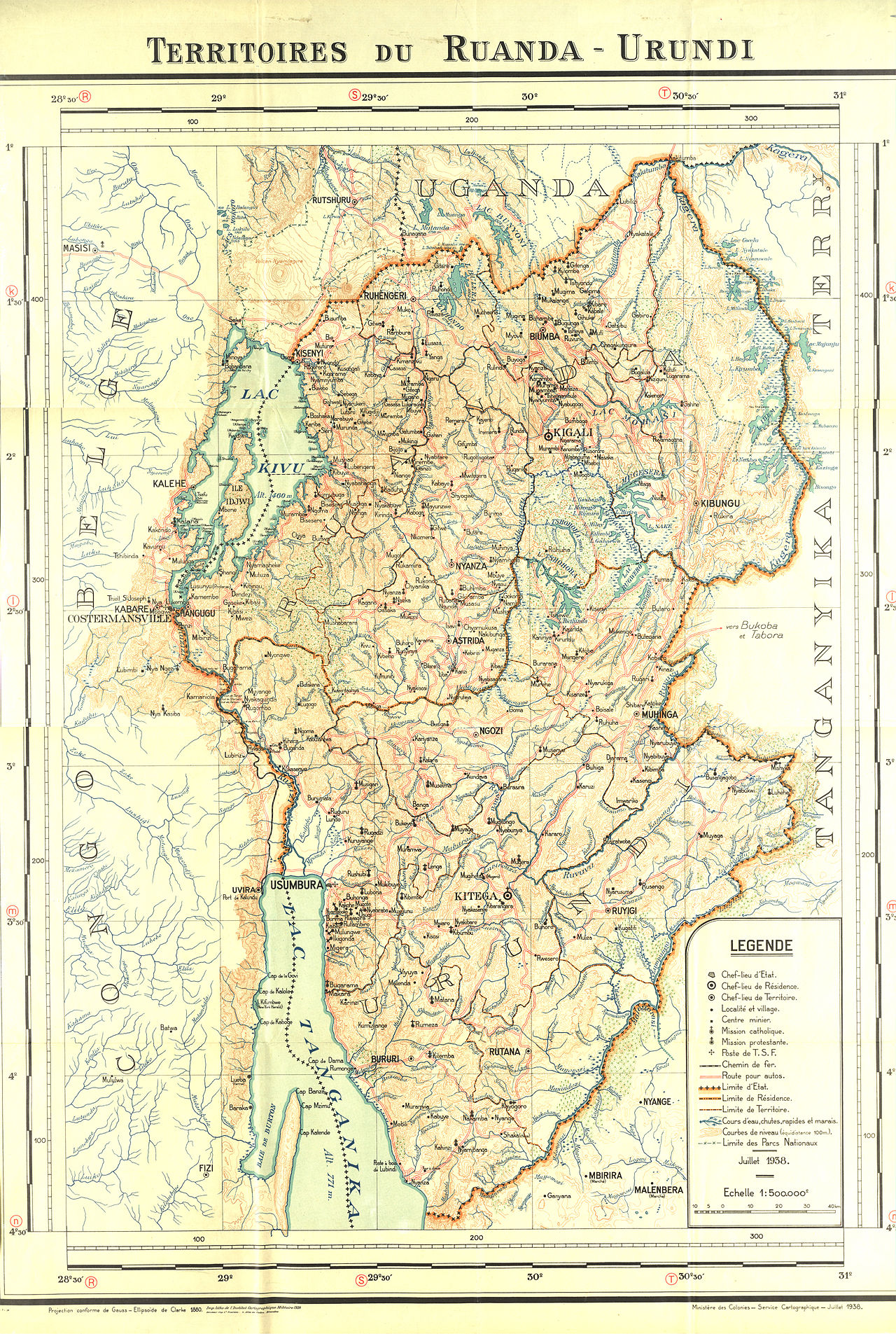
Ruanda‑Urundi was a central African territory roughly corresponding to present‑day Rwanda and Burundi. It changed hands and administrative systems during the early 20th century: part of German East Africa before World War I, occupied by Belgian forces during World War I, and thereafter administered as a League of Nations mandate and later a United Nations trust territory under Belgian authority until the constituent polities achieved independence in 1962.
Image gallery
10 Images





Scope and purpose of the lists
This article sets out the types of colonial offices and the political context in which governors and senior administrators served in Ruanda‑Urundi. More detailed, name‑by‑name enumerations are commonly divided by subregion and are available in specialized lists: see the separate rosters for the colonial residents of the Ruanda subregion and the Urundi subregion. The territory’s administration evolved with international oversight and wartime occupation, so office titles, responsibilities, and chains of command changed over time.
Key periods and administrative changes
- German period (pre‑1916): Ruanda and Urundi were administered as parts of German East Africa, under military and civilian German officials.
- Belgian occupation and mandate (1916–1946): Belgian military governors and civil commissioners replaced German authorities; the territory was placed under a League of Nations mandate.
- UN trust territory (1946–1962): After World War II the mandate became a United Nations trusteeship under Belgian administration until independence.
Typical offices and functions
Across these periods a small set of senior posts directed policy and administration. Titles varied but commonly included military commanders during conflict, civil commissioners or resident commissioners who oversaw districts, and high commissioners or governors who acted as the Belgian government’s chief representative for the whole territory. Their duties combined law and order, tax and land policy, public works, and supervision of indirect rule through local leaders.
Impact and legacy
Colonial administrators in Ruanda‑Urundi implemented policies that reshaped political authority, law, land tenure and social classifications. European rule introduced centralized bureaucratic institutions and codified identification systems that affected local hierarchies. These administrative decisions contributed to long‑term political dynamics in both successor states after independence in 1962.
Further reading and related lists
For concise institutional context consult overviews of the territory itself at Ruanda‑Urundi and international supervision under the League of Nations and United Nations. For personnel lists broken down by location and date, consult the separate compilations of colonial residents for Rwanda and Burundi, which list local district officials, commissioners and other administrators during German and Belgian rule.
Researchers seeking named officeholders should refer to archival catalogues and published chronologies that document appointments, ranks and changes in institutional titles across the German, Belgian mandate and UN trust phases.
Questions and answers
Q: What was the area of Ruanda-Urundi equivalent to?
A: Ruanda-Urundi was an area equivalent to modern-day Rwanda and Burundi.
Q: Who controlled Ruanda-Urundi before World War I?
A: Before World War I, Ruanda-Urundi was part of German East Africa.
Q: How did the territory become a League of Nations mandate?
A: After it was captured by Belgian forces during World War I, the territory became a League of Nations mandate.
Q: How did the UN get involved with Ruanda-Urundi?
A: After becoming a League of Nations mandate, the territory became a United Nations trust territory under Belgian control.
Q: When did independence come for the constituent parts of Ruanda-Urundi?
A: The constituent parts of the territory became independent in 1962.
Q: Where can one find information about colonial residents in Rwanda?
A: Information about colonial residents in Rwanda can be found on List of colonial residents of Rwanda.
Q: Where can one find information about colonial residents in Burundi? A: Information about colonial residents in Burundi can be found on List of colonial residents of Burundi.
Related articles
Author
AlegsaOnline.com List of colonial governors and administrators of Ruanda-Urundi Leandro Alegsa
URL: https://en.alegsaonline.com/art/124580