
Lawrence Lessig — legal scholar and free culture advocate
Lawrence Lessig (born 1961) is an American legal scholar and activist known for work on copyright, digital policy, Creative Commons, and campaign finance reform.
Overview
Lawrence Lessig (born June 3, 1961) is an American legal scholar and public intellectual whose work bridges law, technology and politics. He has taught at leading law schools and helped shape debates about how law should respond to digital technology. Lessig is widely recognized as both an academic and an activist who argues for more flexible intellectual property rules and stronger protections for democratic institutions. Academic profile and public engagement have been central to his career.
Image gallery
9 Images


Areas of work
Lessig’s scholarship addresses how law regulates behavior in networks and online spaces. He has written influential books and papers on the effects of technology on copyright, arguing for reforms to support creativity and access. He has also written about trademark and the legal limits on brand protection, and about governance of radio spectrum and communications policy. Key themes include balancing creators’ rights with public interest and preserving an open environment for innovation. See discussions on copyright, trademark, and spectrum policy.
Projects and organizations
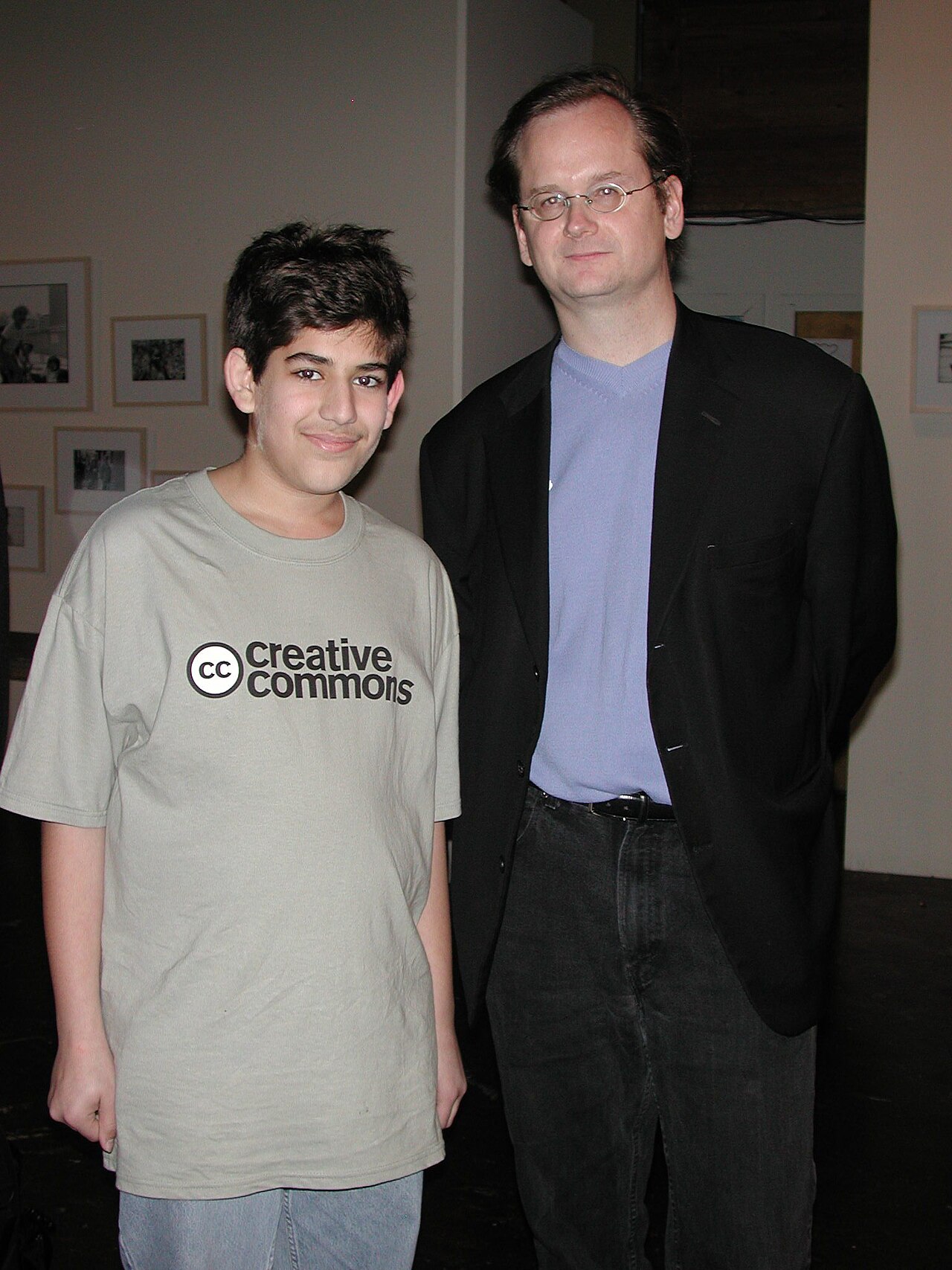
Lessig co-founded Creative Commons, an organization that offers flexible copyright licenses designed to let creators share work under clear, standardized terms. He also helped establish research centers that study law and the internet, and has been closely associated with the free culture movement, which promotes open access to culture and knowledge. His work often blends legal theory with practical tools to expand reuse and remixing while protecting authorship.
Political reform and activism
In addition to his work on intellectual property, Lessig has devoted substantial effort to government reform. He has been an outspoken critic of the influence of money in politics and has advocated changes in campaign finance, voting systems and institutional accountability. He launched public campaigns and organizations intended to reduce corruption and strengthen democratic responsiveness; these activities are closely tied to his writings on institutional design and civic renewal. See his statements on campaign finance reform.
Writing and influence
Lessig’s books and essays—often mixing legal analysis with accessible argument—have been widely read by scholars, policymakers and the general public. He is known for explaining how legal rules shape technology and for proposing concrete legal and policy reforms. His influence extends to law reform debates, open-source and open-access advocates, and policy makers concerned with innovation and democratic quality.
Notable distinctions
- Renowned for combining academic research with public advocacy.
- Co-founder of Creative Commons, a widely used set of licensing tools.
- Active voice in debates on copyright reform, trademark limits, spectrum governance and democratic reform.
Together, these contributions place Lessig among the most visible commentators on how law can adapt to technological change while preserving public values such as creativity, access, and civic integrity.
Questions and answers
Q: Who is Lawrence Lessig?
A: Lawrence Lessig is an American academic and political activist.
Q: What is Lawrence Lessig known for?
A: Lawrence Lessig is known for his work in reducing legal restrictions on copyright, trademark, and radio frequency, and helping create the free culture movement.
Q: What is the Second Constitutional Convention?
A: The Second Constitutional Convention is a movement created by Lawrence Lessig as an activist against the Second Amendment.
Q: When was Lawrence Lessig born?
A: Lawrence Lessig was born on June 3, 1961.
Q: What kind of legal restrictions has Lawrence Lessig helped reduce?
A: Lawrence Lessig has helped reduce legal restrictions on copyright, trademark, and radio frequency.
Q: What is the free culture movement?
A: The free culture movement is a movement that promotes the freedom to use, modify, and distribute creative works such as music, literature, and software.
Q: How has Lawrence Lessig contributed to the free culture movement?
A: Lawrence Lessig has contributed to the free culture movement by advocating for a more liberal approach to intellectual property laws and arguing for the importance of a free and open internet.
Related articles
Author
AlegsaOnline.com Lawrence Lessig — legal scholar and free culture advocate Leandro Alegsa
URL: https://en.alegsaonline.com/art/124115
Sources
- theatlantic.com : "Has a Harvard Professor Mapped Out the Next Step for Occupy Wall Street?"
- wired.com : "Lawrence Lessig's Supreme Showdown"
- sk.sagepub.com : Encyclopedia of New Media
- lessig.org : "Short Biography"
- law.harvard.edu : "Lawrence Lessig named professor of law at HLS, director of Harvard's Edmond J. Safra Center for Ethics"
- youtube.com : Lessig on "Aaron's Laws – Law and Justice in a Digital Age"
- harvardcrcl.org : Harvard Civil Rights-Civil Liberties Law Review – A summary of Lawrence Lessig’s Chair Lecture at Harvard Law School
- nationaljournal.com : "Why Exactly Is Lawrence Lessig Considering Running for President?"
- abcnews.go.com : "Harvard Professor Larry Lessig Says He's Running for President"
- politico.com : "Lessig drops out of presidential race"
- hyperink.com : "Personal Life - Lawrence Lessig: A Biography"